GRAVITAS : General Relativistic Astrophysics VIa Timing And Spectroscopy: An ESA M3 mission proposal
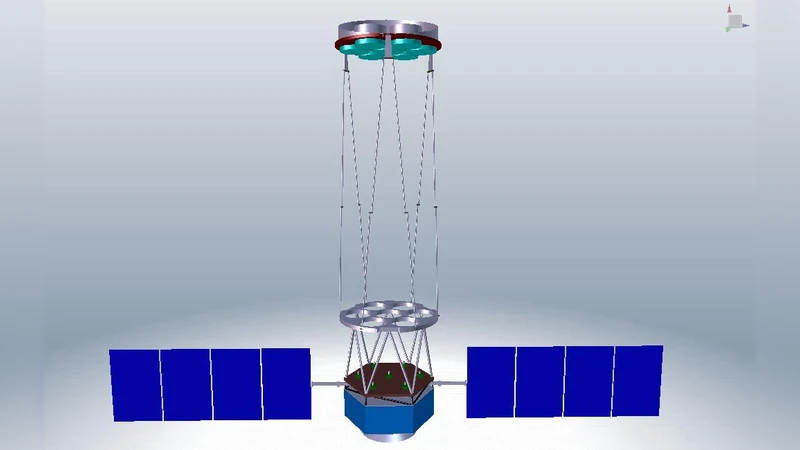
GRAVITAS is an X-ray observatory, designed and optimised to address the ESA Cosmic Vision theme of “Matter under extreme conditions”. It was submitted as a response to the call for M3 mission proposals. The concept centres around an X-ray telescope of unprecedented effective area, which will focus radiation emitted from close to the event horizon of black holes or the surface of neutron stars. To reveal the nature and behaviour of matter in the most extreme astrophysical environments, GRAVITAS targets a key feature in the X-ray spectra of compact objects: the iron Kalpha line at ~6.5 keV. The energy, profile, and variability of this emission line, and the properties of the surrounding continuum emission, shaped by General Relativity (GR) effects, provide a unique probe of gravity in its strong field limit. Among its prime targets are hundreds of supermassive black holes in bright Active Galactic Nuclei (AGN), which form the perfect laboratory to help understand the physical processes behind black hole growth. Accretion plays a fundamental role in the shaping of galaxies throughout cosmic time, via the process of feedback. Modest (~sub-arcmin) spatial resolution would deliver the necessary sensitivity to extend high quality X-ray spectroscopy of AGN to cosmologically-relevant distances. Closer to home, ultra-high count rate capabilities and sub-millisecond time resolution enable the study of GR effects and the equation of state of dense matter in the brightest X-ray binaries in our own Galaxy, using multiple probes, such as the broad iron line, the shape of the disk continuum emission, quasi-periodic oscillations, reverberation mapping, and X-ray burst oscillations. Despite its breakthrough capabilities, all enabling technologies for GRAVITAS are already in a high state of readiness. It is based on ultra light-weight X-ray optics and a focal plane detector using silicon technology.
💡 Research Summary
GRAVITAS (General Relativistic Astrophysics VIA Timing And Spectroscopy) is a proposed ESA M‑class mission designed to address the Cosmic Vision theme “Matter under extreme conditions”. The core of the mission is an X‑ray telescope with an unprecedented effective area, targeting the iron Kα line near 6.5 keV, a diagnostic feature that carries the imprint of strong‑field General Relativity and the physics of matter in the immediate vicinity of black holes and neutron stars.
The optics are based on Silicon Pore Optics (SPO), a lightweight, high‑throughput technology that stacks thin silicon plates into a modular, Wolter‑I geometry. Compared with XMM‑Newton, the SPO assembly provides roughly ten times the collecting area while maintaining a modest angular resolution of better than one arc‑minute. This enables high‑signal‑to‑noise spectroscopy of distant active galactic nuclei (AGN) and bright Galactic X‑ray binaries.
The focal‑plane detector is a silicon‑based device (DePFET or CMOS‑APS) offering microsecond timing, count‑rate capabilities of several million counts per second, and an energy range of 0.2–15 keV. The detector’s read‑out electronics are FPGA‑driven, providing on‑board event filtering and lossless compression, allowing up to 10 TB of raw data per day to be downlinked.
Science objectives are divided into two main pillars. The first pillar focuses on supermassive black holes in AGN. By measuring the shape, energy shift, and variability of the iron Kα line across a sample of hundreds of bright AGN, GRAVITAS will infer black‑hole spin distributions, accretion‑disk geometry, and the role of relativistic effects such as gravitational redshift and Doppler boosting. Time‑lag (reverberation) measurements between the continuum and line emission will map the distance between the corona and the inner disk, providing a direct probe of the accretion flow dynamics and feedback processes that shape galaxy evolution.
The second pillar targets Galactic X‑ray binaries and neutron stars. The combination of high count‑rate capability and sub‑millisecond timing enables the study of quasi‑periodic oscillations (QPOs), burst oscillations, and rapid spectral changes. By jointly analysing the broad iron line, the thermal disk continuum, and timing signatures, GRAVITAS will place stringent constraints on the equation of state of ultra‑dense matter, test models of relativistic precession, and explore the coupling between the accretion disk and the stellar magnetic field.
All enabling technologies are already at high readiness levels. SPO has reached TRL 7–8, and the silicon detector system is at TRL 8–9, with heritage from missions such as XMM‑Newton, Athena’s development, and the eROSITA instrument. The mission design includes passive thermal control to keep the optics at –20 °C, active shielding to protect the detector from radiation, and a modular spacecraft bus compatible with both Vega‑C and Ariane 6.2 launchers, delivering a total mass below 5 tonnes to a low‑Earth or L2 orbit.
Risk assessment identifies detector radiation tolerance and long‑duration low‑temperature operation as the primary concerns; mitigation strategies involve a thin aluminum‑carbon composite shield and redundant heater circuits. Cost estimates place the optics at roughly 30 % of the total budget and the detector/electronics at about 25 %, keeping the overall mission within the ESA M‑class cost envelope (~ 800 M €).
In summary, GRAVITAS offers a unique combination of large effective area, high‑resolution spectroscopy, and microsecond timing that no existing X‑ray observatory can match. It will open a new window on strong‑gravity astrophysics, provide a statistical census of black‑hole spin and growth across cosmic time, and deliver decisive measurements of neutron‑star interiors. As a path‑finder for the next generation of high‑energy missions, GRAVITAS stands to make a transformative contribution to our understanding of the most extreme environments in the Universe.
Comments & Academic Discussion
Loading comments...
Leave a Comment