CTA - A Project for a New Generation of Cherenkov Telescopes
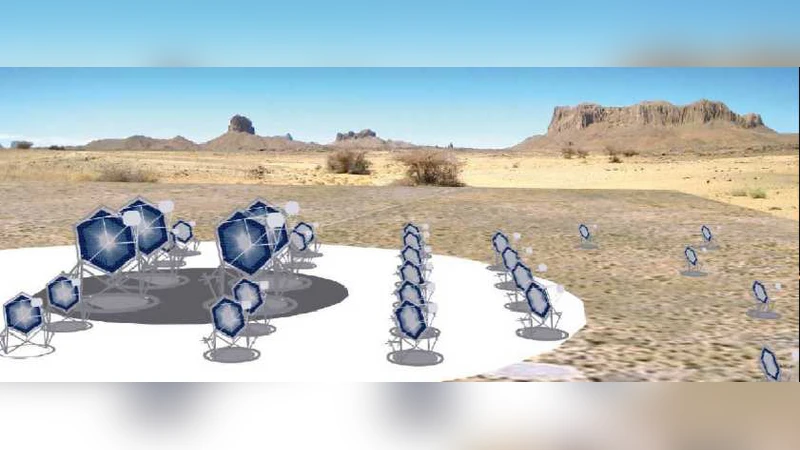
Gamma-rays provide a powerful insight into the non-thermal universe and perhaps a unique probe for new physics beyond the standard model. Current experiments are already giving results in the physics of acceleration of cosmic rays in supernova remnants, pulsar and active galactic nuclei with almost a hundred sources detected at very-high-energies so far. Despite its relatively recent appearance, very high-energy gamma-ray astronomy has proven to have reached a mature technology with fast assembling, relatively cheap and reliable telescopes. The goal of future installation is to increase the sensitivity by a factor ten compared to current installations, and enlarge the energy domain from few tens of GeV to a hundred TeV. Gamma-ray spectra of astrophysical origin are rather soft thus hardly one single size telescope can cover more than 1.5 decades in energy, therefore an array of telescopes of 2,3 different sizes is required. Hereafter, we present design considerations for a Cherenkov Telescope Array (CTA), a project for a new generation of highly automated telescopes for gamma-ray astronomy. The status of the project, technical solutions and an insight in the involved physics will be presented.
💡 Research Summary
The paper presents the scientific motivation, design philosophy, technical implementation, and expected performance of the Cherenkov Telescope Array (CTA), a next‑generation ground‑based observatory for very‑high‑energy (VHE) gamma‑ray astronomy. Current instruments such as H.E.S.S., MAGIC, and VERITAS have demonstrated the maturity of the imaging atmospheric Cherenkov technique, detecting nearly one hundred astrophysical sources and providing valuable insight into particle acceleration in supernova remnants, pulsars, and active galactic nuclei. However, their sensitivity is limited to roughly a factor of ten above the background and their energy coverage spans only about one and a half decades, which is insufficient for the soft spectra (photon index ≈ −2.5 to −3) typical of most gamma‑ray emitters.
CTA addresses these limitations by deploying a heterogeneous array of three telescope classes: Large‑Size Telescopes (LSTs, ~23 m diameter) optimized for the 20 GeV–few TeV range, Medium‑Size Telescopes (MSTs, ~12 m) covering the core 100 GeV–10 TeV band with excellent angular resolution, and Small‑Size Telescopes (SSTs, ~4 m) dedicated to the 10 TeV–100 TeV regime. By combining a modest number of LSTs (≈ 4 – 8), a larger population of MSTs (≈ 25 – 40), and a very large number of SSTs (≈ 70 – 100), the array achieves a ten‑fold increase in point‑source sensitivity and extends the observable energy window from a few tens of GeV up to a hundred TeV.
The optical design explores both traditional single‑mirror Davies‑Cotton/Davis‑Parabolic configurations and the more advanced Schwarzschild‑Couder dual‑mirror system. The latter offers a wider field of view and reduced optical aberrations, enabling compact cameras equipped with silicon photomultipliers (SiPMs) or next‑generation photomultiplier tubes (PMTs). LSTs retain a single‑mirror design to maximize collection area and rapid slewing (≤ 20 s to any sky position), while many MSTs and most SSTs adopt the dual‑mirror layout to improve image quality and reduce pixel size.
Camera electronics must handle several gigabytes per second of raw data. CTA therefore implements a hierarchical trigger architecture: a fast, FPGA‑based pixel‑level trigger feeds into a telescope‑level trigger, which in turn contributes to an array‑wide coincidence logic. Real‑time data reduction (image cleaning, background suppression) occurs on‑site, with calibrated event streams transmitted to central data centers for further reconstruction and scientific analysis. Precise timing (sub‑nanosecond) is achieved through GPS disciplined oscillators and fiber‑optic distribution, while atmospheric calibration relies on dedicated lidar, Raman scattering, and stellar photometry systems.
Geographically, CTA will consist of two sites: a Southern‑Hemisphere location (e.g., the Paranal plateau in Argentina) optimized for Galactic plane coverage and high‑energy observations, and a Northern‑Hemisphere site (e.g., La Palma, Spain) focused on extragalactic sources and low‑energy performance. The layout at each site is the result of extensive Monte‑Carlo simulations that balance sensitivity, angular resolution, and cost. The Southern array will be densely populated with SSTs spread over several square kilometers, whereas the Northern array will emphasize LSTs and MSTs to achieve the lowest possible energy threshold.
Cost‑effective construction is pursued through modular telescope designs, mass‑produced mirror facets, and automated assembly procedures. Remote operation and a high degree of automation reduce manpower requirements, while a unified software framework provides real‑time monitoring, fault detection, and rapid response to transient alerts (e.g., gamma‑ray bursts, neutrino or gravitational‑wave triggers).
Scientifically, CTA aims to (1) resolve the long‑standing question of the origin of Galactic cosmic rays by mapping particle acceleration sites with unprecedented sensitivity; (2) characterize the emission mechanisms of pulsars, pulsar wind nebulae, and AGN jets, including rapid variability and multi‑wavelength correlations; (3) search for signatures of dark‑matter annihilation or decay in dwarf spheroidal galaxies, the Galactic center, and galaxy clusters; and (4) test fundamental physics such as Lorentz invariance violation, photon‑axion conversion, and quantum‑gravity induced dispersion. The broad energy coverage and improved angular resolution (down to a few arcminutes) will also enable population studies of VHE sources and facilitate joint analyses with neutrino observatories (IceCube, KM3NeT) and gravitational‑wave detectors (LIGO/Virgo/KAGRA).
The project is organized as an international consortium of more than 30 countries, with a phased construction schedule: a prototype phase (2022‑2024) to validate designs, a partial array phase (2025‑2027) delivering early science, and full operation expected by the early 2030s. Data will be made publicly available after a proprietary period, fostering community involvement and maximizing scientific return. In summary, CTA represents a transformative step for ground‑based gamma‑ray astronomy, delivering a ten‑fold sensitivity boost, a dramatically expanded energy range, and a versatile platform for multi‑messenger astrophysics and particle‑physics discoveries.
Comments & Academic Discussion
Loading comments...
Leave a Comment