H.E.S.S. VHE gamma-ray observations of the microquasar GRS 1915+105
GRS 1915+105 is a very well studied microquasar with a wide variety of temporal and spectral states. Multi-wavelength observations from radio to X-rays have uncovered clear relations between the varia
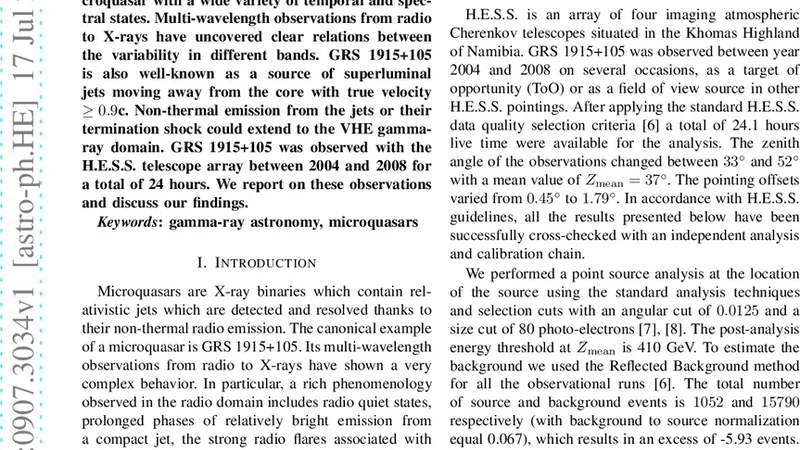
GRS 1915+105 is a very well studied microquasar with a wide variety of temporal and spectral states. Multi-wavelength observations from radio to X-rays have uncovered clear relations between the variability in different bands. GRS 1915+105 is also well-known as a source of superluminal jets moving away from the core with true velocity <=0.9c. Non-thermal emission from the jets or their termination shock could extend to the VHE gamma-ray domain. GRS 1915+105 was observed with the H.E.S.S. telescope array between 2004 and 2008 for a total of 24 hours. We report on these observations and discuss our findings.
💡 Research Summary
The paper presents a systematic search for very‑high‑energy (VHE) gamma‑ray emission from the microquasar GRS 1915+105 using the H.E.S.S. (High Energy Stereoscopic System) array. GRS 1915+105 is a well‑studied X‑ray binary that exhibits a rich phenomenology of temporal and spectral states and launches superluminal radio jets with intrinsic velocities up to ~0.9 c. Theoretical considerations suggest that non‑thermal processes in the jets—such as internal shocks, magnetic reconnection, or termination‑shock interactions with the ambient medium—could accelerate particles to multi‑TeV energies, potentially producing detectable VHE gamma rays via inverse‑Compton scattering or hadronic interactions.
Observations were carried out between May 2004 and September 2008, accumulating a total live time of 24 hours after standard quality selection. The data were processed with the H.E.S.S. standard analysis chain: image cleaning, Hillas parameterisation, stereoscopic reconstruction, and gamma/hadron separation using multivariate cuts. Background estimation employed the reflected‑region method, and statistical significance was evaluated with the Li & Ma formula.
No statistically significant excess was found in any of the examined energy bands. At a 99 % confidence level, the integral flux upper limit above 200 GeV is (F_{UL} < 2.0 \times 10^{-12}) ph cm(^{-2}) s(^{-1}). This limit lies a factor of two to three below the fluxes predicted by several jet‑emission models that assume efficient electron acceleration (≥10 % of jet power) and magnetic fields of order 10 G. Models that invoke a mixed electron‑proton population or lower magnetic field strengths are still compatible with the data, but the results constrain the parameter space: either the acceleration efficiency is modest, the magnetic field is weaker than often assumed, or the gamma‑ray production region is subject to strong internal absorption.
The authors also examined the temporal correspondence between the H.E.S.S. observations and known X‑ray/radio states of GRS 1915+105. During the campaign the source underwent several of its characteristic X‑ray classes (e.g., “heartbeat”, “plateau”, and major flares) and produced radio ejections, yet no contemporaneous VHE flare was detected. This lack of correlation suggests that the conditions required for VHE production—such as a dense external photon field for inverse‑Compton scattering or a sufficiently strong shock at the jet termination—were not met during the observed episodes.
The paper concludes that, with the current sensitivity of H.E.S.S. and the limited exposure, GRS 1915+105 remains undetected in the VHE regime. Future observations with the Cherenkov Telescope Array (CTA), which will provide an order‑of‑magnitude improvement in sensitivity and faster response times, are essential to probe the predicted emission levels, especially during rapid X‑ray/radio flares when particle acceleration is expected to peak. The authors advocate for coordinated multi‑wavelength campaigns that combine radio interferometry, X‑ray monitoring, and VHE observations to pinpoint the exact location and physical conditions of the particle acceleration sites.
In summary, the study delivers the first robust VHE upper limits for GRS 1915+105, places meaningful constraints on jet‑based non‑thermal emission models, and outlines the observational strategies required to finally detect—or definitively rule out—VHE gamma‑ray production in this archetypal microquasar.
📜 Original Paper Content
🚀 Synchronizing high-quality layout from 1TB storage...