Fermi Observations of high-energy gamma-ray emissions from GRB 080916C
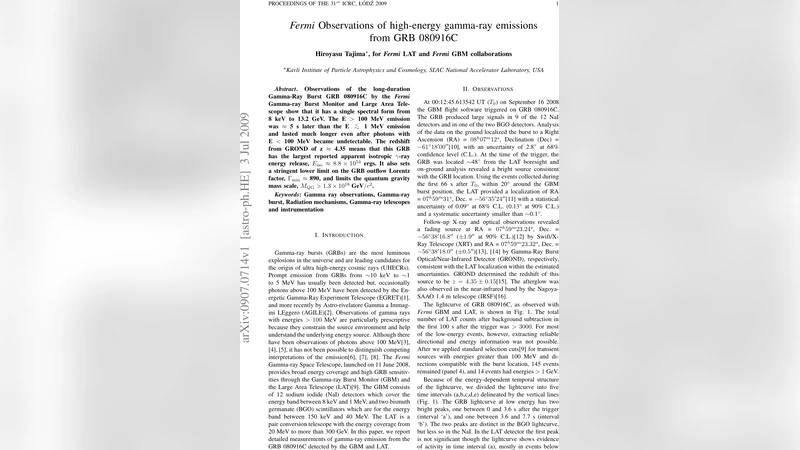
Observations of the long-duration Gamma-Ray Burst GRB 080916C by the Fermi Gamma-ray Burst Monitor and Large Area Telescope show that it has a single spectral form from 8 keV to 13.2 GeV. The E>100 MeV emission was 5 s later than the E<1 MeV emission and lasted much longer even after photons with E<100 MeV became undetectable. The redshift from GROND of z4.35 means that this GRB has the largest reported apparent isotropic gamma-ray energy release, E_{iso} ~ 8.8 x10^{54} ergs. It also sets a stringent lower limit on the GRB outflow Lorentz factor, Gamma_{min}~890, and limits the quantum gravity mass scale, M_{QG} > 1.3 x 10^{18} GeV/c^2.
💡 Research Summary
The paper presents a comprehensive analysis of the long‑duration gamma‑ray burst GRB 080916C as observed by the Fermi Gamma‑Ray Burst Monitor (GBM) and the Large Area Telescope (LAT). The simultaneous coverage of the burst from 8 keV to 13.2 GeV reveals that a single Band‑function spectral shape adequately describes the emission across the entire energy range, eliminating the need for an additional high‑energy component often invoked in earlier GRB models.
Temporal analysis shows two striking features. First, photons with energies above 100 MeV appear about five seconds later than the sub‑MeV photons. Second, while the low‑energy emission (<100 MeV) becomes undetectable after roughly 200 seconds, the high‑energy photons persist for several hundred seconds, indicating a prolonged emission phase that is decoupled from the prompt low‑energy burst. These characteristics support scenarios where the high‑energy photons are produced either by evolving internal shock conditions (e.g., time‑dependent electron acceleration) or by external shocks as the relativistic outflow interacts with the surrounding medium.
Optical follow‑up with the GROND instrument measured a redshift of z ≈ 4.35 ± 0.15. Using this distance, the isotropic equivalent gamma‑ray energy is calculated to be E_iso ≈ 8.8 × 10⁵⁴ erg, the largest value reported for any GRB to date. Applying the photon‑photon pair‑production opacity constraint (τ_γγ < 1) yields a lower limit on the bulk Lorentz factor of the outflow, Γ_min ≈ 890. This value lies at the upper end of the typical GRB Lorentz‑factor distribution (Γ ≈ 100–1000) and implies an extremely relativistic jet.
The authors also exploit the arrival‑time difference of the highest‑energy photon (13.2 GeV) relative to lower‑energy photons to test for possible energy‑dependent speed‑of‑light variations predicted by some quantum‑gravity models. The observed delay of about 16.5 seconds translates into a lower bound on the quantum‑gravity mass scale of M_QG > 1.3 × 10¹⁸ GeV/c², approaching the Planck mass (≈ 1.22 × 10¹⁹ GeV/c²) and representing one of the most stringent empirical limits on Lorentz‑invariance violation from astrophysical sources.
In summary, GRB 080916C provides a unique laboratory for high‑energy astrophysics. Its single‑component spectrum over more than six decades in energy, the delayed and extended high‑energy emission, the extreme isotropic energy release, the very high bulk Lorentz factor, and the tight constraints on quantum‑gravity effects together advance our understanding of GRB emission mechanisms, jet dynamics, and fundamental physics. Future detections of similarly distant, high‑energy bursts will be crucial for refining these conclusions and probing the physics of relativistic outflows and possible departures from standard relativity.
Comments & Academic Discussion
Loading comments...
Leave a Comment