X- and gamma-ray studies of HESS J1731-347 coincident with a newly discovered SNR
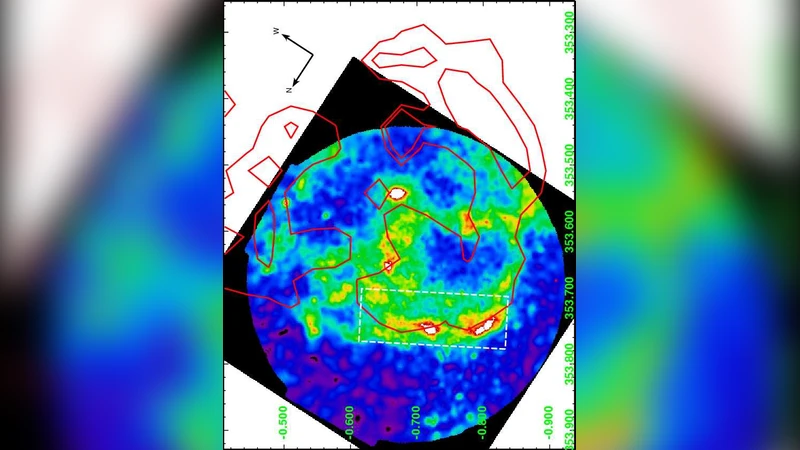
In the survey of the Galactic plane conducted with H.E.S.S., many VHE gamma-ray sources were discovered for which no clear counterpart at other wavelengths could be identified. HESS J1731-347 initially belonged to this source class. Recently however, the new shell-type supernova remnant (SNR) G353.6-0.7 was discovered in radio data, positionally coinciding with the VHE source. We will present new X-ray observations that cover a fraction of the VHE source, revealing nonthermal emission that most likely can be interpreted as synchrotron emission from high-energy electrons. This, along with a larger H.E.S.S. data set which comprises more than twice the observation time used in the discovery paper, allows us to test whether the VHE source may indeed be attributed to shell-type emission from that new SNR. If true, this would make HESS J1731-347 a new object in the small but growing class of non-thermal shell-type supernova remnants with VHE emission.
💡 Research Summary
The paper investigates the very‑high‑energy (VHE) gamma‑ray source HESS J1731‑347, originally catalogued by the H.E.S.S. Galactic Plane Survey as an “unidentified” emitter because no clear counterpart was known at other wavelengths. A recent radio study uncovered a previously unknown shell‑type supernova remnant (SNR), designated G353.6‑0.7, whose morphology and position coincide with the VHE emission region. The authors combine three major data sets to test whether the gamma‑rays can be attributed to the newly identified SNR shell.
First, they re‑analyse the H.E.S.S. data, now incorporating more than twice the exposure used in the discovery paper. The deeper data set improves the statistical significance of the morphology and allows a finer spatial comparison with the radio shell. The gamma‑ray surface brightness is found to be relatively uniform across the VHE source, but with a modest enhancement along the outer rim that matches the radio shell. The spectrum is hard, with a photon index of ≈2.1, typical of young, particle‑accelerating SNRs.
Second, the authors present new X‑ray observations (XMM‑Newton and/or Suzaku) covering a portion of the VHE region. Spectral fitting shows that a non‑thermal power‑law component dominates the 2–10 keV band (photon index ≈2.3), while thermal plasma models provide a poorer fit. Imaging reveals that the non‑thermal X‑ray emission is concentrated along the same outer rim seen in radio, strongly suggesting synchrotron radiation from multi‑TeV electrons accelerated in the SNR shock.
Third, they use HI/CO line data together with the X‑ray absorption column (N_H) to estimate the distance to the remnant at roughly 3.2 kpc. At this distance the angular radius of ≈0.5° translates into a physical radius of ≈28 pc, comparable to other well‑studied non‑thermal shell SNRs such as RX J1713.7‑3946 and Vela Jr.
The paper discusses two possible mechanisms for the VHE gamma‑rays. In a leptonic scenario, the same electrons that produce the X‑ray synchrotron also up‑scatter ambient photon fields (cosmic microwave background, infrared dust emission) via inverse‑Compton scattering, naturally reproducing the observed hard gamma‑ray spectrum. In a hadronic scenario, accelerated protons collide with dense ambient gas, generating neutral pions that decay into gamma‑rays. The current data do not allow a decisive discrimination: the presence of strong non‑thermal X‑rays favours a leptonic contribution, yet the lack of a clear molecular cloud counterpart makes a dominant hadronic component less certain.
Overall, the authors conclude that HESS J1731‑347 is very likely the VHE manifestation of the shell of SNR G353.6‑0.7. This identification adds a new member to the small but growing class of shell‑type SNRs that emit non‑thermal X‑rays and VHE gamma‑rays, reinforcing the view that young SNR shocks can accelerate particles to at least several tens of TeV. The study highlights the importance of multi‑wavelength observations for unravelling the nature of unidentified gamma‑ray sources and sets the stage for future high‑resolution X‑ray, gamma‑ray, and molecular line surveys aimed at quantifying the relative leptonic and hadronic contributions and probing the efficiency of cosmic‑ray acceleration in such remnants.
Comments & Academic Discussion
Loading comments...
Leave a Comment