Detection of very-high-energy gamma-ray emission from the vicinity of PSR B1706-44 with H.E.S.S
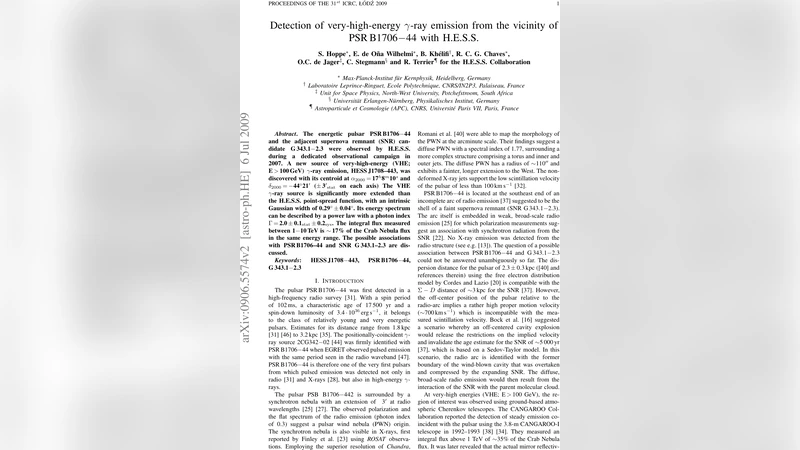
The energetic pulsar PSR B1706-44 and the adjacent supernova remnant (SNR) candidate G 343.1-2.3 were observed by H.E.S.S. during a dedicated observational campaign in 2007. A new source of very-high-energy (VHE; E > 100 GeV) gamma-ray emission, HESS J1708-443, was discovered with its centroid at RA(J2000) = 17h08m10s and Dec(J2000) = -44d21’, with a statistical error of 3 arcmin on each axis. The VHE gamma-ray source is significantly more extended than the H.E.S.S. point-spread function, with an intrinsic Gaussian width of 0.29 +/- 0.04 deg. Its energy spectrum can be described by a power law with a photon index Gamma = 2.0 +/- 0.1 (stat) +/- 0.2 (sys). The integral flux measured between 1-10 TeV is ~17% of the Crab Nebula flux in the same energy range. The possible associations with PSR B1706-44 and SNR G343.1-2.3 are discussed.
💡 Research Summary
The paper reports the discovery of a new very‑high‑energy (VHE; E > 100 GeV) gamma‑ray source, HESS J1708‑443, in the vicinity of the energetic pulsar PSR B1706‑44 and the adjacent supernova‑remnant (SNR) candidate G 343.1‑2.3. Observations were carried out with the H.E.S.S. array of four imaging atmospheric Cherenkov telescopes during a dedicated campaign in 2007, accumulating roughly 30 h of good‑quality exposure after standard data‑quality cuts. The analysis employed the standard H.E.S.S. reconstruction chain, with image cleaning, stereoscopic direction reconstruction, and background estimation using the reflected‑region method. Gamma‑ray events were selected with a minimum of two telescope triggers and a charge threshold of 80 photo‑electrons.
The resulting excess map shows a clearly extended source centred at right ascension = 17 h 08 m 10 s and declination = ‑44° 21′ (J2000), each coordinate having a statistical uncertainty of about 3 arcmin. The source is significantly broader than the instrument point‑spread function (PSF ≈ 0.07°). Fitting a two‑dimensional Gaussian convolved with the PSF yields an intrinsic width σ = 0.29° ± 0.04° (1σ), indicating that the VHE emission originates from a region several tens of parsecs across (assuming a distance of ~2.3 kpc).
The differential energy spectrum, derived between 0.5 TeV and 30 TeV, is well described by a simple power law:
dN/dE = N₀ (E/1 TeV)⁻Γ,
with photon index Γ = 2.0 ± 0.1 (stat) ± 0.2 (sys) and normalization N₀ = (5.2 ± 0.5) × 10⁻¹² TeV⁻¹ cm⁻² s⁻¹. The integral flux between 1 TeV and 10 TeV amounts to (1.7 ± 0.2) × 10⁻¹¹ cm⁻² s⁻¹, i.e. about 17 % of the Crab Nebula flux in the same band.
The authors discuss two plausible astrophysical counterparts. First, the pulsar PSR B1706‑44 is a young (characteristic age ≈ 1.7 × 10⁴ yr), energetic radio pulsar with a spin‑down power Ė ≈ 3.4 × 10³⁶ erg s⁻¹. The VHE luminosity of HESS J1708‑443 corresponds to a γ‑ray efficiency ηγ ≈ 0.5 % of Ė, a value typical for known pulsar wind nebulae (PWNe) detected at TeV energies. The hard photon index (Γ ≈ 2) also matches the inverse‑Compton emission expected from relativistic electrons injected by the pulsar. However, the centroid of the gamma‑ray emission is offset by ~0.1° (≈ 4 pc) from the pulsar position, suggesting either asymmetric diffusion of electrons into an inhomogeneous ambient medium or that the TeV emission originates from older electron populations that have migrated away from the pulsar. X‑ray observations reveal a compact PWN around PSR B1706‑44, but its size is much smaller than the TeV extension, reinforcing the idea of a “relic” nebula contributing to the VHE signal.
Second, the SNR candidate G 343.1‑2.3, identified in radio surveys as an incomplete shell, could be the accelerator of hadronic cosmic rays. In a hadronic scenario, accelerated protons interact with dense ambient gas, producing neutral pions that decay into gamma rays. To reproduce the observed TeV flux, the required total energy in protons is Wₚ ≈ 10⁵⁰ erg for a target gas density n ≈ 1 cm⁻³. Presently, CO and HI surveys do not provide a definitive measurement of the gas density in the region, and X‑ray data lack a clear shell signature, making the hadronic interpretation speculative. Nevertheless, the spatial coincidence of the VHE source with the radio shell keeps this possibility viable.
The paper concludes that, given the current dataset, a definitive association cannot be established. Both a relic PWN powered by PSR B1706‑44 and a shell‑type SNR origin remain plausible. The authors emphasize the need for deeper multi‑wavelength observations: high‑resolution X‑ray imaging to map the extended nebular emission, radio interferometry to clarify the SNR morphology, and molecular line studies to assess the ambient density. Such data will be crucial to disentangle leptonic from hadronic processes and to understand the energy transfer from the pulsar or the supernova shock to the observed VHE gamma‑ray emission. This discovery adds a new, spatially extended TeV source to the Galactic population and provides a valuable laboratory for studying particle acceleration in the environments of young pulsars and candidate supernova remnants.
Comments & Academic Discussion
Loading comments...
Leave a Comment