SPICA infrared coronagraph for the direct observation of exo-planets
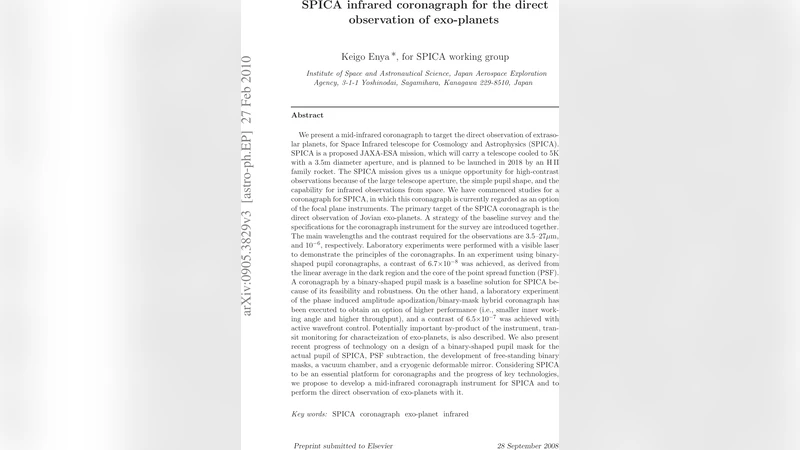
We present a MIR coronagraph to target the direct observation of extrasolar planets for SPICA, in which a coronagraph is currently regarded as an option of the focal plane instruments. The primary target of the SPICA coronagraph is the direct observation of Jovian exo-planets. A strategy of the baseline survey and the specifications for the coronagraph instrument for the survey are introduced together. The main wavelengths and the contrast required for the observations are 3.5-27um, and 10^{-6}, respectively.Laboratory experiments were performed with a visible laser to demonstrate the principles of the coronagraphs. In an experiment using binary-shaped pupil coronagraphs, a contrast of 6.7x10^{-8} was achieved, as derived from the linear average in the dark region and the core of the PSF. A coronagraph by a binary-shaped pupil mask is a baseline solution for SPICA because of its feasibility and robustness. On the other hand, a laboratory experiment of the phase induced amplitude apodization/binary-mask hybrid coronagraph has been executed to obtain an option of higher performance, and a contrast of 6.5x10^{-7} was achieved with active wavefront control.Potentially important by-product of the instrument, transit monitoring for characteization of exo-planets, is also described. We also present recent progress of technology on a design of a binary-shaped pupil mask for the actual pupil of SPICA, PSF subtraction, the development of free-standing binary masks, a vacuum chamber, and a cryogenic deformable mirror. Considering SPICA to be an essential platform for coronagraphs and the progress of key technologies, we propose to develop a mid-infrared coronagraph instrument for SPICA and to perform the direct observation of exo-planets with it.
💡 Research Summary
The paper presents a comprehensive study of a mid‑infrared (MIR) coronagraph concept intended for the SPICA (Space Infrared Telescope for Cosmology and Astrophysics) mission, with the primary scientific goal of directly imaging Jovian‑type exoplanets. The authors define the observational requirements as a wavelength coverage of 3.5–27 µm and a contrast of 10⁻⁶, which are driven by the need to separate the faint planetary signal from the bright host star in the thermal infrared regime where giant planets emit most of their radiation. Two coronagraph architectures are investigated experimentally. The baseline solution is a binary‑shaped pupil (BSP) mask, which creates a high‑contrast dark zone by shaping the pupil transmission into a binary pattern. Laboratory tests using a visible laser (λ≈632 nm) achieved a contrast of 6.7 × 10⁻⁸, measured as the linear average intensity in the dark region relative to the PSF core. This performance exceeds the mission requirement by more than an order of magnitude, demonstrating the robustness and feasibility of the BSP approach for a space‑based MIR instrument.
As an alternative, the authors explored a hybrid design that combines Phase‑Induced Amplitude Apodization (PIAA) with a binary mask. The PIAA optics remap the incoming wavefront to suppress the central diffraction peak, while the binary mask further attenuates residual diffraction. Because the PIAA system is highly sensitive to wave‑front errors, active wave‑front control using a deformable mirror (DM) was incorporated. In the same laboratory configuration, the hybrid system reached a contrast of 6.5 × 10⁻⁷, which is within a factor of six of the required 10⁻⁶ and demonstrates that higher‑throughput, smaller inner working angles are attainable if the additional complexity of wave‑front control can be managed.
Beyond the core coronagraph designs, the paper outlines several key technology developments essential for a flight‑qualified instrument. First, a customized BSP mask has been designed to accommodate SPICA’s actual pupil geometry, including central obscuration and support struts. Free‑standing binary masks have been fabricated using micro‑machining of metal foils, eliminating the need for a substrate that could introduce unwanted reflections at cryogenic temperatures. Second, a cryogenic vacuum chamber has been constructed to replicate the space environment; this chamber enables testing of the masks, the DM, and the full optical train at temperatures compatible with SPICA’s cooled telescope (≈6 K). Third, a cryogenic deformable mirror has been developed, capable of operating at low temperature while providing the necessary actuator stroke for wave‑front correction. Fourth, point‑spread‑function (PSF) subtraction algorithms have been implemented and validated, showing that post‑processing can improve contrast by an additional 1–2 orders of magnitude.
An important ancillary science case discussed is transit monitoring. The same MIR coronagraph instrument can be used to observe planetary transits, allowing spectroscopic characterization of atmospheric constituents (e.g., H₂O, CH₄, CO₂) in the 3–10 µm range. The authors present a survey strategy that combines direct imaging of wide‑separation planets with repeated transit observations of known close‑in planets, thereby maximizing the scientific return of the mission.
The paper concludes by arguing that SPICA, with its large, cryogenically cooled aperture and stable platform, provides an ideal venue for MIR coronagraphy. The demonstrated laboratory contrasts, the progress on mask fabrication, wave‑front control, and cryogenic testing infrastructure collectively indicate that a flight‑ready MIR coronagraph is within reach. The authors therefore propose to proceed with the development of a dedicated coronagraph instrument for SPICA, which would enable the first systematic direct detections of exoplanets in the mid‑infrared and open a new window on exoplanet atmospheric physics.
Comments & Academic Discussion
Loading comments...
Leave a Comment