GRB Theory in the Fermi Era
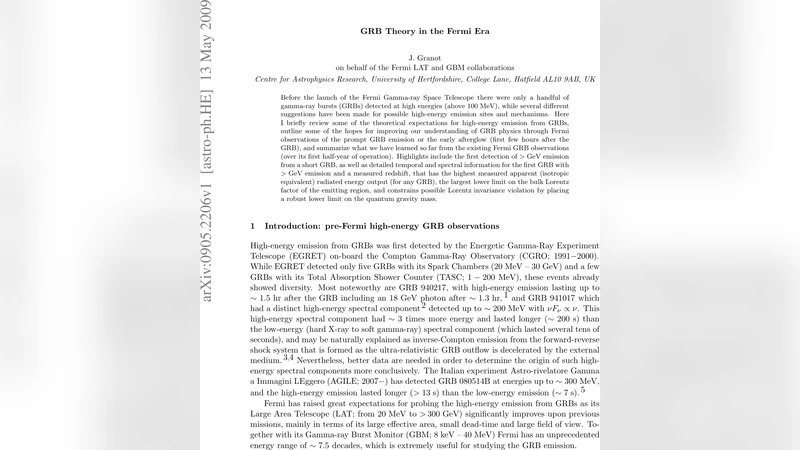
Before the launch of the Fermi Gamma-ray Space Telescope there were only a handful of gamma-ray bursts (GRBs) detected at high energies (above 100 MeV), while several different suggestions have been made for possible high-energy emission sites and mechanisms. Here I briefly review some of the theoretical expectations for high-energy emission from GRBs, outline some of the hopes for improving our understanding of GRB physics through Fermi observations of the prompt GRB emission or the early afterglow (first few hours after the GRB), and summarize what we have learned so far from the existing Fermi GRB observations (over its first half-year of operation). Highlights include the first detection of > GeV emission from a short GRB, as well as detailed temporal and spectral information for the first GRB with > GeV emission and a measured redshift, that has the highest measured apparent (isotropic equivalent) radiated energy output (for any GRB), the largest lower limit on the bulk Lorentz factor of the emitting region, and constrains possible Lorentz invariance violation by placing a robust lower limit on the quantum gravity mass.
💡 Research Summary
**
The paper provides a concise yet comprehensive review of high‑energy gamma‑ray burst (GRB) theory in the era of the Fermi Gamma‑ray Space Telescope. Before Fermi’s launch, only a handful of GRBs had been detected above 100 MeV, and a variety of possible emission sites and mechanisms had been proposed. The author first outlines the principal theoretical frameworks that were in place prior to Fermi: internal‑shock models where electrons accelerated in colliding shells emit synchrotron radiation at keV–MeV energies and may produce a secondary high‑energy component via synchrotron self‑Compton (SSC); external‑shock models in which forward and reverse shocks generate long‑lasting GeV photons; magnetic‑reconnection scenarios that can produce very hard spectra; and hadronic models that invoke proton‑photon or proton‑proton interactions, leading to neutral pion decay and high‑energy photon production. Each of these mechanisms predicts distinct observational signatures: the timing of the GeV onset relative to the MeV prompt pulse, the duration of the high‑energy tail, the presence or absence of an extra hard spectral component, and the energy at which γ‑γ pair‑production cuts off the spectrum.
Fermi’s two instruments, the Gamma‑ray Burst Monitor (GBM, 8 keV–40 MeV) and the Large Area Telescope (LAT, > 20 MeV), together cover more than six decades in energy with sub‑second temporal resolution, providing the ideal data set to test these predictions. The author then focuses on the first half‑year of LAT observations, highlighting two landmark events that have shaped our current understanding.
GRB 090510 – a short‑duration burst – was the first short GRB from which LAT detected photons above 1 GeV. A 31 GeV photon arrived 0.8 s after the GBM trigger, establishing a clear delay between the MeV and GeV emission. By requiring that the source be transparent to γ‑γ pair production, a lower limit on the bulk Lorentz factor of the emitting region was derived: Γ > 1200, far exceeding the typical Γ ≈ 300–500 assumed in early internal‑shock models. The same data set was used to test Lorentz‑invariance violation (LIV). No energy‑dependent speed of light was observed, allowing the authors to place a robust lower bound on the quantum‑gravity mass scale, MQG > 1.2 × 10¹⁹ GeV, one of the most stringent limits to date.
GRB 090902B – a long‑duration burst with a measured redshift z ≈ 1.822 – provided the first LAT detection of a GRB with both a known distance and a very high apparent isotropic energy, Eiso ≈ 3 × 10⁵⁴ erg, the largest ever recorded. The LAT observed photons up to 33 GeV, and the time‑integrated spectrum required an additional hard power‑law component beyond the standard Band function. This extra component persisted longer than the MeV prompt emission, suggesting that the high‑energy photons were produced in the external shock or via SSC/hadronic processes rather than solely in the internal dissipation region. The inferred bulk Lorentz factor again exceeded 1000, reinforcing the conclusion that GRB outflows are ultra‑relativistic.
Beyond these two cases, the paper notes a recurring pattern in the early LAT sample: (1) a delayed onset of GeV emission relative to the MeV pulse, (2) an extended GeV tail that can last from tens to thousands of seconds, and (3) in several bursts, the presence of a distinct hard spectral component that does not evolve in concert with the Band component. These observational trends collectively argue against a single‑mechanism description of GRB high‑energy emission. Instead, they point to a hybrid picture where internal dissipation may dominate the early MeV light, while external shocks, SSC, and possibly hadronic cascades take over at later times to produce the long‑lasting GeV photons.
The author concludes that Fermi has dramatically advanced the field by (i) confirming that GRB outflows routinely achieve Γ > 1000, (ii) providing the first robust constraints on Lorentz‑invariance violation from astrophysical sources, and (iii) revealing the complexity of high‑energy spectra, which demand multi‑component theoretical models. Future progress will rely on coordinated multi‑wavelength observations (optical, X‑ray, radio) and on next‑generation ground‑based gamma‑ray facilities such as the Cherenkov Telescope Array (CTA), which will extend sensitivity into the TeV regime. Together, these efforts promise to finally disentangle the relative contributions of synchrotron, SSC, magnetic reconnection, and hadronic processes, and to deliver a unified physical description of GRB high‑energy emission.