The Promise of Low-Frequency Gravitational Wave Astronomy
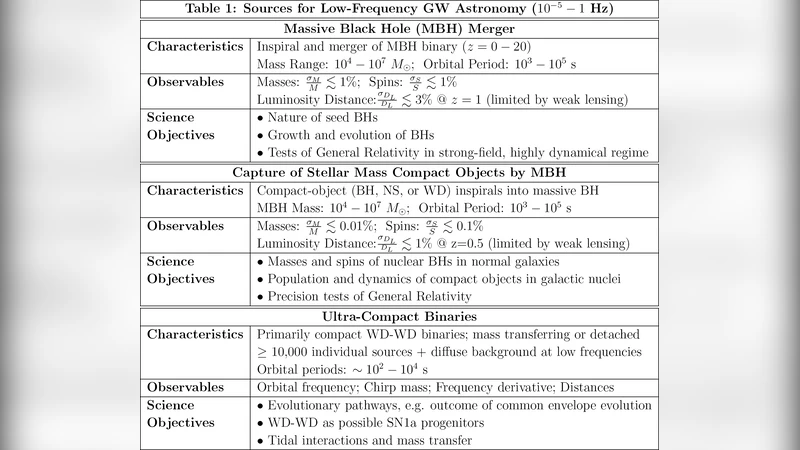
This Astro2010 science white paper provides an overview of the opportunities in low-frequency gravitational-wave astronomy, a new field that is poised to make significant advances. While discussing the broad context of gravitational-wave astronomy, this paper concentrates on the low-frequency region (10^(-5) to 1 Hz), a frequency range abundantly populated in strong sources of gravitational waves including massive black hole mergers, ultra-compact stellar-mass galactic binaries, and capture of compact objects by massive black holes in the nuclei of galaxies.
💡 Research Summary
The white paper “The Promise of Low‑Frequency Gravitational Wave Astronomy” presents a forward‑looking vision for the emerging field of low‑frequency (10⁻⁵ – 1 Hz) gravitational‑wave (GW) science. It begins by placing low‑frequency GW astronomy in the broader context of the recent successes of ground‑based detectors such as LIGO and Virgo, emphasizing that the low‑frequency band probes a completely different population of sources—massive black‑hole binaries, extreme‑mass‑ratio inspirals (EMRIs), and compact stellar‑mass binaries within our own Galaxy. These sources emit long‑duration, high‑amplitude waveforms that cannot be accessed by electromagnetic observations, offering a direct view of strong‑field gravity and the growth of structure in the Universe.
The paper identifies four primary scientific objectives. First, to map the merger history of supermassive black holes (SMBHs) with masses from 10⁶ to 10⁹ M☉, thereby linking black‑hole growth to galaxy evolution. Second, to use EMRIs—compact objects such as stellar‑mass black holes, neutron stars, or white dwarfs spiralling into SMBHs—to measure SMBH mass, spin, and the surrounding stellar density profile with percent‑level precision, providing a unique test of general relativity in the strong‑field regime. Third, to catalogue the Galactic population of ultra‑compact binaries (white‑dwarf pairs, white‑dwarf–neutron‑star systems) that act as both astrophysical laboratories and “verification sources” for space‑based detectors. Fourth, to exploit these GW signals as “standard sirens” for independent measurements of the Hubble constant and the dark‑energy equation of state, complementing traditional electromagnetic distance ladders.
The technical centerpiece of the proposal is the Laser Interferometer Space Antenna (LISA), a triangular constellation of three spacecraft separated by 2.5–5 million km, operating in a heliocentric orbit. LISA’s design sensitivity of 10⁻²⁰–10⁻²¹ Hz⁻¹/² across the 0.1 mHz–1 Hz band would enable detection of thousands of SMBH mergers out to redshift z ≈ 20, tens of thousands of Galactic binaries, and dozens of EMRIs per year. The paper discusses the key engineering challenges: ultra‑stable lasers, drag‑free test‑mass control, thermal and vibration isolation, and the need for sophisticated data‑analysis pipelines capable of handling millions of overlapping signals. It stresses that EMRI waveforms are highly complex, requiring high‑dimensional template banks and Bayesian inference methods (e.g., Markov‑Chain Monte Carlo, nested sampling) possibly accelerated by machine‑learning surrogates.
Scientific impact is explored in depth. SMBH merger rates and mass distributions will directly test hierarchical galaxy‑formation models and provide a census of black‑hole growth channels. EMRIs will probe the spacetime geometry of SMBHs, offering the most stringent tests of the Kerr metric and potential deviations predicted by alternative gravity theories. Galactic binaries will illuminate binary‑evolution pathways, common‑envelope physics, and the contribution of unresolved binaries to the stochastic GW background. As standard sirens, low‑frequency GW observations will deliver an independent distance–redshift relation, crucial for resolving current tensions in H₀ measurements and for constraining the dynamics of dark energy.
The paper concludes with a roadmap: (1) accelerate technology development and path‑finder missions for space‑based interferometry; (2) invest in waveform modeling, high‑performance computing, and open‑source data‑analysis tools; (3) foster interdisciplinary collaborations among astronomers, physicists, and computer scientists; and (4) establish international data‑sharing policies and joint observation campaigns with electromagnetic facilities (e.g., X‑ray, radio, optical surveys). By committing to these steps, the community can unlock the transformative potential of low‑frequency GW astronomy, turning it into a cornerstone of 21st‑century astrophysics and fundamental physics.
Comments & Academic Discussion
Loading comments...
Leave a Comment