The EROS2 search for microlensing events towards the spiral arms: the complete seven season results
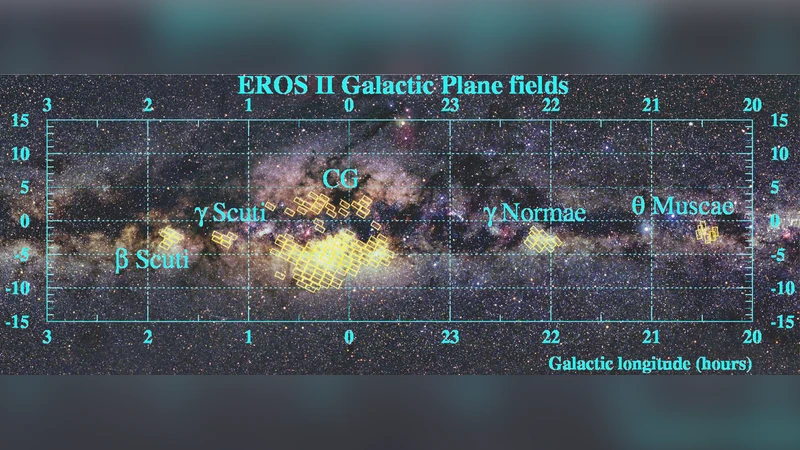
The EROS-2 project has been designed to search for microlensing events towards any dense stellar field. The densest parts of the Galactic spiral arms have been monitored to maximize the microlensing signal expected from the stars of the Galactic disk and bulge. 12.9 million stars have been monitored during 7 seasons towards 4 directions in the Galactic plane, away from the Galactic center. A total of 27 microlensing event candidates have been found. Estimates of the optical depths from the 22 best events are provided. A first order interpretation shows that simple Galactic models with a standard disk and an elongated bulge are in agreement with our observations. We find that the average microlensing optical depth towards the complete EROS-cataloged stars of the spiral arms is $\bar{\tau} =0.51\pm .13\times 10^{-6}$, a number that is stable when the selection criteria are moderately varied. As the EROS catalog is almost complete up to $I_C=18.5$, the optical depth estimated for the sub-sample of bright target stars with $I_C<18.5$ ($\bar{\tau}=0.39\pm >.11\times 10^{-6}$) is easier to interpret. The set of microlensing events that we have observed is consistent with a simple Galactic model. A more precise interpretation would require either a better knowledge of the distance distribution of the target stars, or a simulation based on a Galactic model. For this purpose, we define and discuss the concept of optical depth for a given catalog or for a limiting magnitude.
💡 Research Summary
The paper presents the final results of the EROS‑2 microlensing survey toward the Milky Way’s spiral arms, covering seven observing seasons (1996‑2003). The authors monitored 12.9 million stars in four fields located away from the Galactic centre, chosen to maximise the expected microlensing signal from both the Galactic disk and the elongated bulge. Using a two‑band (V and I) CCD camera, they obtained a dense time‑series with an average cadence of 2–3 days, reaching a completeness limit of I_C ≈ 18.5.
Candidate events were identified through a standard point‑source, point‑lens Paczyński light‑curve fit. The selection required at least three consecutive points above a 3σ threshold, a good χ² fit to the Paczyński model, no significant colour change, and the exclusion of blended or variable-star artefacts. This procedure yielded 27 microlensing candidates; 22 of them satisfied the most stringent quality criteria and were used for the optical‑depth analysis.
Detection efficiency ε(t_E) was quantified by injecting artificial events into the real data stream and measuring the recovery rate as a function of the Einstein‑crossing time t_E. Efficiency rises from roughly 10 % at t_E ≈ 1 day to a peak of about 70 % near t_E ≈ 30 days, then declines for longer events. The optical depth τ was computed with the standard estimator
\
Comments & Academic Discussion
Loading comments...
Leave a Comment