Status of the VERITAS Upgrade
The VERITAS gamma ray observatory (Amado, AZ, veritas.sao.arizona.edu) uses the Imaging Atmospheric Cherenkov Technique (IACT) to study sources of Very High Energy (VHE: E > 100 GeV) gamma rays. Key science results from the first three years of observation include the discovery of the first VHE emitting starburst galaxy, detection of new Active Galactic Nuclei (AGN), SuperNova Remnants (SNR), gamma ray binaries as well as strong limits on the emission of VHE gamma rays from dark matter annihilation in dwarf galaxies. In April 2010, VERITAS received funding to upgrade the photomultiplier tube cameras, pattern triggers, and networking systems in order to improve detector sensitivity, especially near detection threshold (E ~ 100 GeV). In this paper we describe the status of the VERITAS upgrade and the expected improvements in sensitivity when it is completed in summer 2012.
💡 Research Summary
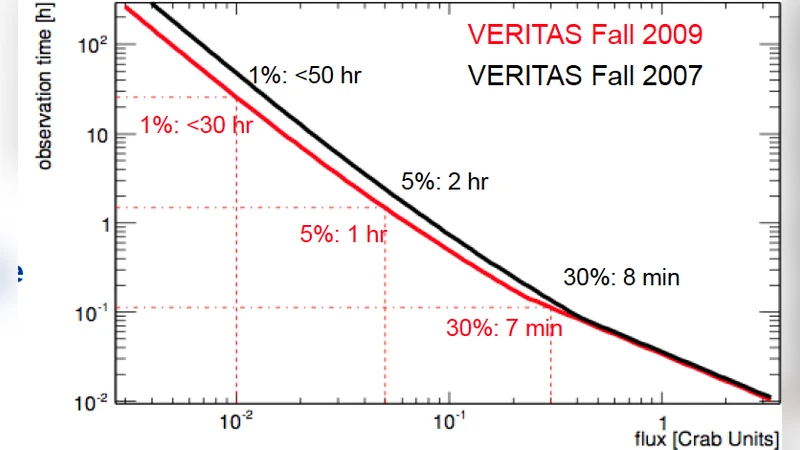
The VERITAS (Very Energetic Radiation Imaging Telescope Array System) observatory, located near Amado, Arizona, consists of four 12‑meter imaging atmospheric Cherenkov telescopes equipped with 499‑pixel photomultiplier tube (PMT) cameras. Since its commissioning in 2007, VERITAS has expanded the catalog of northern‑hemisphere very‑high‑energy (VHE) gamma‑ray sources, discovering new blazars, a starburst galaxy, several supernova remnants, and setting strong limits on dark‑matter annihilation in dwarf spheroidals. Continuous improvements—mirror alignment automation, array re‑configuration, and refined analysis—have already reduced the exposure needed to detect a 1 % Crab‑flux source from ~46 h (2007) to ~25 h (2010). Nevertheless, sensitivity near the detection threshold (~100 GeV) remains limited by photon collection efficiency and background event rates.
To address these limitations, VERITAS launched a three‑year upgrade program in April 2010, targeting three major subsystems: (1) replacement of the existing Photonis XP2970 PMTs (quantum efficiency, QE, 18‑22 %) with Hamamatsu R10560‑100‑20 high‑QE (hQE) PMTs (QE 32‑34 %); (2) installation of a new FPGA‑based pattern trigger with a narrower coincidence window; and (3) a comprehensive network upgrade to high‑capacity, redundant fiber links.
High‑QE PMT Replacement
The R10560‑100‑20 is a super‑bialkali tube offering roughly a 35‑50 % increase in photon detection efficiency relative to the legacy tubes. Its active diameter (26.2 mm) is slightly smaller than the XP2970 (29 mm), but the existing Winston cones preserve the effective collection area, avoiding any geometric loss. Hamamatsu supplies the tubes at a rate of 250 units per month, starting May 2011. Acceptance testing, performed at Purdue University, subjects each PMT to a one‑hour high‑voltage soak, followed by single‑photon spectra acquisition at eight HV settings. This yields gain‑vs‑voltage curves, absolute gain from the single‑photoelectron peak, and stores all results in an online database. Testing is batched (16 PMTs per run) and completes in ~3 h. A random 10 % subset undergoes additional uniformity, QE vs. wavelength, after‑pulsing, and photo‑electron detection efficiency measurements at UC Santa Cruz.
Mechanical and Preamplifier Design
The new hQE pixel retains full compatibility with the existing camera architecture (“plug‑compatible”), allowing rapid replacement without redesign of the camera or readout electronics. The mechanical assembly is a two‑piece design that eliminates the need for an alignment jig, reduces overall weight by 7.7 % per pixel, and meets environmental specifications from –40 °C to +140 °F. The preamplifier circuitry is unchanged from the legacy design, preserving power, signal polarity, and connector layout, while employing a nylon‑fabric “spaghetti” shield for lighter, more flexible cabling.
FPGA‑Based Pattern Trigger
The legacy Level‑2 telescope‑level trigger is being superseded by an FPGA‑implemented system that can process pixel‑level patterns with sub‑nanosecond precision and a tighter coincidence window. This architecture is expected to suppress accidental triggers from night‑sky background photons, improve the low‑energy trigger efficiency, and provide a platform for future multi‑telescope real‑time coincidence logic. Software development and bench testing concluded in late 2010; field verification began in June 2011, with full deployment slated for after successful validation.
Network Upgrade
Initially, VERITAS relied on a single pair of multimode (62.5/125 µm) fibers delivering 1 Gbps total bandwidth, with no redundancy—any fiber failure caused a complete loss of data from the affected telescope. The upgrade replaces these with six pairs of single‑mode (50/125 µm) fibers, each capable of 10 Gbps. LACP (Link Aggregation Control Protocol) is enabled on the new switches, allowing bandwidth aggregation across multiple fibers and providing automatic fail‑over. The target bandwidth per telescope is ≥20 MB s⁻¹ (≈160 Mbps) by summer 2012, sufficient to stream the high‑speed Optical Monitoring (OM) and Stellar Intensity Interferometry (SII) data continuously.
OM/SII Capability
A dedicated high‑speed pixel will be installed at the centre of each camera for optical monitoring and intensity interferometry. The pixel incorporates a removable narrow‑band filter (Δλ≈10 nm) and is read out by a National Instruments PXIe‑7965R FPGA (FlexRIO, Virtex‑5 SX95T) coupled with a NI‑5761 digitizer (4‑channel, 250 MS/s, 14‑bit). The system can stream raw PMT waveforms at 500 MS/s, 8‑bit resolution to a 12 TB RAID array for up to six hours of uninterrupted recording. Laboratory tests with two R10560 PMTs in a fiber‑based interferometer achieved cross‑correlation to autocorrelation ratios <10⁻⁴, meeting the sensitivity required for measuring stellar radii of bright hot stars. A field test using two 3‑m telescopes separated by 23 m is planned for summer 2011, after which the full four‑telescope OM/SII system will be installed alongside the hQE pixel upgrade in summer 2012.
Expected Sensitivity Gains
Monte‑Carlo simulations indicate that the hQE pixel upgrade alone can increase the effective collection area by 35‑50 % for primary gamma‑ray energies between 100 GeV and 200 GeV. This translates into a substantial reduction in the observation time required for low‑flux sources and improves the energy threshold of the array. Combined with the faster, more selective FPGA trigger and the higher‑bandwidth, redundant network, the overall sensitivity—especially below 200 GeV—is expected to improve markedly, opening the door to deeper studies of AGN, supernova remnants, pulsar wind nebulae, and indirect dark‑matter searches.
Project Timeline
- Summer 2010: Commencement of upgrade; Telescope #1 relocated and mirror alignment system deployed.
- November 2010: Completion of PMT acceptance testing; order placed for 2 200 PMTs.
- May 2011: First shipment of 191 high‑QE PMTs received; delivery rate set at 250 units/month.
- June 2011: Field test of FPGA trigger system.
- January 2012: Final batch of PMTs arrives.
- April 2012: Completion of hQE pixel fabrication and laboratory verification.
- Summer 2012: Installation of hQE pixels on all four telescopes, network switch upgrade to support 20 Gbps links, and deployment of the OM/SII high‑speed pixel system. First light with the upgraded array is scheduled for the start of the 2012‑2013 observing season.
In summary, the VERITAS upgrade is a coordinated effort to boost photon detection efficiency, modernize trigger electronics, and expand data‑transfer capacity. The anticipated outcome is a significantly lower energy threshold and higher sensitivity, particularly in the 100‑200 GeV regime, thereby enhancing VERITAS’s capability to address its core scientific goals and to explore new observational modes such as high‑speed optical monitoring and stellar intensity interferometry.
Comments & Academic Discussion
Loading comments...
Leave a Comment