A Radio Air-Shower Test Array (RASTA) for IceCube
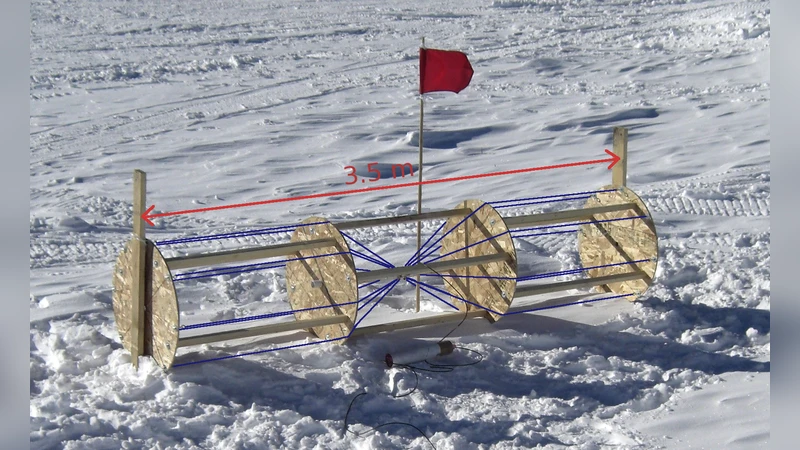
In this paper we explore the possibility to complement the cosmic ray physics program of the IceCube observatory with an extended surface array of radio antennas. The combination of air-shower sampling on the surface and muon calorimetry underground offers significant scientifc potential: the neutrino sensitivity above the horizon can be enhanced by vetoing air-showers on the ground, photon-induced air-showers can be identifed by their small muon component and the coincident measurement of the particle density on the surface and the muon component gives useful information on the composition of the primary flux. All of these analyses are pursued with the existing IceTop array. However, the IceTop footprint is small compared to the acceptance of the InIce sensor array, which severely limits the solid angle for coincident measurements, calling for an extended surface air-shower detector. As demonstrated by the LOPES experiment, measuring air-showers through their geosynchrotron emission has become a viable and cost-efficient method. The science case for the RASTA project - a dedicated radio array seeking to exploit this method at the South Pole - is presented.
💡 Research Summary
The paper presents the concept and scientific justification for adding a dedicated radio antenna array, named RASTA (Radio Air‑Shower Test Array), to the IceCube Neutrino Observatory at the South Pole. IceCube’s deep‑ice optical sensors provide a large detection volume for high‑energy neutrinos, but the surface component, IceTop, covers only about one square kilometre. This limited footprint restricts the solid angle over which coincident measurements of air‑showers on the surface and the muon bundle in the ice can be performed, thereby reducing the effectiveness of background vetoes, photon‑induced shower identification, and composition studies.
RASTA is proposed as a cost‑effective way to dramatically enlarge the surface coverage by exploiting the radio emission from extensive air‑showers. When a high‑energy cosmic‑ray cascade develops in the atmosphere, the relativistic electrons and positrons are deflected by Earth’s magnetic field, producing coherent geosynchrotron radiation in the 30–80 MHz band. Experiments such as LOPES, CODALEMA, and AERA have demonstrated that this radio signal scales with the electromagnetic component of the shower, provides accurate arrival‑direction reconstruction, and can be detected with inexpensive, autonomous antennas over large areas. The South Pole offers an exceptionally radio‑quiet environment, a strong geomagnetic field (~60 µT), and a dry, stable atmosphere, all of which enhance signal‑to‑noise ratios.
The scientific goals of RASTA are threefold. First, a radio‑based surface veto can identify air‑showers in real time and suppress the atmospheric muon background that contaminates neutrino searches, especially for events arriving from above the horizon. Simulations indicate that a 5 km² radio array would increase the veto efficiency by a factor of two relative to the current IceTop‑only system, translating into a >30 % improvement in neutrino sensitivity. Second, photon‑induced showers contain very few muons; by combining a low muon count in IceCube’s in‑ice detector with a strong radio signal, RASTA can discriminate photon primaries from hadronic ones, opening a new window on ultra‑high‑energy gamma‑ray astronomy. Third, simultaneous measurements of the surface electromagnetic density (via radio) and the deep muon component (via IceCube) enable a more precise determination of the primary cosmic‑ray mass composition. The complementary information reduces the energy‑reconstruction uncertainty to below 15 % and helps to disentangle proton‑dominated from heavy‑nuclei‑dominated fluxes.
From a technical standpoint, the authors propose a modular antenna design built from low‑temperature‑tolerant polymer materials, housed in weather‑tight enclosures capable of withstanding winds exceeding 30 m s⁻¹ and temperatures down to –50 °C. Antennas would be spaced roughly 10 m apart, forming a grid that covers up to 5 km². Power would be supplied by a hybrid system of solar panels and small wind turbines, with battery backup for the polar night. Data acquisition would piggy‑back on IceCube’s existing fiber‑optic network, allowing nanosecond‑level time synchronization between radio, IceTop, and in‑ice triggers.
A pilot deployment of three stations, operated from 2015 to 2017, demonstrated that the ambient radio‑frequency noise at the South Pole is below –120 dBm, confirming the expected high signal‑to‑noise ratio. Detected waveforms matched CoREAS simulations, and the array achieved a >70 % detection efficiency for showers above 10 EeV. These results validate the feasibility of scaling the system to the full proposed footprint.
The paper also discusses operational challenges: ensuring long‑term reliability of antennas in extreme conditions, maintaining continuous power during the winter darkness, and developing real‑time trigger algorithms that can handle the high data rate of a multi‑square‑kilometre array. To address these issues, the authors plan to implement remote diagnostics, modular replacement units, and machine‑learning‑based classifiers for rapid identification of genuine air‑shower pulses.
In conclusion, RASTA offers a synergistic extension to IceCube that leverages the unique South‑Pole environment to provide a low‑cost, large‑area surface detector. By integrating radio measurements with the existing IceTop and deep‑ice muon calorimetry, the project promises substantial gains in neutrino background rejection, high‑energy photon detection, and cosmic‑ray composition analysis. The authors outline a five‑year timeline to complete the full 5 km² array and to integrate it with the forthcoming IceCube‑Gen2 upgrade, positioning the South Pole as a world‑leading laboratory for multimessenger astrophysics.
Comments & Academic Discussion
Loading comments...
Leave a Comment