The LOPES experiment - recent results, status and perspectives
The LOPES experiment at the Karlsruhe Institute of Technology has been taking radio data in the frequency range from 40 to 80 MHz in coincidence with the KASCADE-Grande air shower detector since 2003.
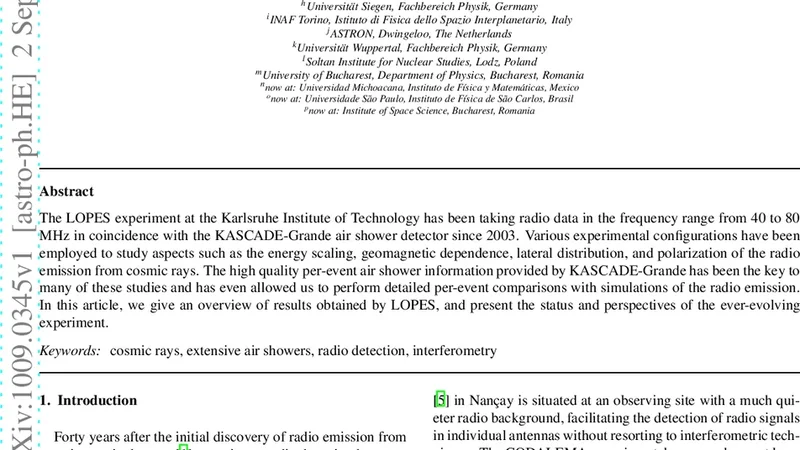
The LOPES experiment at the Karlsruhe Institute of Technology has been taking radio data in the frequency range from 40 to 80 MHz in coincidence with the KASCADE-Grande air shower detector since 2003. Various experimental configurations have been employed to study aspects such as the energy scaling, geomagnetic dependence, lateral distribution, and polarization of the radio emission from cosmic rays. The high quality per-event air shower information provided by KASCADE-Grande has been the key to many of these studies and has even allowed us to perform detailed per-event comparisons with simulations of the radio emission. In this article, we give an overview of results obtained by LOPES, and present the status and perspectives of the ever-evolving experiment.
💡 Research Summary
The LOPES (LOFAR Prototype Station) experiment, operating at the Karlsruhe Institute of Technology since 2003, has been a pioneering effort in the radio detection of extensive air showers (EAS) from high‑energy cosmic rays. Co‑located with the KASCADE‑Grande particle detector, LOPES recorded broadband radio pulses in the 40–80 MHz band in coincidence with the particle measurements, allowing a unique per‑event correlation between the radio signal and the detailed shower parameters (core position, energy, arrival direction, muon/electron content).
The paper reviews the main achievements of LOPES over more than a decade. First, an energy scaling law was established: the radio amplitude measured at a reference distance (≈ 100 m from the shower axis) scales linearly with the primary cosmic‑ray energy in the range 10¹⁶–10¹⁸ eV, with a relative uncertainty of about 20 %. This confirms that radio detection can provide an independent, calorimetric energy estimator comparable to traditional particle arrays.
Second, the geomagnetic dependence was quantified. By analysing events with a wide spread of geomagnetic angles (θ, the angle between the shower axis and the Earth’s magnetic field), LOPES demonstrated that the radio amplitude follows a sin θ behavior, as predicted by the geomagnetic emission model. This result enabled the introduction of a correction factor that removes the directional bias in energy reconstruction.
Third, the lateral distribution function (LDF) of the radio signal was measured with high precision. The amplitude falls off steeply within the first 100 m from the core and can be described by an exponential or NKG‑type function. The shape of the LDF carries information on the shower development stage and, indirectly, on the mass composition of the primary particle.
Fourth, polarization studies showed that the electric field vector is predominantly aligned perpendicular to the geomagnetic field, confirming the dominance of the geomagnetic emission mechanism over the sub‑dominant Askaryan (charge‑excess) contribution in the 40–80 MHz band.
A cornerstone of LOPES’ scientific output is the per‑event comparison with state‑of‑the‑art Monte‑Carlo codes such as CoREAS and ZHAireS. By feeding the exact KASCADE‑Grande shower parameters into the simulations, LOPES verified that simulated waveforms, amplitudes, and phases match the measured data within experimental uncertainties. Discrepancies at low frequencies led to refinements in the treatment of atmospheric refractivity and antenna response, thereby improving the reliability of radio‑based shower reconstruction.
The paper also outlines the current status of the experiment. The antenna array has been upgraded with additional stations, a broader frequency coverage (30–100 MHz) is being tested, and real‑time digital beam‑forming and trigger algorithms are under development. These upgrades aim to lower the detection threshold, increase the event‑rate, and enhance the reconstruction accuracy for both energy and Xmax (the depth of shower maximum).
Finally, LOPES’ perspective is placed in the context of next‑generation projects such as GRAND, SKA‑Low, and the proposed radio extensions of the Pierre Auger Observatory. The techniques, calibration procedures, and analysis pipelines pioneered by LOPES are directly transferable to these larger arrays, promising a future where radio detection becomes a standard, cost‑effective tool for ultra‑high‑energy cosmic‑ray astronomy.
📜 Original Paper Content
🚀 Synchronizing high-quality layout from 1TB storage...