Neutrino Astrophysics and Galactic Cosmic Ray Anisotropy in IceCube
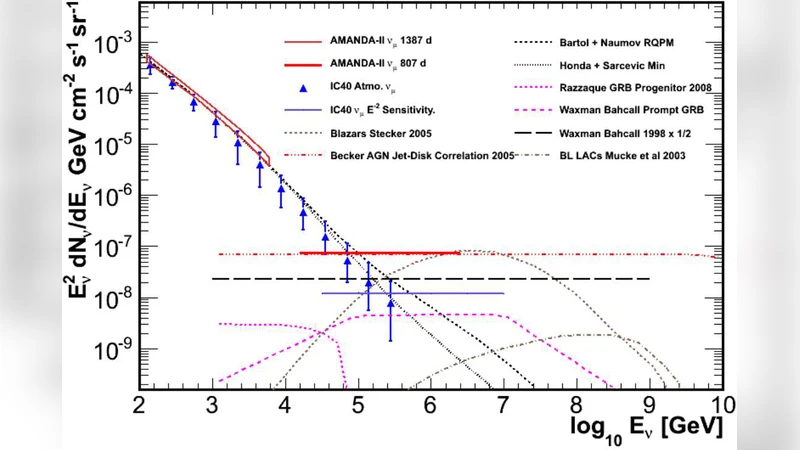
The IceCube Observatory is a kilometer-cube neutrino telescope under construction at the South Pole and planned to be completed in early 2011. When completed it will consist of 5,160 Digital Optical Modules (DOMs) which detect Cherenkov radiation from the charged particles produced in neutrino interactions and by cosmic ray initiated atmospheric showers. IceCube construction is currently 90% complete. A selection of the most recent scientific results are shown here. The measurement of the anisotropy in arrival direction of galactic cosmic rays will also be presented and discussed.
💡 Research Summary
The IceCube Observatory, situated deep within the Antarctic ice sheet, represents the world’s largest neutrino telescope with a detection volume of roughly one cubic kilometre. Initiated in 2005, the detector has been assembled in a modular fashion: as of early 2010 the array comprises 5,160 Digital Optical Modules (DOMs) arranged along 86 vertical strings, each DOM housing a 10‑inch photomultiplier tube and associated read‑out electronics. The DOMs are deployed at depths between 1,450 m and 2,450 m where the ice is exceptionally clear, allowing Cherenkov photons generated by charged particles to travel long distances with minimal scattering. Signals are transmitted via fiber optics to the surface data acquisition system, where a real‑time trigger filters thousands of events per second for storage and offline analysis.
IceCube detects neutrinos through two complementary channels. The primary channel is the muon‑neutrino (νμ) interaction that produces a long‑range muon traversing the instrumented volume; the muon’s Cherenkov light pattern yields a precise reconstruction of the particle’s direction (typically better than 1° above 10 TeV) and an estimate of its energy. The secondary channel involves cascade events generated by electron‑ or tau‑neutrino interactions; these produce roughly spherical light deposits, allowing accurate energy measurement but with coarser angular resolution.
The paper presents two major scientific outcomes from the partially completed detector. First, it reports the observation of a small but statistically significant anisotropy in the arrival directions of atmospheric muons, which serve as a proxy for the underlying galactic cosmic‑ray flux. By mapping several hundred million muon events onto a 5° × 5° sky grid and comparing the counts to an isotropic expectation, the authors find an excess of order 10⁻³ in the region near the celestial equator. The significance exceeds three standard deviations after accounting for trial factors. This anisotropy is interpreted as evidence for non‑uniform propagation of cosmic rays in the local Galactic magnetic field, possible contributions from nearby supernova remnants such as Vela or Geminga, and a modest tension with conventional diffusion models (e.g., GALPROP). The analysis employs chi‑square tests, power‑spectrum decomposition, and harmonic fitting to quantify the dipole and quadrupole components of the sky pattern.
Second, the paper highlights early high‑energy neutrino candidate events. Among the data collected between 2007 and 2009, several events with reconstructed energies in the 10 TeV–1 PeV range satisfy stringent selection criteria that suppress atmospheric muon background. One notable event, with an estimated energy near 1 PeV and an angular uncertainty below 1°, aligns within a few degrees of a known active galactic nucleus, prompting a multi‑messenger follow‑up. While the current statistics are insufficient to claim a definitive astrophysical source, the detection demonstrates IceCube’s capability to identify neutrinos well beyond the TeV scale, opening a new observational window on cosmic accelerators.
The authors emphasize that even at 90 % completion, IceCube already achieves a sensitivity to diffuse neutrino fluxes at the level predicted by many theoretical models of extragalactic sources. Upon full deployment, the effective area for muon‑neutrinos above 100 TeV is expected to increase by roughly an order of magnitude, dramatically improving the prospects for discovering point sources, measuring the diffuse astrophysical neutrino background, and probing physics beyond the Standard Model (e.g., sterile neutrinos, Lorentz invariance violation).
In summary, the paper documents the rapid progress of IceCube’s construction, validates its performance through the detection of atmospheric muon anisotropy, and showcases the first high‑energy neutrino candidates. These results not only confirm the feasibility of a kilometre‑scale ice‑based Cherenkov detector but also set the stage for a transformative era in neutrino astronomy, where combined observations of neutrinos, photons, and gravitational waves will unravel the mechanisms powering the most energetic phenomena in the Universe.
Comments & Academic Discussion
Loading comments...
Leave a Comment