BATATA: A device to characterize the punch-through observed in underground muon detectors and to operate as a prototype for AMIGA
BATATA is a hodoscope comprising three X-Y planes of plastic scintillation detectors. This system of buried counters is complemented by an array of 3 water-Cherenkov detectors, located at the vertices of an equilateral triangle with 200 m sides. This small surface array is triggered by extensive air showers. The BATATA detector will be installed at the centre of the AMIGA array, where it will be used to quantify the electromagnetic contamination of the muon signal as a function of depth, and so to validate, in situ, the numerical estimates made of the optimal depth for the AMIGA muon detectors. BATATA will also serves as a prototype to aid the design of these detectors.
💡 Research Summary
The paper presents BATATA, a compact prototype designed to support the AMIGA (Auger Muons and Infill for the Ground Array) extension of the Pierre Auger Observatory in Argentina. BATATA consists of a buried hodoscope made of three orthogonal X‑Y planes of plastic scintillator strips and an accompanying surface array of three water‑Cherenkov detectors arranged at the vertices of an equilateral triangle with 200 m sides. The surface array provides the trigger for extensive air‑shower (EAS) events, while the underground hodoscope records the particle content that reaches three different depths (approximately 0.5 m, 1.0 m and 1.5 m below ground). Each scintillator plane covers roughly 4 m × 4 m, is wrapped in a thin light‑tight foil, and is read out by wavelength‑shifting fibers coupled to multi‑pixel photon counters (MPPCs). The three planes are stacked so that both X and Y coordinates are measured simultaneously, allowing a three‑dimensional reconstruction of each particle track.
The primary scientific goal of BATATA is to quantify the electromagnetic (EM) contamination of the muon signal as a function of burial depth. In EAS, the muon component is a robust estimator of the primary cosmic‑ray mass, but it is mixed with an EM halo of electrons, positrons and gammas that can penetrate shallow detectors. Simulations based on CORSIKA and GEANT4 predict that an optimal burial depth of about 2.5 m reduces the EM fraction to below 1 % while preserving muon statistics. BATATA directly measures the EM fraction at shallower depths, providing an in‑situ validation of those predictions. Preliminary Monte‑Carlo studies indicate that at 1.5 m the EM contamination drops to roughly 5 % of the total signal, and at 2.5 m it falls below 1 %. By comparing measured depth‑dependent contamination with the simulated expectations, BATATA will either confirm the 2.5 m design choice or suggest that a shallower, more cost‑effective deployment could still meet the AMIGA performance requirements (muon purity > 95 %).
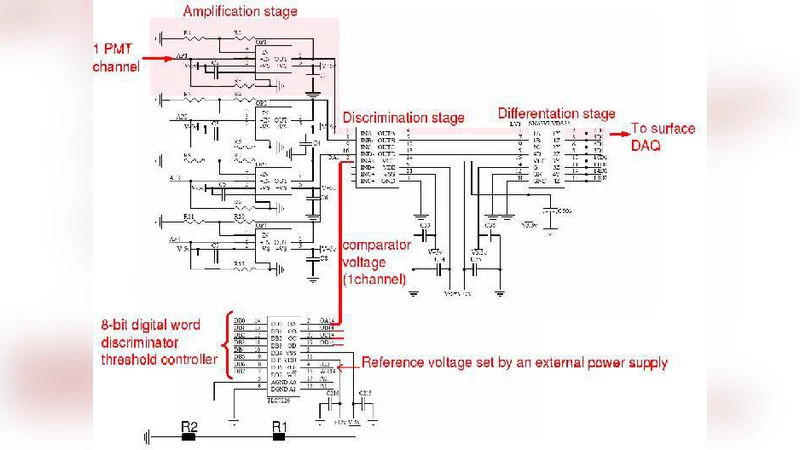
From an engineering perspective, BATATA serves as a test‑bed for the full AMIGA detection chain. The read‑out electronics are built around low‑voltage ASICs that perform pre‑amplification, shaping and digitisation (12‑bit ADC). Each channel is time‑stamped and stored locally before being transmitted via a 802.11n wireless link to a remote monitoring station. The system incorporates automatic temperature compensation for the MPPC gain, fiber‑loss calibration, and real‑time background suppression algorithms. The water‑Cherenkov surface detectors each contain a 10 m² water tank instrumented with three photomultiplier tubes; a coincidence of at least two tanks generates the trigger that initiates data acquisition in the underground hodoscope.
Beyond the physics measurement, BATATA provides critical feedback on mechanical layout, scintillator spacing, fiber routing, and detector shielding. By systematically varying the inter‑strip distance, fiber length, and burial material, the prototype identifies the optimal configuration that balances signal‑to‑noise, construction cost, and long‑term reliability. The data acquired will be used to refine the production specifications for the full AMIGA array, which will eventually consist of hundreds of muon counters deployed over a 23.5 km² infill region.
In summary, BATATA is a multi‑purpose instrument that (1) delivers the first direct, depth‑resolved measurement of EM contamination in underground muon detectors, (2) validates or revises the simulated optimal burial depth for AMIGA, and (3) functions as a prototype platform for the complete hardware, firmware and data‑handling chain required for large‑scale muon detection at the Pierre Auger Observatory. The successful operation of BATATA will enhance the overall sensitivity of the observatory to the mass composition of ultra‑high‑energy cosmic rays and will inform the design of future underground particle detectors in astroparticle physics.
Comments & Academic Discussion
Loading comments...
Leave a Comment