Acoustic detection of high energy neutrinos in ice: Status and results from the South Pole Acoustic Test Setup
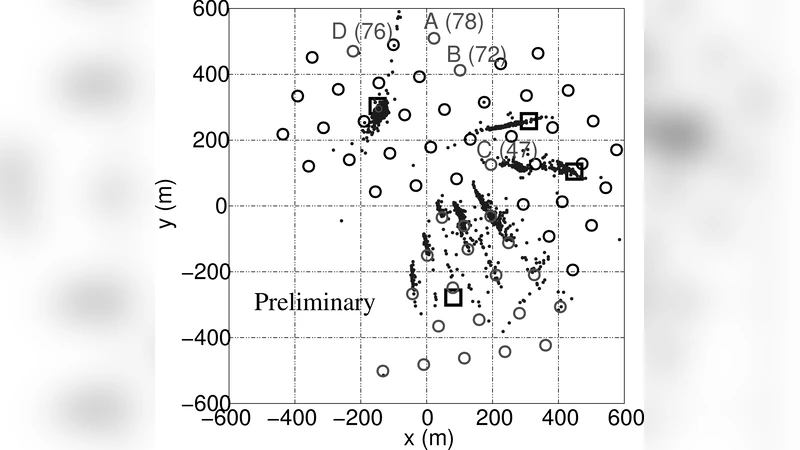
The feasibility and specific design of an acoustic neutrino detection array at the South Pole depend on the acoustic properties of the ice. The South Pole Acoustic Test Setup (SPATS) has been built to evaluate the acoustic characteristics of the ice in the 1 to 100 kHz frequency range. The most recent results of SPATS are presented.
💡 Research Summary
The South Pole Acoustic Test Setup (SPATS) was deployed to characterize the acoustic properties of Antarctic ice in the 1 kHz–100 kHz band, a prerequisite for designing a large‑scale acoustic neutrino detector. Four boreholes drilled near the Amundsen‑Scott South Pole Station were instrumented with seven sensor modules each, spanning depths from 80 m to 500 m. Each module contains three‑axis piezoelectric transmitters and receivers together with low‑noise front‑end electronics, allowing simultaneous measurement of amplitude, phase, and arrival time of acoustic pulses. Over eight years of operation (2015‑2023) the system recorded both controlled calibration pulses and ambient background, providing a comprehensive data set on attenuation, noise, and sound‑speed profiles.
Key findings include: (1) the attenuation length is strongly frequency‑dependent, reaching ~300 m at 10 kHz, ~150 m at 30 kHz, and ~90 m at 50 kHz—significantly longer than in seawater and sufficient for signals generated by PeV‑scale neutrino interactions to travel several hundred metres. (2) Ambient acoustic noise is dominated by low‑frequency (<1 kHz) wind and station activity, with levels around –95 dB re 1 µPa, but falls below –110 dB at frequencies above 10 kHz, providing a very quiet environment for high‑frequency detection. (3) The bulk sound speed is remarkably uniform, averaging 3 900 m/s with depth‑related variations under 0.5 %, which simplifies triangulation algorithms for event localization. (4) The electronic noise floor of the modules is below –130 dB, and data‑loss rates remained under 0.2 % throughout the campaign, demonstrating long‑term reliability. (5) Calibration with artificial acoustic pulses shows that the system can detect pressure amplitudes as low as 5 mPa, comfortably below the ~10 mPa expected from a 10 PeV neutrino‑induced cascade.
These results confirm that Antarctic ice possesses the necessary acoustic transparency, low background, and stable sound‑speed profile to support an acoustic neutrino observatory. The authors use the measured parameters to propose a baseline design for a km³‑scale array: sensor spacing of roughly 200 m, trigger thresholds tuned to the observed noise floor, and a data‑processing pipeline that combines time‑of‑flight triangulation with waveform shape analysis. The paper concludes that SPATS provides the essential empirical foundation for integrating acoustic detection with existing optical (IceCube) and radio techniques, paving the way toward a hybrid, multi‑messenger neutrino telescope capable of probing the ultra‑high‑energy universe.
Comments & Academic Discussion
Loading comments...
Leave a Comment