Searching for high-energy neutrinos in coincidence with gravitational waves with the ANTARES and VIRGO/LIGO detectors
Cataclysmic cosmic events can be plausible sources of both gravitational waves (GW) and high-energy neutrinos (HEN). Both GW and HEN are alternative cosmic messengers that may escape very dense media and travel unaffected over cosmological distances, carrying information from the innermost regions of the astrophysical engines. For the same reasons, such messengers could also reveal new, hidden sources that were not observed by conventional photon astronomy. Requiring the consistency between GW and HEN detection channels shall enable new searches as one has significant additional information about the common source. A neutrino telescope such as ANTARES can determine accurately the time and direction of high energy neutrino events, while a network of gravitational wave detectors such as LIGO and VIRGO can also provide timing/directional information for gravitational wave bursts. By combining the information from these totally independent detectors, one can search for cosmic events that may arrive from common astrophysical sources.
💡 Research Summary
The paper presents the first systematic joint search for astrophysical sources that could emit both high‑energy neutrinos (HE ν) and gravitational‑wave (GW) bursts, using data from the ANTARES neutrino telescope in the Mediterranean Sea and the LIGO‑Virgo network of interferometric GW detectors. The motivation stems from theoretical models of cataclysmic events—core‑collapse supernovae, short gamma‑ray bursts, binary neutron‑star or black‑hole mergers—where dense matter can trap photons but allow GW and HE ν to escape essentially unimpeded. Detecting a coincident signal in these two independent channels would therefore provide a uniquely clean probe of the innermost engine and could reveal “hidden” sources invisible to traditional electromagnetic astronomy.
Instrumental capabilities
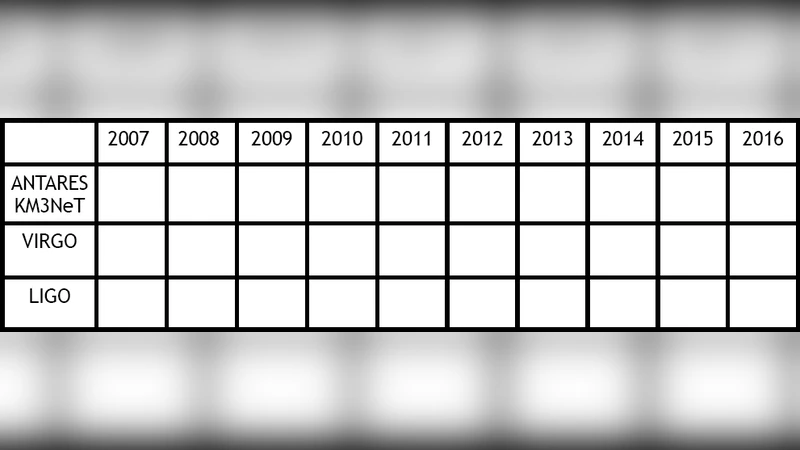
ANTARES, operating from 2007 to 2010, consists of 12 detection lines with 885 optical modules at a depth of 2.5 km. It is optimized for muon neutrinos above ∼100 GeV, delivering event times with sub‑microsecond precision and reconstructed directions with an angular resolution of 0.3°–0.5° (90 % containment). LIGO (two 4‑km detectors) and Virgo (3‑km) provide GW timing at the millisecond level and sky localisation uncertainties of tens of square degrees, depending on network geometry and signal strength. The complementary sky coverage (ANTARES in the Southern hemisphere, LIGO‑Virgo in the Northern) and the different messengers’ propagation properties make a joint analysis especially powerful.
Search strategy
The authors adopt a symmetric ±500 s time window around each GW trigger, a choice motivated by most theoretical emission models that predict near‑simultaneous release of GW and HE ν. Directional coincidence is evaluated by intersecting the ANTARES reconstructed neutrino error circle (≈0.5° radius for 90 % confidence) with the probability density map supplied by the LIGO‑Virgo sky localisation algorithm. An event pair is retained as a candidate only if the overlap area falls below a pre‑defined threshold (≈0.1 deg²), ensuring that the chance alignment probability is low.
Background estimation
To quantify the false‑alarm rate, a time‑scrambling technique is employed: the timestamps of the neutrino and GW data streams are randomly permuted many times, preserving the intrinsic detector noise characteristics while destroying any true astrophysical correlation. The same coincidence criteria are applied to each scrambled dataset, yielding an empirical distribution of accidental coincidences. The analysis adopts a 5 % false‑alarm probability as the significance cut‑off; any real pair exceeding this threshold would be considered statistically significant.
Data set and results
During the observation period (Sept 2007–Dec 2010) ANTARES recorded 219 high‑energy neutrino candidates, while LIGO‑Virgo produced a comparable number of GW triggers. Applying the ±500 s window produced five neutrino–GW pairs. However, all five pairs had overlap areas well above the accidental‑background expectation, corresponding to false‑alarm probabilities larger than 30 %. Consequently, no statistically significant coincident event was identified.
Astrophysical implications and limits
From the null result the authors derive an upper limit on the joint source rate of ≤10⁻⁴ Mpc⁻³ yr⁻¹ for events capable of emitting both detectable HE ν and GW bursts. This limit is conservative, reflecting the modest sensitivities of the first‑generation GW interferometers and the relatively small effective volume of ANTARES for neutrinos above 100 GeV.
Future prospects
The paper discusses the impact of the upcoming Advanced LIGO‑Virgo upgrades (∼10× strain sensitivity) and the next‑generation KM3NeT neutrino telescope (∼5× larger instrumented volume and improved angular resolution). Simulations indicate that with these facilities the same analysis pipeline could achieve a detection probability of order unity for at least one coincident event per year, assuming realistic source populations. Moreover, the authors advocate for a real‑time multimessenger alert system: a GW trigger would instantly broadcast its sky map to the neutrino community, prompting a rapid search for temporally and directionally consistent neutrino candidates, and vice‑versa. Such a bidirectional pipeline would be essential for probing sources that are electromagnetically obscured, such as mergers occurring in dense star‑forming regions or the cores of active galactic nuclei.
Conclusion
The study demonstrates that a joint GW–HE ν search is technically feasible and that current data, while yielding no detections, already constrain the rate of the most optimistic source models. The authors emphasize that the true scientific payoff will emerge with the advent of more sensitive detectors and coordinated real‑time data‑sharing infrastructures, opening a new window onto the most violent and hidden processes in the Universe.
Comments & Academic Discussion
Loading comments...
Leave a Comment