Point source searches with the ANTARES neutrino telescope
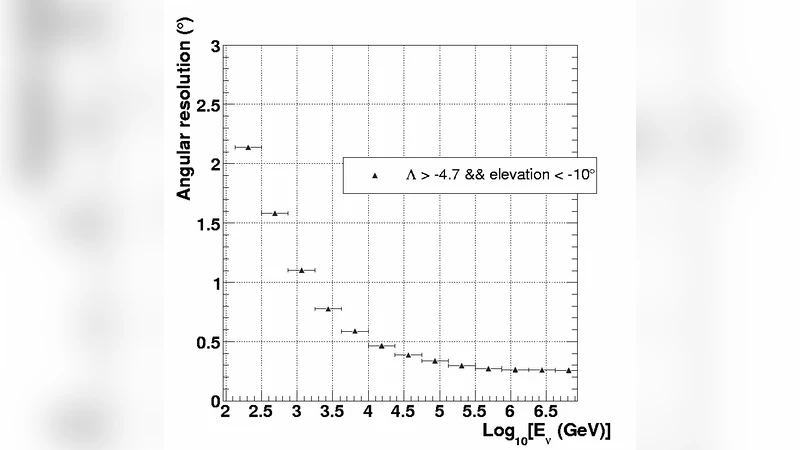
With the installation of its last two lines in May 2008, ANTARES is currently the largest neutrino detector in the Northern Hemisphere. The detector comprises 12 detection lines, carrying 884 ten-inch photomultipliers, at a depth of about 2500 m in the Mediterranean Sea, about 40 km off shore Toulon in South France. Thanks to its exceptional angular resolution, better than 0.3 degree above 10 TeV, and its favorable location with the Galactic Center visible 63% of time, ANTARES is specially suited for the search of astrophysical point sources. Since 2007 ANTARES has been taking data in smaller configurations with 5 and 10 lines. With only 5 lines it already has been possible to set the most restrictive upper limits in the Southern sky. In this contribution we present the search of point sources with the 5-line data sample.
💡 Research Summary
The paper presents the first point‑source search performed with data from the ANTARES neutrino telescope while it was operating in a reduced five‑line configuration. ANTARES is a deep‑sea detector located at a depth of about 2.5 km in the Mediterranean Sea, 40 km off the coast of Toulon, France. When fully deployed it consists of twelve detection lines bearing a total of 884 ten‑inch photomultiplier tubes (PMTs). Even in its intermediate five‑line stage, the detector already offered a unique combination of a large instrumented volume, excellent angular resolution (better than 0.3° for neutrino energies above 10 TeV), and a favorable geographic location that provides 63 % visibility of the Galactic Center.
Data taking began in 2007, and the authors analyse a data set corresponding to roughly 140 days of effective livetime collected with five lines. The raw data are first cleaned of instrumental noise, bioluminescent bursts, and the overwhelming background of atmospheric muons. A time‑coincidence requirement among several PMTs and a clustering algorithm are used to select well‑reconstructed events. The direction and energy of each candidate muon track are then obtained using a maximum‑likelihood reconstruction that exploits the precise timing of the Cherenkov photons recorded by the PMTs. The resulting angular uncertainty is typically below 0.3°, which is crucial for distinguishing a genuine astrophysical point source from the isotropic background.
The point‑source search employs two complementary statistical approaches. First, an all‑sky scan is performed by evaluating a test statistic (TS) on a fine grid covering the visible sky. For each grid point the likelihood ratio between the signal‑plus‑background hypothesis and the background‑only hypothesis is computed, yielding a TS map that highlights any localized excess. Second, a list of pre‑selected candidate sources—such as known active galactic nuclei, supernova remnants, and microquasars—is examined individually using the same likelihood framework. In the absence of a statistically significant excess (no point reaches the 5σ discovery threshold), the authors set 90 % confidence level upper limits on the muon‑neutrino flux from each candidate.
The results are noteworthy because, despite the limited detector size, the five‑line configuration already produces the most restrictive upper limits in the Southern sky for neutrino point sources at the time of publication. In particular, the limits improve upon those from earlier Mediterranean experiments by roughly 30 % in the high‑declination region. The paper also discusses the expected sensitivity gain when the full twelve‑line detector becomes operational. Simulations indicate roughly a factor of two improvement in flux sensitivity, especially at energies below 10 TeV where the detector’s effective area grows most rapidly with the addition of more lines. Moreover, the authors anticipate that multi‑year data accumulation will further lower the limits and may eventually reveal a genuine astrophysical neutrino point source.
In conclusion, the study demonstrates that even a partially built ANTARES detector can perform competitive searches for astrophysical neutrino point sources, thanks to its superior angular resolution and strategic location. The work establishes a solid methodological foundation for future analyses with the complete twelve‑line array and contributes valuable constraints to the emerging field of neutrino astronomy, complementing observations from other messengers such as photons and gravitational waves.
Comments & Academic Discussion
Loading comments...
Leave a Comment