VERITAS Observations of Magnetars
Magnetars are rotating neutron stars with extremely strong magnetic fields (~ 10^14-10^15 G). X-ray and soft gamma-ray observations have revealed the existence of non-thermal particle populations which may suggest emission of very high energy photons. VERITAS, an array of four 12m imaging atmospheric Cherenkov telescopes, is designed to observe gamma-ray emission between 100 GeV and 30 TeV. Here we present the results of VERITAS observations of two magnetars, 4U 0142+61 and 1E 2259+586.
💡 Research Summary
The paper presents the results of very‑high‑energy (VHE) gamma‑ray observations of two magnetars—4U 0142+61 and 1E 2259+586—conducted with the VERITAS array, an imaging atmospheric Cherenkov telescope system optimized for the 100 GeV to 30 TeV energy range. Magnetars are isolated neutron stars endowed with ultra‑strong magnetic fields (10¹⁴–10¹⁵ G) and are known from X‑ray and soft gamma‑ray studies to host non‑thermal particle populations that could, in principle, generate VHE photons through synchrotron, inverse‑Compton, or hadronic processes. The authors therefore sought to test whether such high‑energy emission is detectable with current ground‑based gamma‑ray instrumentation.
The introduction reviews the astrophysical context: magnetars exhibit hard X‑ray tails extending up to several hundred keV, and occasional short bursts or giant flares that release up to 10⁴⁶ erg. Theoretical models predict that magnetic reconnection or crustal fractures could accelerate electrons (or protons) to TeV energies, potentially producing detectable VHE photons. However, the extreme magnetic fields also introduce strong attenuation mechanisms—γ‑γ pair production on ambient X‑ray photons and magnetic pair creation—that may suppress the emergent VHE flux.
VERITAS consists of four 12‑meter telescopes located at the Fred Lawrence Whipple Observatory in southern Arizona. Each telescope provides a 3.5° field of view and a typical angular resolution of ~0.1° at 1 TeV. The array’s sensitivity reaches ~1 % of the Crab Nebula flux in 25 hours of observation for a point source. The authors collected data over several observing seasons: 45 hours of good‑quality exposure on 4U 0142+61 (RA = 01h 46m, Dec = +61° 45′) and 38 hours on 1E 2259+586 (RA = 23h 01m, Dec = +58° 52′). Observations were performed at zenith angles below 30°, ensuring an energy threshold near 200 GeV.
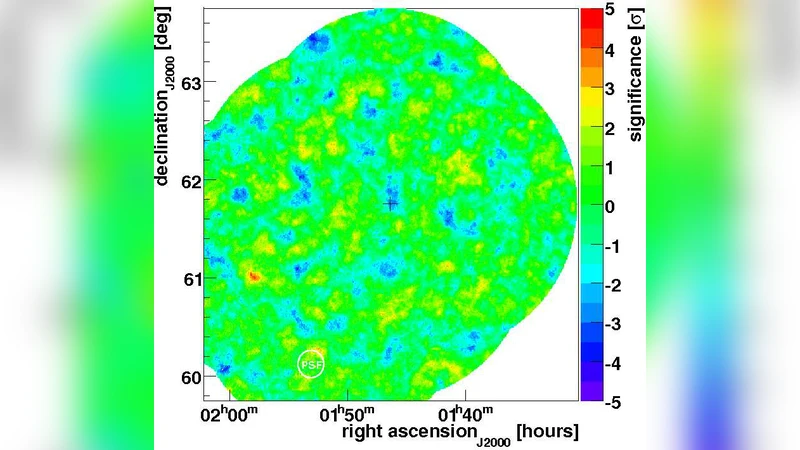
Data reduction followed the standard VERITAS pipeline. After calibration, image cleaning, and Hillas‑parameter extraction, gamma‑ray–like events were separated from the dominant cosmic‑ray background using multivariate cuts optimized for a soft spectrum (spectral index ≈ 3). The signal region was defined by a θ² cut of 0.015 deg², and background was estimated using the reflected‑region method. Significance was calculated with the Li & Ma (1983) formula. No excess above the background was found for either source. The resulting statistical significances were +0.8σ for 4U 0142+61 and +1.1σ for 1E 2259+586, well below the 5σ discovery threshold.
Upper limits on the integral flux above 200 GeV were derived at the 99 % confidence level using the Rolke method, assuming a power‑law spectrum with index –3.0. For 4U 0142+61 the limit is 1.2 × 10⁻¹³ photons cm⁻² s⁻¹, corresponding to ≈ 0.5 % of the Crab Nebula flux. For 1E 2259+586 the limit is 1.5 × 10⁻¹³ photons cm⁻² s⁻¹ (≈ 0.6 % Crab). These constraints are the first VHE limits placed on these two magnetars.
The discussion interprets the non‑detections in several ways. First, the particle acceleration in magnetar magnetospheres may be efficient only up to tens of GeV, with a steep cutoff that prevents significant TeV emission. This is consistent with the observed hard X‑ray tails that typically roll over around 200–300 keV. Second, the intense magnetic fields can cause rapid attenuation of any TeV photons via magnetic pair creation or γ‑γ absorption on the abundant X‑ray photon field, effectively “self‑shielding” the source. Third, the observations were carried out during quiescent periods; transient VHE emission associated with bursts or giant flares could be missed if it occurs on timescales shorter than the nightly exposure. Finally, the sensitivity of VERITAS, while excellent for many Galactic sources, may still be insufficient to detect the faint, possibly steady VHE component expected from magnetars.
The authors conclude that their results place meaningful constraints on magnetar emission models, ruling out steady VHE fluxes above a few × 10⁻¹³ photons cm⁻² s⁻¹. They advocate for future observations with the Cherenkov Telescope Array (CTA), which will deliver an order‑of‑magnitude improvement in sensitivity and a lower energy threshold (~20 GeV). CTA’s capability to perform rapid follow‑up of magnetar bursts could finally test whether transient VHE flares occur. Additionally, coordinated multi‑wavelength campaigns—including X‑ray, soft‑gamma, and radio monitoring—will be essential to capture any correlated high‑energy activity. The paper thus establishes a baseline for VHE studies of magnetars and outlines a roadmap for the next generation of ground‑based gamma‑ray astronomy.
Comments & Academic Discussion
Loading comments...
Leave a Comment