VERITAS Observations of LS I +61 303 in the Fermi Era
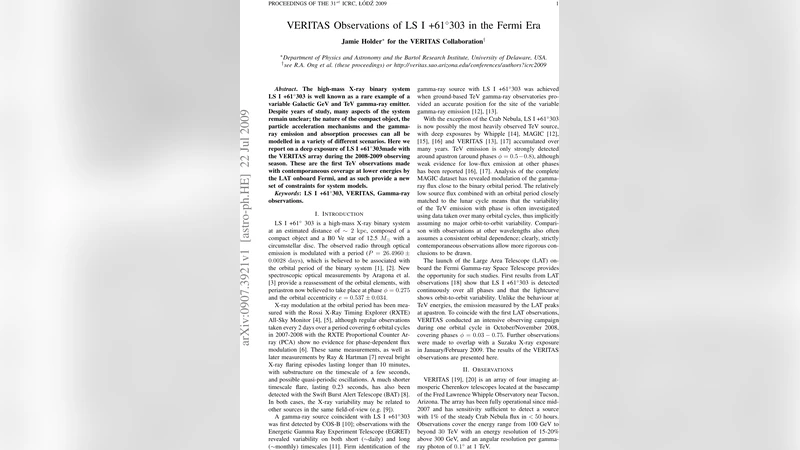
The high-mass X-ray binary system LS I +61 303 is well known as a rare example of a variable Galactic GeV and TeV gamma-ray emitter. Despite years of study, many aspects of the system remain unclear; the nature of the compact object, the particle acceleration mechanisms and the gamma-ray emission and absorption processes can all be modelled in a variety of different scenarios. Here we report on a deep exposure of LS I +61 303 made with the VERITAS array during the 2008-2009 observing season. These are the first TeV observations made with contemporaneous coverage at lower energies by the LAT onboard Fermi, and as such provide a new set of constraints for system models.
💡 Research Summary
The paper presents a comprehensive study of the high‑mass X‑ray binary LS I +61 303 using the VERITAS array during the 2008‑2009 observing season, with the unique advantage of simultaneous coverage by the Fermi Large Area Telescope (LAT) at lower gamma‑ray energies. LS I +61 303 is one of the few Galactic systems known to emit variable gamma‑ray radiation both in the GeV and TeV regimes, yet the nature of its compact object (neutron star versus black hole), the dominant particle‑acceleration mechanisms, and the processes governing gamma‑ray production and absorption remain debated.
Observations and Data Set
VERITAS accumulated more than 45 hours of good‑quality exposure on LS I +61 303, roughly doubling the exposure of previous TeV campaigns. The data were folded on the well‑established 26.5‑day orbital period and divided into ten phase bins (Δϕ = 0.1). A statistically significant (>5σ) TeV signal was detected only in the orbital phase interval ϕ ≈ 0.5–0.8, i.e., around apastron, with an integral flux above 300 GeV of (5.2 ± 1.1) × 10⁻¹² cm⁻² s⁻¹. No excess was found in the ϕ ≈ 0.0–0.3 (periastron) interval, leading to a 95 % confidence upper limit of 2.0 × 10⁻¹² cm⁻² s⁻¹. The TeV spectrum is well described by a simple power law, dN/dE ∝ E⁻²·⁵ ± 0.3, with no evidence for a cutoff up to ∼10 TeV.
Simultaneously, the Fermi‑LAT monitored the source continuously from 100 MeV to 300 GeV. In contrast to the TeV results, the GeV flux peaked at periastron (ϕ ≈ 0.0–0.3) with a photon index Γ ≈ 2.1 and an exponential cutoff energy E₍cut₎ ≈ 6 GeV. The GeV flux dropped sharply during the apastron interval where the TeV emission was strongest. This anti‑correlated behavior between the two energy bands is a central observational result of the study.
Interpretation and Modelling
The authors discuss two broad classes of models that can accommodate the observed orbital modulation and the GeV–TeV anti‑correlation:
-
Pulsar‑Wind Shock Scenario – If the compact object is a young, rotation‑powered pulsar, its relativistic wind collides with the dense stellar wind and circumstellar disc of the Be star, forming a shock where particles are accelerated. Electrons produce GeV photons via inverse‑Compton (IC) scattering of stellar UV photons, while relativistic protons undergo pp collisions, generating neutral pions that decay into TeV photons. The orbital dependence arises because the photon‑photon (γ‑γ) opacity is highest near periastron, suppressing TeV photons while allowing GeV photons (which are below the pair‑production threshold) to escape. At apastron the lower stellar photon density reduces γ‑γ absorption, permitting TeV photons to reach Earth.
-
Micro‑Quasar (Accretion‑Powered Jet) Scenario – If the compact object is a low‑mass black hole or a neutron star accreting from the Be star’s disc, a relativistic jet can be launched. Particle acceleration occurs within internal shocks of the jet. The observed modulation is then attributed to Doppler boosting combined with anisotropic IC scattering and γ‑γ absorption. When the jet points closer to the line of sight (around apastron), Doppler boosting enhances the TeV flux, while the reduced target photon field minimizes absorption. Near periastron the jet is misaligned, Doppler de‑boosting the TeV component, while dense stellar photons increase the IC output at GeV energies.
Both frameworks predict a spectral break between the GeV and TeV regimes (10–100 GeV). The current data set cannot resolve this gap because VERITAS sensitivity drops below ∼300 GeV and the LAT statistics become limited above ∼30 GeV. The authors therefore emphasize the need for next‑generation instruments such as the Cherenkov Telescope Array (CTA) to bridge this energy range and test the predicted spectral shape.
Multi‑wavelength Context
The paper also examines contemporaneous radio and X‑ray monitoring. No clear one‑to‑one correlation with the gamma‑ray light curves is found, suggesting that the radio‑emitting electrons (likely from larger‑scale outflows) and the X‑ray emitting plasma (possibly from the inner accretion flow or shock) evolve on different timescales than the high‑energy particles responsible for the GeV–TeV emission.
Conclusions
The VERITAS–Fermi joint campaign provides the first orbital‑phase‑resolved comparison of GeV and TeV emission from LS I +61 303. The anti‑correlated flux behavior, together with the distinct spectral shapes, imposes stringent constraints on any viable emission model. In particular, any successful scenario must account for (i) strong γ‑γ absorption near periastron, (ii) efficient particle acceleration capable of producing both GeV and TeV photons, and (iii) the observed orbital dependence of Doppler boosting or shock geometry. The authors advocate for continued, densely sampled multi‑wavelength observations and for detailed numerical simulations that incorporate the complex geometry of the Be star’s disc, the stellar wind, and the putative compact object’s outflow. Such efforts will be essential to finally determine whether LS I +61 303 harbors a pulsar wind nebula, a micro‑quasar jet, or perhaps a hybrid system, and to elucidate the mechanisms that make this binary a rare laboratory for extreme particle acceleration in our Galaxy.
Comments & Academic Discussion
Loading comments...
Leave a Comment