Observation of shadowing of the cosmic electrons and positrons by the Moon with IACT
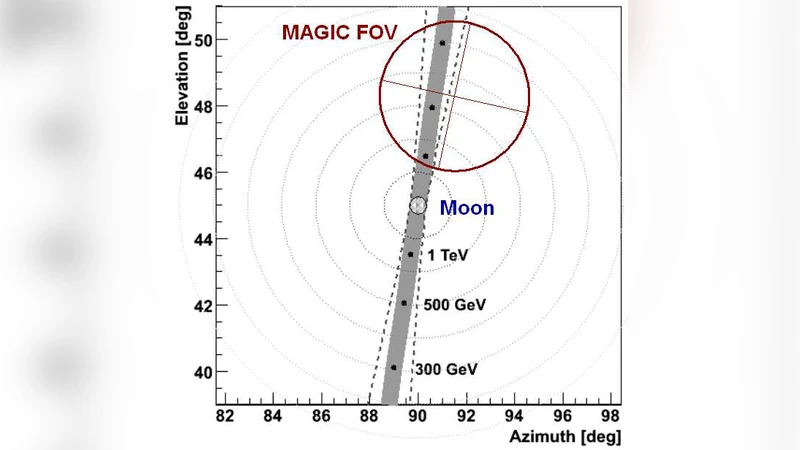
Recent measurements of the cosmic-ray electron (e-) and positron (e+) fluxes show apparent excesses compared to the spectra expected by standard cosmic-ray (CR) propagation models in our galaxy. These excesses may be related to particle acceleration in local astrophysical objects, or to dark matter annihilation/decay. The e+/e- ratio (measured up to ~100 GeV) increases unexpectedly above 10 GeV and this may be connected to the excess measured in all-electron flux at 300-800 GeV. Measurement of this ratio at higher energies is a key parameter to understand the origin of these spectral anomalies. Imaging Atmospheric Cherenkov Telescopes (IACT) detect electromagnetic air showers above 100 GeV, but, with this technique, the discrimination between primary e-, e+ and diffuse gamma-rays is almost impossible. However, the Moon and the geomagnetic field provide an incredible opportunity to separate these 3 components. Indeed, the Moon produces a 0.5deg-diameter hole in the isotropic CR flux, which is shifted by the Earth magnetosphere depending on the momentum and charge of the particles. Below few TeV, the e+ and e- shadows are shifted at >0.5deg each side of the Moon and the e+, e- and gamma-ray shadows are spatially separated. IACT can observe the e+ and e- shadows without direct moonlight in the field of view, but the scattered moonlight induces a very high background level. Operating at the highest altitude (2200m), with the largest telescopes (17m) of the current IACT, MAGIC is the best candidate to reach a low energy threshold in these peculiar conditions. Here we discuss the feasibility of such observations.
💡 Research Summary
Recent measurements by PAMELA, AMS‑02, Fermi‑LAT, DAMPE and CALET have revealed an unexpected rise in the positron‑to‑electron ratio above ~10 GeV and a hardening of the all‑electron spectrum between 300 GeV and 800 GeV. These features may be signatures of nearby astrophysical accelerators (such as pulsar wind nebulae or supernova remnants) or of dark‑matter annihilation/decay. Discriminating between these scenarios requires a precise measurement of the e⁺/e⁻ ratio at energies well beyond 100 GeV, a regime where space‑borne detectors suffer from limited acceptance and ground‑based instruments traditionally lack charge discrimination.
The paper proposes to exploit the Moon’s “shadow” in the isotropic cosmic‑ray flux together with the Earth’s geomagnetic field to separate electrons, positrons and diffuse gamma rays using Imaging Atmospheric Cherenkov Telescopes (IACT). The Moon blocks a circular region of ~0.5° diameter. Charged particles traversing the geomagnetic field are deflected by an angle θ ≈ (Z · B · L)/(p c), where Z is the charge sign, B the average magnetic field, L the effective path length, and p the particle momentum. For electrons and positrons below a few TeV this deflection exceeds 0.5°, shifting the electron shadow to one side of the Moon and the positron shadow to the opposite side, while the neutral gamma‑ray shadow remains centered. Consequently, the three shadows become spatially separated, allowing an IACT to identify the charge of the primary particle without any intrinsic charge‑sensitive detector.
MAGIC, located at 2200 m altitude and equipped with two 17‑m mirrors, is identified as the most suitable existing IACT. Its large collection area and low energy threshold (~50 GeV in dark conditions) make it capable of detecting the relatively faint electron and positron showers. Observations must be performed when the Moon is less than ~30 % illuminated to avoid direct moonlight in the camera. By pointing the telescopes slightly offset (≈0.7°–1.0°) from the Moon’s centre, the direct bright limb is excluded while the shadow region remains within the field of view. Scattered moonlight raises the night‑sky background by a factor of 5–10, but advanced image‑parameter cuts (Width, Length) and sub‑nanosecond timing filters can suppress this background to a level that still permits a 3σ detection of the shadow depth (3–5 % deficit).
Monte‑Carlo simulations using CORSIKA and the MAGIC sim_telarray chain model the air‑shower development for electrons, positrons and gamma rays, the telescope optics, and the camera response. The geomagnetic field is represented by the IGRF‑12 model, and the Moon’s ephemeris is incorporated to compute the expected shadow displacement as a function of energy. The simulations predict that at 300 GeV–1 TeV the electron and positron shadows are displaced by 0.6°–1.2° to opposite sides of the Moon, providing a clear spatial separation. To achieve a statistically significant measurement of each charge component, an effective exposure of roughly 100 hours per component is required. Given the limited observing windows imposed by moon phase, weather, and the need to avoid bright moonlight, this corresponds to a multi‑year campaign (2–3 years) with realistic scheduling.
Systematic uncertainties arise mainly from the geomagnetic model (≈5 % on deflection), the precise lunar position (≈0.01°), and variations in the scattered moonlight background (≈10 %). These translate into an overall positional uncertainty of ~0.05°, well below the ~0.5° separation between the electron and positron shadows, and therefore do not compromise charge discrimination.
The authors conclude that the Moon‑shadow technique, combined with the high‑altitude, large‑mirror MAGIC array, offers a viable path to measure the e⁺/e⁻ ratio above 100 GeV from the ground. A successful detection would provide a critical data point for distinguishing between dark‑matter‑related and astrophysical explanations of the observed spectral anomalies. Moreover, the method can be extended to next‑generation IACT facilities such as the Cherenkov Telescope Array (CTA), potentially reaching the TeV regime and delivering unprecedented charge‑resolved measurements of cosmic‑ray electrons and positrons.
Comments & Academic Discussion
Loading comments...
Leave a Comment