The readout system of the MAGIC-II Cherenkov Telescope
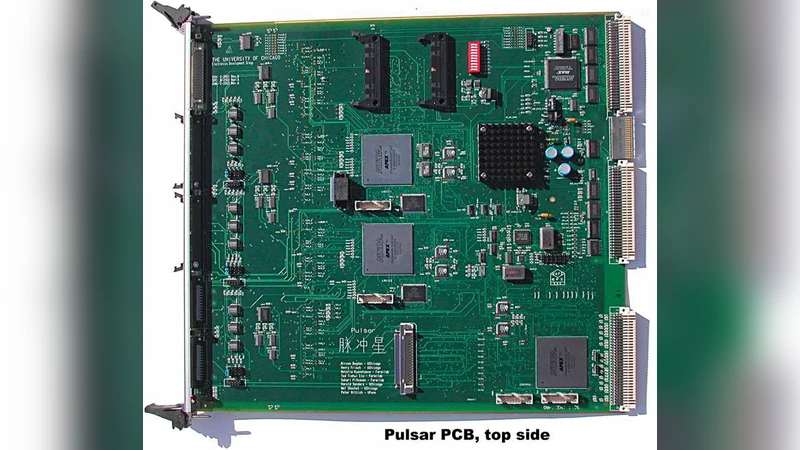
In this contribution we describe the hardware, firmware and software components of the readout system of the MAGIC-II Cherenkov telescope on the Canary island La Palma. The PMT analog signals are transmitted by means of optical fibers from the MAGIC-II camera to the 80 m away counting house where they are routed to the new high bandwidth and fully programmable receiver boards (MONSTER), which convert back the signals from optical to electrical ones. Then the signals are split, one half provide the input signals for the level ONE trigger system while the other half is sent to the digitizing units. The fast Cherenkov pulses are sampled by low-power Domino Ring Sampler chips (DRS2) and temporarily stored in an array of 1024 capacitors. Signals are sampled at the ultra-fast speed of 2 GSample/s, which allows a very precise measurement of the signal arrival times in all pixels. They are then digitized with 12-bit resolution by an external ADC readout at 40 MHz speed. The Domino samplers are integrated in the newly designed mezzanines which equip a set of fourteen multi-purpose PULSAR boards. Finally, the data are sent through an S-LINK optical interface to a single computer. The entire DAQ hardware is controlled through a VME interface and steered by the slow control software program (MIR). The Data AcQuisition software program (DAQ) proceeds finally to the event building and data storage.
💡 Research Summary
The paper presents a comprehensive description of the readout chain employed by the MAGIC‑II imaging atmospheric Cherenkov telescope, detailing hardware, firmware, and software components that together enable the capture and processing of ultra‑fast Cherenkov light signals. Photomultiplier tubes (PMTs) in the camera generate analog pulses that are transmitted via 80 m of optical fiber to the counting house, where MONSTER receiver boards perform high‑bandwidth optical‑to‑electrical conversion. The recovered electrical signals are split: one branch feeds the Level‑1 trigger, while the other is directed to the digitization path.
Digitization relies on the Domino Ring Sampler version 2 (DRS2) ASIC, which samples each channel at 2 GS/s into an array of 1024 capacitors, preserving the fine time structure of the Cherenkov waveforms. After sampling, the stored charge is read out by an external 12‑bit ADC operating at 40 MHz, and each cell’s non‑linearity and temperature dependence are corrected using calibration tables. The DRS2 chips are mounted on custom mezzanine cards that plug into fourteen multi‑purpose PULSAR carrier boards; each PULSAR hosts up to four mezzanines, providing coverage for all 1039 camera pixels. A dedicated clock distribution network and FPGA‑based timing logic keep inter‑board jitter below 1 ns.
Digitized data are streamed via an S‑LINK optical link to a single acquisition computer at >1 Gbps, ensuring loss‑free transfer of roughly 30 kB per event. System control is implemented through a VME bus and the MIR (MAGIC Interface for Readout) software, which offers a graphical interface for configuring board parameters, trigger thresholds, and environmental monitoring. The DAQ (Data Acquisition) software completes the chain by performing event building, format conversion (e.g., FITS or ROOT), real‑time quality monitoring, and storage, while also providing redundancy through backup streams.
Overall, the readout architecture delivers high bandwidth (>2 GHz), low power consumption (each mezzanine <2 W), and modular scalability, enabling precise timing measurements (tens of picoseconds) across the full camera. These capabilities are essential for MAGIC‑II’s scientific goals in very‑high‑energy gamma‑ray astronomy and constitute a robust template for future Cherenkov facilities such as the Cherenkov Telescope Array.
Comments & Academic Discussion
Loading comments...
Leave a Comment