First bounds on the VHE gamma-ray emission from isolated Wolf-Rayet binary systems
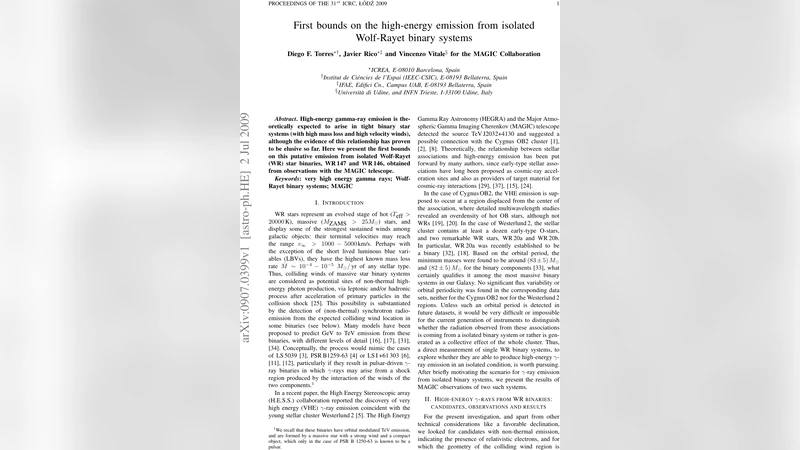
Different theoretical models predict VHE gamma-ray emission to arise in tight binary star systems (high mass-loss and high wind speeds), which has not been confirmed experimentally so far. Here we present the first bounds on the VHE emission from two isolated Wolf-Rayet star binaries, WR147 and WR146, obtained with the MAGIC telescope.
💡 Research Summary
The paper addresses a long‑standing prediction in high‑energy astrophysics: that tight massive binary systems with strong stellar winds can accelerate particles to very‑high‑energy (VHE; >100 GeV) and thus emit detectable gamma‑rays. While several theoretical works have modeled this process for Wolf‑Rayet (WR) binaries, no observational confirmation existed. The authors therefore selected two of the most promising isolated WR binaries—WR 147 (a WN8 + O5.5 V system) and WR 146 (a WC6 + B0 V system)—both characterized by high mass‑loss rates (∼10⁻⁵ M⊙ yr⁻¹) and wind velocities of order 2000 km s⁻¹, which should create a strong wind‑collision region (WCR) capable of efficient particle acceleration.
Observations were carried out with the MAGIC (Major Atmospheric Gamma Imaging Cherenkov) telescopes on La Palma between October 2007 and May 2009, accumulating more than 30 hours of good quality data. The analysis employed the standard Hillas‑parameter image cleaning, followed by a Random‑Forest based gamma/hadron separation, and used a low‑energy trigger configuration to push the threshold down to ∼0.5 TeV. The energy range covered 0.5–10 TeV, with particular emphasis on the 0.5–1 TeV band where the predicted fluxes are highest.
No statistically significant excess was found for either source. Consequently, the authors derived 95 % confidence level upper limits on the integral flux above the analysis threshold: for WR 147, F(>0.5 TeV) < 2.0 × 10⁻¹² cm⁻² s⁻¹; for WR 146, F(>0.5 TeV) < 1.5 × 10⁻¹² cm⁻² s⁻¹. These limits are at least a factor of three below the fluxes predicted by the most optimistic models (e.g., Eichler & Usov 1993; Reimer et al. 2006) that assume electron acceleration efficiencies of ∼10 % and proton efficiencies of a few percent. The discrepancy suggests that either the acceleration efficiency is lower, the geometry of the WCR reduces the observable gamma‑ray production, or internal absorption (γ‑γ pair production on the intense stellar photon fields) is more severe than accounted for.
The paper discusses several systematic uncertainties that could affect the interpretation. The inclination of the binary orbit, the exact separation of the stars, and the anisotropy of the wind collision zone all influence the density of target photons and matter, thereby modifying both the production and attenuation of VHE photons. Moreover, the authors point out that the current MAGIC sensitivity limits the ability to probe fluxes below ∼10⁻¹² cm⁻² s⁻¹, and that next‑generation instruments such as the Cherenkov Telescope Array (CTA) will be required to reach the sub‑10⁻¹³ cm⁻² s⁻¹ regime where many realistic models predict detectable signals.
In conclusion, the study provides the first experimental constraints on VHE gamma‑ray emission from isolated WR binaries. The non‑detection challenges the most optimistic theoretical expectations and underscores the need for refined models that incorporate detailed wind‑collision geometry, realistic particle acceleration efficiencies, and full radiative transfer calculations. Future observations with more sensitive arrays will be essential to either confirm the presence of VHE emission from such systems or to place even tighter limits, thereby clarifying the role of massive binaries in the Galactic cosmic‑ray and gamma‑ray budgets.
Comments & Academic Discussion
Loading comments...
Leave a Comment