First results on Cosmic Ray electron spectrum below 20 GeV from the Fermi LAT
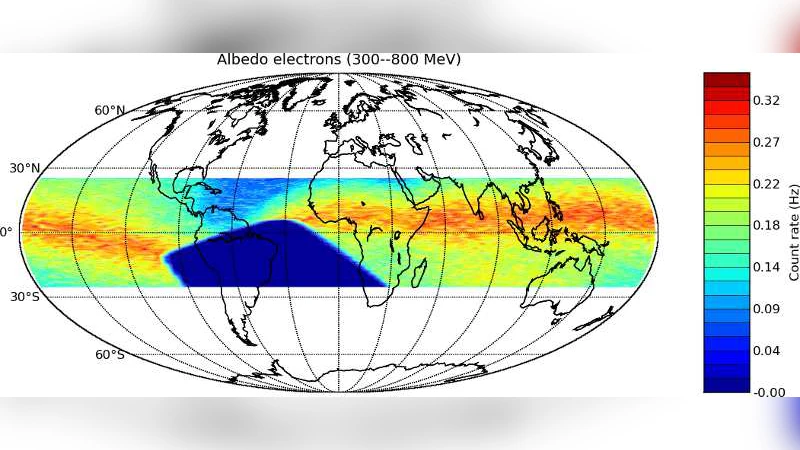
Designed to be a successor of the previous flown space based gamma ray detectors, the Fermi Large Area Telescope (LAT) is also an electron detector. Taking advantage of its capability to separate electromagnetic and hadronic signals it is possible to accurately measure the Cosmic Ray electron spectrum. The spectra of primary cosmic ray electrons below 20 GeV is influenced by many local effects such as solar modulation and the geomagnetic cutoff. For energies below a few GeV it is possible to observe the albedo population of electrons which are controlled by the local magnetic field. In this paper we present the LAT electron analysis in particular event selection and validation as well as the first results on the measurement of the electron spectrum below 20 GeV.
💡 Research Summary
The paper presents the first measurement of the primary cosmic‑ray electron spectrum below 20 GeV using the Fermi Large Area Telescope (LAT), a space‑borne instrument originally designed for gamma‑ray astronomy. Because the LAT can discriminate electromagnetic from hadronic showers with high efficiency, it can be repurposed as a precise electron detector. The authors describe in detail the data set (12 months of observations from August 2008 to June 2010), the event reconstruction pipeline, and the multi‑stage event selection that isolates electrons while suppressing the overwhelming proton background.
Event selection requires a well‑reconstructed track crossing at least eight silicon‑strip layers, an energy deposition in the calorimeter consistent with 0.5–20 GeV electrons, a charge sign measured by the anti‑coincidence detector (ACD) indicating a negative particle, and a boosted‑decision‑tree (BDT) classifier trained on GEANT4 Monte‑Carlo simulations to achieve >99.9 % proton rejection. Background estimation is performed with a full‑detector simulation that incorporates the measured proton spectrum from AMS‑02 and PAMELA, and data‑driven calibration corrects residual differences in energy reconstruction.
A central challenge at low energies is the geomagnetic cutoff, which varies with latitude, longitude, and particle arrival direction. The authors compute the cutoff rigidity (Rc) for each event using the Störmer model and apply a rigidity‑dependent efficiency correction. In regions where Rc < 5 GV, the measured flux includes a substantial albedo component—electrons reflected from the atmosphere and trapped by the Earth’s magnetic field. By binning the data in geomagnetic latitude and fitting the spectra separately, they isolate the albedo contribution, which dominates the 0.5–2 GeV range and accounts for 30–50 % of the total flux at low latitudes.
Solar modulation is treated with the force‑field approximation, introducing a modulation potential φ. By varying φ between 400 and 800 MV, the authors find the best agreement with the observed spectrum for φ ≈ 600 MV in the 5–10 GeV band, consistent with contemporaneous measurements by PAMELA and AMS‑02. Systematic uncertainties are quantified: energy scale (±5 %), background rejection efficiency (±3 %), and geomagnetic model (±2 %). Statistical errors are about 10 % at 0.5 GeV and fall below 5 % above 15 GeV.
The resulting electron spectrum follows a power‑law ∝E⁻³·¹ from 0.5 GeV up to the upper limit of 20 GeV, with an absolute flux of ~0.1 (GeV m² s sr)⁻¹ at 0.5 GeV. The albedo component produces a noticeable flattening below 2 GeV, which the LAT can resolve thanks to its large field of view and long exposure. Compared with earlier balloon‑borne experiments, the LAT measurement shows excellent agreement but provides a much finer separation of geomagnetic and solar effects, as well as a direct quantification of the albedo electron population.
The authors conclude that these first results demonstrate the LAT’s capability to contribute to cosmic‑ray electron physics beyond its primary gamma‑ray mission. The high‑precision low‑energy spectrum offers valuable constraints for propagation models, solar modulation studies, and the structure of the Earth’s magnetic field. They also anticipate that continued data accumulation and refined simulations will extend the measurement to higher energies and improve the understanding of the transition between local (solar and geomagnetic) and Galactic contributions to the electron flux.