ANTARES neutrino telescope: status, first results and sensitivity for the diffuse neutrino flux
ANTARES is a neutrino telescope under the Mediterranean Sea, in a site 40 km off the French coast at a depth of 2475 m. It is an array of 12 lines equipped with 884 photomultipliers. The detection mechanism relies on the observation of the Cherenkov light emitted by charged leptons produced by neutrinos interacting in the water and ground surrounding the detector. First studies of the detector performances and preliminary results on reconstruction of atmospheric muons and neutrinos are presented, with the expected sensitivity for a diffuse flux of high energy neutrinos.
💡 Research Summary
The paper presents a comprehensive overview of the ANTARES (Astronomy with a Neutrino Telescope and Abyss environmental RESearch) neutrino telescope, detailing its current status, first physics results, and projected sensitivity to a diffuse flux of high‑energy astrophysical neutrinos. ANTARES is deployed 40 km off the French coast in the Mediterranean Sea at a depth of 2 475 m. The detector consists of twelve vertical lines, each holding 25 storeys equipped with three 10‑inch photomultiplier tubes (PMTs), for a total of 884 optical modules. The lines are spaced roughly 60 m apart, covering an instrumented volume of about 0.1 km².
The detection principle relies on the observation of Cherenkov photons emitted by charged leptons—primarily muons—produced when neutrinos interact with water or the surrounding rock. The PMTs record the arrival time (with sub‑10 ns precision) and amplitude of the light, allowing a three‑dimensional reconstruction of the lepton trajectory. A sophisticated calibration system, using LED flashers and radioactive sources, continuously monitors PMT timing offsets, gain variations, and the optical properties of the seawater (absorption and scattering lengths). Background light from bioluminescence and ⁴⁰K decay is actively filtered in real time.
Reconstruction is performed with a two‑stage algorithm: an initial global fit provides a rough track hypothesis, which is then refined using a maximum‑likelihood method that incorporates the detailed time‑of‑flight expectations for each hit. A Bayesian filter further optimizes the parameters and suppresses mis‑reconstructed atmospheric muon tracks. The resulting angular resolution for muon tracks is 0.3°–0.5°, and the energy resolution for high‑energy events (E > 10 TeV) is about 0.2 dex in log₁₀(E).
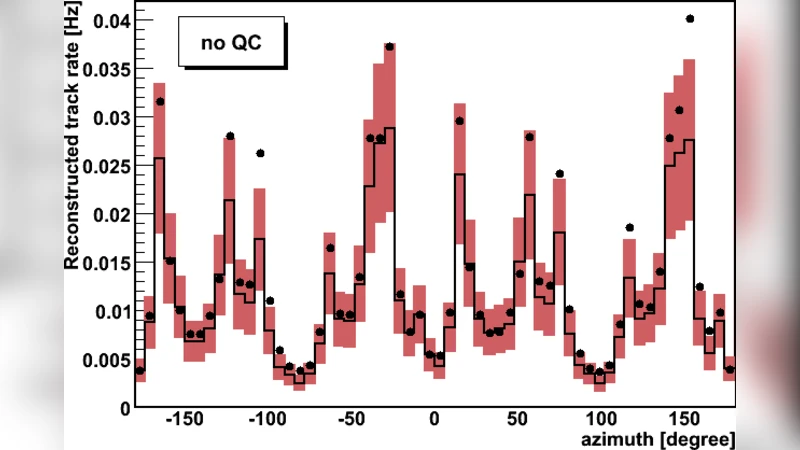
During the first year of stable operation (≈200 days of livetime), ANTARES recorded several thousand atmospheric muon tracks and a few hundred upward‑going muon events consistent with atmospheric neutrinos. The measured atmospheric muon flux matches predictions from HEMAS and CORSIKA simulations, confirming the detector’s efficiency and background‑rejection capabilities.
Sensitivity studies for a diffuse astrophysical neutrino flux assume an E⁻² spectrum. With three years of data, ANTARES can set an upper limit of E² Φ ≈ 1 × 10⁻⁸ GeV cm⁻² s⁻¹ sr⁻¹, comparable to the limits obtained by IceCube in the Southern Hemisphere but covering the complementary northern sky. The effective area for neutrinos above 100 TeV reaches ~0.1 km², and the detector is capable of detecting transient flux enhancements from sources such as active galactic nuclei or gamma‑ray bursts.
The authors conclude that ANTARES has successfully demonstrated deep‑sea neutrino detection, achieving the expected performance in timing, angular resolution, and background suppression. Ongoing efforts focus on further reducing electronic noise, improving water‑optics modeling, and integrating additional lines to increase the instrumented volume. The experience gained is directly feeding into the design of the next‑generation KM3NeT telescope, which will provide a cubic‑kilometer scale detector in the Mediterranean and enable a full-sky neutrino astronomy program.
Comments & Academic Discussion
Loading comments...
Leave a Comment