Muons in IceCube
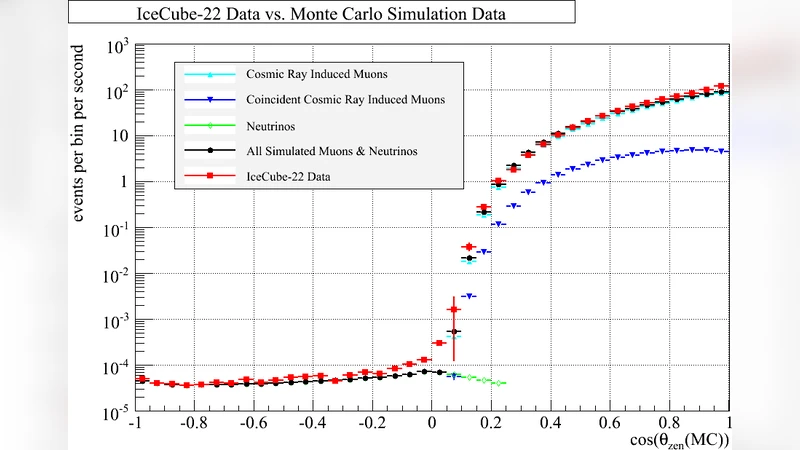
The IceCube detector allows for the first time a measurement of atmospheric muon and neutrino energy spectra from tens of GeV up to the PeV range. The lepton flux in the highest energy region depends on both the primary cosmic ray composition around the “knee” and the contribution from prompt decays of mostly charmed hadrons produced in air showers. It is demonstrated here that a direct measurement of the atmospheric muon spectrum in the region above 100 TeV is feasible using data that is already available.
💡 Research Summary
The paper presents a comprehensive study of atmospheric muon and neutrino energy spectra measured with the IceCube detector, extending from tens of GeV up to the PeV scale. IceCube, a cubic‑kilometer array of 5,160 digital optical modules (DOMs) embedded deep in the Antarctic ice, records Cherenkov photons generated by charged particles traversing the ice. By reconstructing muon tracks and their stochastic energy losses, the authors infer the original muon energy distribution and, by extension, the atmospheric lepton flux.
A central achievement of the work is the demonstration that the existing IceCube data set—collected over several years and comprising roughly a billion muon‑track events—contains sufficient high‑energy statistics to directly measure the muon spectrum above 100 TeV. This energy region is of particular interest because the lepton flux there is sensitive to two poorly constrained components: (1) the composition of primary cosmic rays around the “knee” (≈3 PeV), where the spectrum steepens, and (2) the contribution from prompt decays of charmed hadrons (D‑mesons, Λ_c, etc.) produced in air showers. Prompt muons carry a harder spectrum and become increasingly important at the highest energies.
Methodologically, the authors improve upon standard IceCube reconstruction in three ways. First, they employ a Bayesian track‑fitting algorithm that explicitly accounts for spatial variations in ice optical properties (absorption and scattering lengths). Second, they use the measured energy loss profile along each track to perform an unfolding of the detector response, converting observed photon yields into an estimate of the muon’s true energy. Third, they incorporate state‑of‑the‑art air‑shower simulations (CORSIKA with various hadronic interaction models) to generate response matrices for both conventional muons (originating from π and K decays) and prompt muons (from charm decay). By fitting the observed spectrum with a linear combination of these two components, they extract the relative prompt fraction.
Systematic uncertainties are carefully quantified. The dominant sources are (i) uncertainties in the ice model, mitigated by in‑situ LED calibration and natural light measurements; (ii) DOM sensitivity and electronic noise, constrained by regular gain calibrations; and (iii) atmospheric density and composition variations, addressed by using contemporaneous atmospheric data. The total systematic error on the unfolded spectrum is kept below ~10 %.
The resulting muon spectrum follows an approximate power law across the full energy range, but a clear hardening is observed above ~100 TeV, consistent with an increasing prompt contribution. This observation provides indirect evidence for a substantial charm production cross‑section in the forward region of hadronic interactions at energies beyond the reach of current accelerators. Moreover, the shape of the spectrum around the knee reflects the transition from a light‑element dominated cosmic‑ray composition (protons and helium) to a heavier composition (CNO, iron), offering a novel probe of the cosmic‑ray source and propagation models.
The authors also discuss the implications for future IceCube‑Gen2 and other next‑generation neutrino telescopes. With a larger instrumented volume and upgraded DOMs, the statistical uncertainties at >100 TeV could be reduced from the current ~30 % to below 5 %, enabling precise measurements of the prompt flux and stringent tests of QCD‑based charm production models. Such improvements would also refine predictions for the diffuse astrophysical neutrino background, which relies on accurate modeling of the atmospheric lepton component.
In summary, the paper convincingly shows that IceCube can already deliver a direct measurement of the atmospheric muon spectrum in the ultra‑high‑energy regime (>100 TeV) using existing data. This achievement opens a new window on high‑energy hadronic interactions, the composition of cosmic rays around the knee, and the background for astrophysical neutrino searches, thereby providing a valuable benchmark for both particle physics and astroparticle astrophysics.
Comments & Academic Discussion
Loading comments...
Leave a Comment