The hunt for cosmic neutrino sources with IceCube
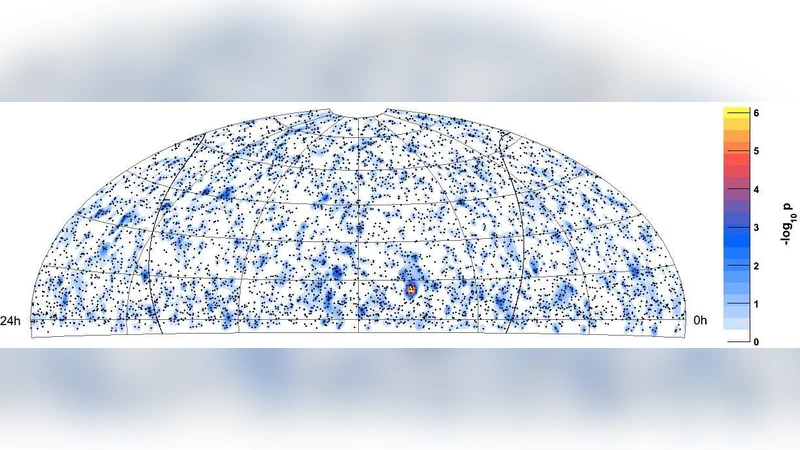
IceCube is a cubic-kilometer neutrino telescope under construction at the geographic South Pole. Once completed it will comprise 4800 optical sensors deployed on 80 vertical strings at depths in the ice between 1450 and 2450 meters. Part of the array is already operational and data was recorded in the configurations with 9 (year 2006/2007), 22 (year 2007/2008) and 40-strings (year 2008/2009) respectively. Here we report preliminary results on the search for point-like neutrino sources using data collected with the first 22 strings (IC-22).
💡 Research Summary
**
The paper reports on the first systematic search for point‑like astrophysical neutrino sources using data from the partially built IceCube detector, specifically the 22‑string configuration (IC‑22) that operated during the 2007‑2008 Antarctic winter season. IceCube is a cubic‑kilometre neutrino observatory located at the geographic South Pole, designed to detect Cherenkov light emitted by secondary muons produced when high‑energy muon neutrinos (νμ) interact in the deep Antarctic ice. Although the full detector will eventually comprise 80 strings with 4800 optical modules (OMs), the analysis presented here is based on 1320 OMs distributed over 22 vertical strings, covering a live time of roughly 275 days.
Instrument and Data Set
Each string holds 60 OMs spaced 17 m apart, deployed between 1450 m and 2450 m depth. The trigger requires a coincidence of at least eight OMs within a 5 µs window, after which the event is recorded with the timing and charge (photo‑electron) information from each hit OM. The reconstruction algorithm provides a best‑fit muon direction (zenith and azimuth) and an energy proxy derived from the total recorded charge. Calibration of the ice optical properties (scattering and absorption lengths) and OM sensitivities is performed continuously, yielding a detector uptime above 99 %.
Analysis Strategy
The search for point sources relies on two distinguishing features of astrophysical νμ relative to the overwhelming background of atmospheric muons and neutrinos: (1) directionality – astrophysical νμ arriving from the Northern Hemisphere must traverse the Earth, which suppresses the atmospheric muon background; (2) spectral hardness – many source models predict a power‑law spectrum ∝ E⁻², considerably harder than the steeply falling atmospheric neutrino spectrum (∝ E⁻³.⁷). To exploit both, the authors employ an unbinned maximum‑likelihood method that combines spatial and energy information for each event.
For a given sky location (α, δ), the likelihood is defined as
L(n_s) = ∏_{i=1}^{N}
Comments & Academic Discussion
Loading comments...
Leave a Comment