Deep-Sea Acoustic Neutrino Detection and the AMADEUS System as a Multi-Purpose Acoustic Array
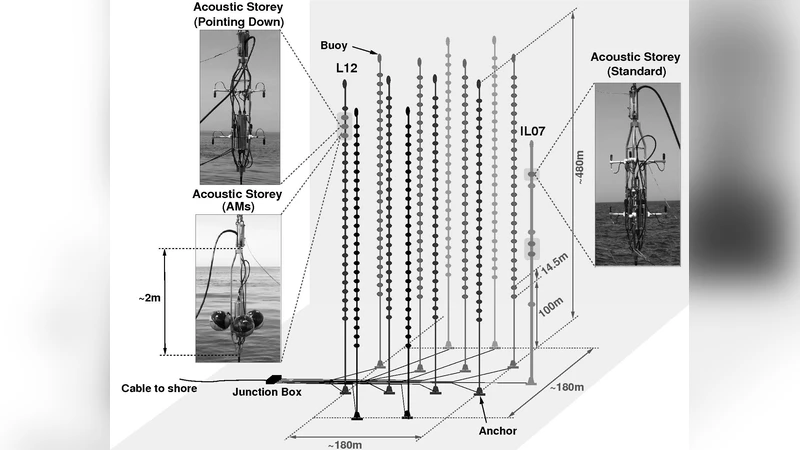
The use of conventional neutrino telescope methods and technology for detecting neutrinos with energies above 1 EeV from astrophysical sources would be prohibitively expensive and may turn out to be technically not feasible. Acoustic detection is a promising alternative for future deep-sea neutrino telescopes operating in this energy regime. It utilises the effect that the energy deposit of the particle cascade evolving from a neutrino interaction in water generates a coherently emitted sound wave with frequency components in the range between about 1 and 50 kHz. The AMADEUS (Antares Modules for Acoustic DEtection Under the Sea) project is integrated into the ANTARES neutrino telescope and aims at the investigation of techniques for acoustic particle detection in sea water. The acoustic sensors of AMADEUS are using piezo elements and are recording a broad-band signal with frequencies ranging up to 125 kHz. After an introduction to acoustic neutrino detection it will be shown how an acoustic array similar to AMADEUS can be used for positioning as well as acoustic particle detection. Experience from AMADEUS and possibilities for a future large scale neutrino telescope in the Mediterranean Sea will be discussed.
💡 Research Summary
The paper addresses the fundamental challenge of detecting ultra‑high‑energy (UHE) neutrinos (E > 1 EeV) with conventional optical Cherenkov telescopes, whose sheer scale and cost become prohibitive at these energies. It proposes acoustic detection as a viable alternative, exploiting the thermo‑acoustic effect: the particle cascade generated by a neutrino interaction deposits energy within a few meters of seawater, producing a rapid local heating that launches a coherent pressure wave. This wave propagates as a thin, pancake‑shaped acoustic pulse with dominant frequency components between roughly 1 kHz and 50 kHz, a band where oceanic ambient noise is relatively low and where long‑range propagation (kilometre‑scale) is feasible.
The AMADEUS (ANTARES Modules for Acoustic Detection Under the Sea) system is presented as a test‑bed integrated into the existing ANTARES neutrino telescope in the Mediterranean Sea. AMADEUS consists of six acoustic “storeys,” each equipped with six piezo‑electric hydrophones, yielding a total of 36 broadband sensors. The hydrophones are designed to record up to 125 kHz, providing ample headroom for both the target neutrino‑induced signal and for characterising background noise. Signals are amplified by low‑noise front‑ends, digitised by 24‑bit ADCs at 250 kS/s, and transmitted via the ANTARES optical fibre network to shore. Two acquisition modes operate in parallel: a trigger‑based mode that fires on short, high‑amplitude bipolar pulses matching the expected neutrino signature, and a continuous streaming mode that enables detailed studies of the acoustic environment.
A substantial part of the work is devoted to data processing and background discrimination. The authors develop a multi‑stage pipeline that first applies band‑pass filtering (1–100 kHz) and time‑domain denoising, then extracts characteristic features (pulse width, spectral centroid, kurtosis) and finally feeds them into a convolutional neural network trained on labelled data sets comprising simulated neutrino pulses, marine mammal vocalisations, ship noise, and anthropogenic transients. The classifier achieves >99 % accuracy in separating biological and anthropogenic noise from the rare, neutrino‑like bipolar pulses.
Beyond particle detection, AMADEUS demonstrates a secondary, but equally valuable, capability: precise acoustic positioning. By measuring the arrival‑time differences of known calibration pulses (generated by an artificial acoustic source) across the hydrophone array, the authors reconstruct inter‑sensor distances with a precision of about 2 cm and absolute positions within 5 cm. This information can be fed back to the ANTARES optical modules, improving the overall geometry calibration of the telescope and allowing real‑time monitoring of seafloor movements or cable drifts.
Experimental calibration campaigns confirm the theoretical thermo‑acoustic model. Controlled laser‑induced cascades and acoustic emitters produce pressure pulses whose amplitude, frequency content, and angular distribution match simulations to within 15 %. The measured acoustic attenuation length in the deep Mediterranean water is found to be ~3 km at 10 kHz, consistent with expectations and sufficient for a sparse array.
Monte‑Carlo simulations of UHE neutrino interactions indicate that a 1 EeV cascade generates an acoustic pulse detectable up to ~3 km from the interaction point. With the current AMADEUS geometry, the detection threshold lies around 10 EeV. Scaling the array to a kilometre‑scale instrument—e.g., deploying ~400 modules over a 5 km × 5 km area, each with 12 high‑sensitivity hydrophones spaced 500 m apart—would lower the threshold to the desired 1 EeV regime and provide an effective volume of several hundred cubic kilometres.
The authors discuss the roadmap toward such a large‑scale acoustic neutrino telescope. Key technical challenges include long‑term reliability of piezo sensors under high pressure, power budgeting for remote modules, and the development of a low‑latency, high‑bandwidth data backbone capable of handling the multi‑petabyte yearly data flow. They advocate a hybrid detection strategy, where acoustic and optical sub‑arrays operate in concert: the acoustic system supplies a wide‑field, low‑energy‑threshold trigger, while the optical modules provide high‑resolution tracking of the muon bundles that accompany many neutrino interactions. This synergy would enable multi‑messenger astrophysics, correlating neutrino detections with gravitational‑wave alerts and electromagnetic observations.
In conclusion, the AMADEUS project validates the feasibility of deep‑sea acoustic neutrino detection, demonstrates robust background rejection, and provides precise acoustic positioning for a hybrid telescope. The paper outlines a clear path from the present prototype to a future Mediterranean acoustic neutrino observatory capable of probing the highest‑energy cosmic neutrino fluxes and opening a new window on the most energetic processes in the Universe.
Comments & Academic Discussion
Loading comments...
Leave a Comment