On the Whitehead spectrum of the circle
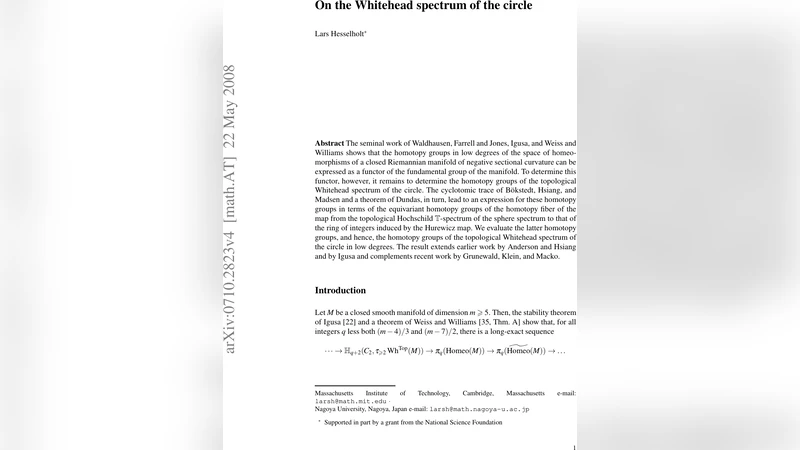
The seminal work of Waldhausen, Farrell and Jones, Igusa, and Weiss and Williams shows that the homotopy groups in low degrees of the space of homeomorphisms of a closed Riemannian manifold of negative sectional curvature can be expressed as a functor of the fundamental group of the manifold. To determine this functor, however, it remains to determine the homotopy groups of the topological Whitehead spectrum of the circle. The cyclotomic trace of B okstedt, Hsiang, and Madsen and a theorem of Dundas, in turn, lead to an expression for these homotopy groups in terms of the equivariant homotopy groups of the homotopy fiber of the map from the topological Hochschild T-spectrum of the sphere spectrum to that of the ring of integers induced by the Hurewicz map. We evaluate the latter homotopy groups, and hence, the homotopy groups of the topological Whitehead spectrum of the circle in low degrees. The result extends earlier work by Anderson and Hsiang and by Igusa and complements recent work by Grunewald, Klein, and Macko.
💡 Research Summary
The paper “On the Whitehead spectrum of the circle” tackles the long‑standing problem of determining the low‑dimensional homotopy groups of the topological Whitehead spectrum Wh^{Top}(S¹). This problem is central to the program initiated by Waldhausen, Farrell, Jones, Igusa, Weiss, and Williams, which shows that the homotopy groups of the space of homeomorphisms of a closed negatively curved Riemannian manifold can be expressed purely in terms of the manifold’s fundamental group. To make this functor explicit one must first understand Wh^{Top}(S¹), the case where the fundamental group is ℤ.
The authors begin by recalling the cyclotomic trace map trc : K^{Top} → TC introduced by Bökstedt, Hsiang, and Madsen. Here K^{Top} denotes the topological K‑theory spectrum and TC the topological cyclic homology, both equipped with natural C_{pⁿ}‑actions. Dundas’s theorem (a refinement of the Dundas‑Goodwillie‑McCarthy theorem) asserts that for the Hurewicz map S → ℤ the homotopy fibers of K^{Top}(S) → K^{Top}(ℤ) and of TC(S) → TC(ℤ) are equivalent. Consequently, the fiber of K^{Top}(S¹) → K^{Top}(ℤ) – which by definition is Wh^{Top}(S¹) – can be studied through the fiber of TC(S¹) → TC(ℤ).
The key technical step is to replace TC by the topological Hochschild T‑spectrum THH_T, which carries a genuine cyclotomic structure. The authors analyse the map THH_T(S) → THH_T(ℤ) induced by the Hurewicz map, and compute its equivariant homotopy groups using the Bökstedt‑Hsiang‑Madsen spectral sequence \
Comments & Academic Discussion
Loading comments...
Leave a Comment