The Effect of Social Information in the Dictator Game with a Taking Option
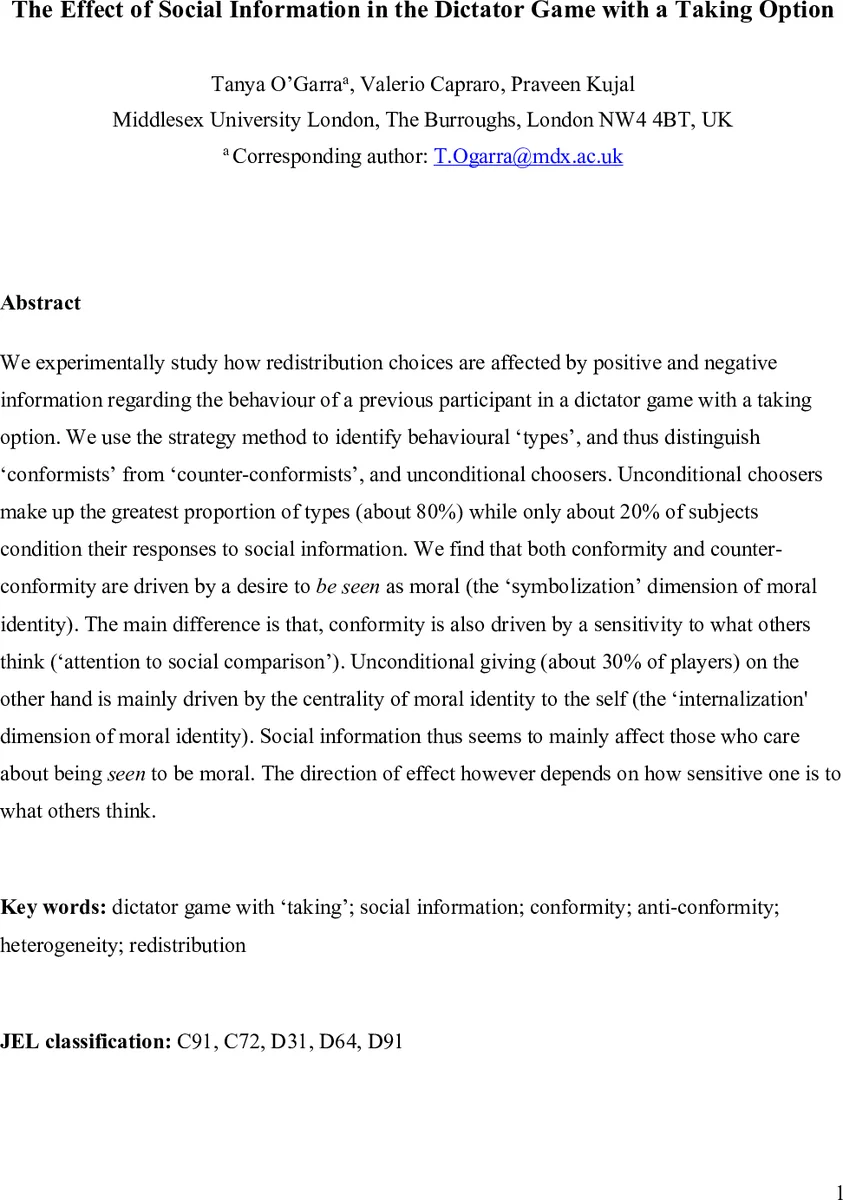
We experimentally study how redistribution choices are affected by positive and negative information regarding the behaviour of a previous participant in a dictator game with a taking option. We use the strategy method to identify behavioural “types”, and thus distinguish “conformists” from “counter-conformists”, and unconditional choosers. Unconditional choosers make up the greatest proportion of types (about 80%) while only about 20% of subjects condition their responses to social information. We find that both conformity and counter-conformity are driven by a desire to be seen as moral (the “symbolization” dimension of moral identity). The main difference is that, conformity is also driven by a sensitivity to what others think (“attention to social comparison”). Unconditional giving (about 30% of players) on the other hand is mainly driven by the centrality of moral identity to the self (the “internalization” dimension of moral identity). Social information thus seems to mainly affect those who care about being seen to be moral. The direction of effect however depends on how sensitive one is to what others think.
💡 Research Summary
The paper investigates how providing participants with information about a previous player’s decision in a dictator game that includes a “taking” option influences their own redistribution choices. In the experiment, a “dictator” (Player A) receives $1.50 and the recipient (Player B) receives $0.50. Player A can (i) take $0.50 from B, (ii) give $0.50 to B, or (iii) do nothing. Before deciding, Player A is shown what a prior participant (Player C) chose – either give, take, or remain neutral – and is asked to state what they would do in response to each possible prior action. The strategy‑method design allows the researchers to map each individual’s conditional response pattern and to classify participants into three behavioural types: (1) unconditional choosers, who make the same decision regardless of social information; (2) conformists, who mimic the prior player’s action; and (3) counter‑conformists, who do the opposite of the prior player’s action.
The sample was recruited on Amazon Mechanical Turk; after the allocation task participants answered open‑ended questions and completed two psychological scales: the Moral Identity scale (Aquino & Reed, 2002) and the Attention to Social Comparison Information (AT‑SCI) scale (Lennox & Wolfe, 1984). The Moral Identity scale distinguishes an “internalization” dimension (the extent to which moral traits are central to one’s self‑concept) and a “symbolization” dimension (the desire to be seen as moral by others). AT‑SCI measures sensitivity to others’ judgments and a general propensity to conform.
Results show that roughly 80 % of subjects are unconditional choosers, most of whom consistently give rather than take. About 20 % are conditional responders. Within this group, half are conformists and half are counter‑conformists. Both conditional types score higher on the symbolization sub‑scale of Moral Identity, indicating that the wish to appear moral drives their responsiveness to social information. However, only conformists also score high on AT‑SCI, suggesting that sensitivity to social comparison amplifies the tendency to follow the observed norm. Counter‑conformists, while also motivated by moral self‑presentation, are less influenced by concerns about others’ judgments and therefore react oppositely to negative information. Unconditional choosers, by contrast, are associated with the internalization dimension of Moral Identity; their giving behavior appears rooted in a stable, intrinsic moral self‑image that is largely immune to external cues.
Demographic variables (gender, age, religiosity) do not explain the observed heterogeneity; the psychological measures provide the primary explanatory power. A manipulation check confirms that participants perceive the “take” action as socially inappropriate, validating the experimental framing.
The study contributes to three strands of literature. First, it extends the normative‑information literature on dictator games by incorporating a taking option, thereby allowing a direct test of whether negative social information can generate counter‑conformity. Second, it demonstrates that moral identity is multidimensional: the symbolization facet predicts responsiveness to social cues, while the internalization facet predicts stable altruistic behavior. Third, it identifies AT‑SCI as a key moderator of conformity, clarifying why some individuals follow observed norms while others react against them.
Policy implications follow: interventions that aim to promote prosocial redistribution (e.g., charitable appeals) may be most effective when they highlight moral visibility for individuals high in symbolization and social‑comparison sensitivity. Conversely, for audiences with strong internalized moral identities, such cues are less necessary. The findings also caution that exposing people to antisocial behavior (e.g., reports of “taking”) may trigger counter‑conformity among those who care about moral reputation but are not highly sensitive to social comparison, potentially leading to increased generosity rather than the feared “contagion” of selfishness. Overall, the paper provides a nuanced picture of how positive and negative social information interacts with moral self‑concepts to shape redistribution decisions.
Comments & Academic Discussion
Loading comments...
Leave a Comment