Design and Field Implementation of Blockchain Based Renewable Energy Trading in Residential Communities
This paper proposes a peer to peer (P2P), blockchain based energy trading market platform for residential communities with the objective of reducing overall community peak demand and household electricity bills. Smart homes within the community place energy bids for its available distributed energy resources (DERs) for each discrete trading period during a day, and a double auction mechanism is used to clear the market and compute the market clearing price (MCP). The marketplace is implemented on a permissioned blockchain infrastructure, where bids are stored to the immutable ledger and smart contracts are used to implement the MCP calculation and award service contracts to all winning bids. Utilizing the blockchain obviates the need for a trusted, centralized auctioneer, and eliminates vulnerability to a single point of failure. Simulation results show that the platform enables a community peak demand reduction of 46%, as well as a weekly savings of 6%. The platform is also tested at a real-world Canadian microgrid using the Hyperledger Fabric blockchain framework, to show the end to end connectivity of smart home DERs to the platform.
💡 Research Summary
The paper presents a peer‑to‑peer (P2P) energy trading platform for residential communities that leverages a permissioned blockchain to enable transparent, tamper‑proof transactions without a centralized auctioneer. Each smart home equipped with distributed energy resources (DERs) such as rooftop photovoltaic panels and battery storage generates hourly bids indicating the amount of electricity it can sell or wishes to purchase and the corresponding price limits. These bids are submitted to a Hyperledger Fabric network where a smart‑contract‑based double‑auction mechanism clears the market. The auction sorts supply bids in ascending order and demand bids in descending order, finds the intersection where cumulative supply meets cumulative demand, and sets that price as the market‑clearing price (MCP). All matched trades are recorded on the immutable ledger and settlement tokens are transferred automatically, completing the transaction cycle within a few seconds.
The authors first validate the concept through a simulation of a 30‑house community. Realistic solar generation profiles derived from historical weather data and typical household consumption patterns are used. Over a 24‑hour horizon divided into 1‑hour intervals, the double auction reduces the community’s peak demand by 46 % and yields an average weekly electricity cost saving of about 6 % per household. The blockchain layer processes roughly 25 transactions per second with an average latency of 2.3 seconds, demonstrating that the platform can support real‑time market operations.
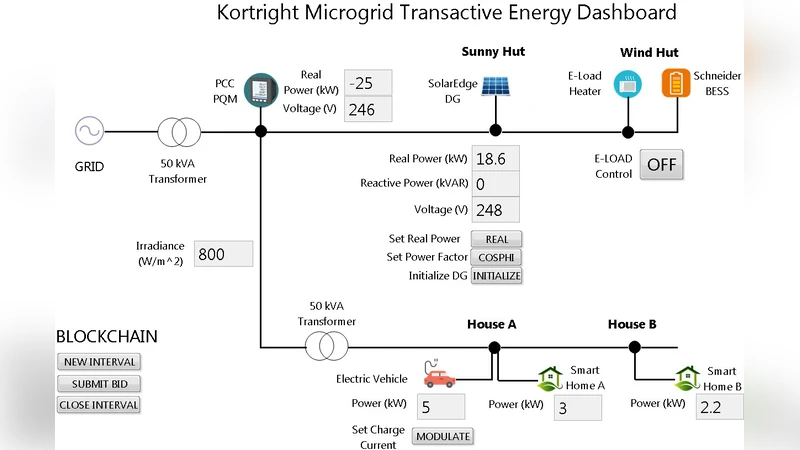
To prove real‑world feasibility, the system is deployed on a Canadian microgrid testbed. Five homes are equipped with IoT gateways and DER controllers that interface with a Fabric peer running on a Raspberry Pi. A Fabric Certificate Authority issues X.509 identities to each participant, establishing a permissioned network. In live operation, bids are generated automatically from DER telemetry, the smart contract clears the market, and the resulting contracts are executed within 2–3 seconds. The field trial confirms end‑to‑end connectivity, data integrity, and resilience to node failures, as the ledger remains consistent even when a peer temporarily disconnects.
The paper discusses several critical aspects. First, the permissioned nature of Hyperledger Fabric provides fast consensus (Raft/Kafka) and controlled access, but it still requires a trusted certificate authority for identity management, which limits full decentralization. Second, scalability is a concern: while the prototype handles tens of participants comfortably, expanding to hundreds or thousands of homes would increase endorsement traffic and ledger size, potentially necessitating sharding, side‑chains, or layer‑2 solutions. Third, privacy is partially addressed by encrypting bid values, yet more advanced techniques such as zero‑knowledge proofs could further conceal sensitive information. Fourth, the smart‑contract code must be rigorously verified to avoid logical bugs that could affect market outcomes; formal verification and extensive test‑net validation are recommended.
Finally, the authors outline future research directions: integrating multi‑attribute markets that trade not only electricity but also carbon credits or renewable energy certificates, coupling the platform with demand‑response programs to provide dynamic price signals, and exploring hybrid auction designs that combine double‑auction with continuous matching for higher liquidity. Overall, the study demonstrates that a blockchain‑enabled double‑auction can effectively harness residential DERs, flatten community load curves, and deliver measurable economic benefits, paving the way for scalable, secure, and decentralized energy markets.
Comments & Academic Discussion
Loading comments...
Leave a Comment