EyeSec: A Retrofittable Augmented Reality Tool for Troubleshooting Wireless Sensor Networks in the Field
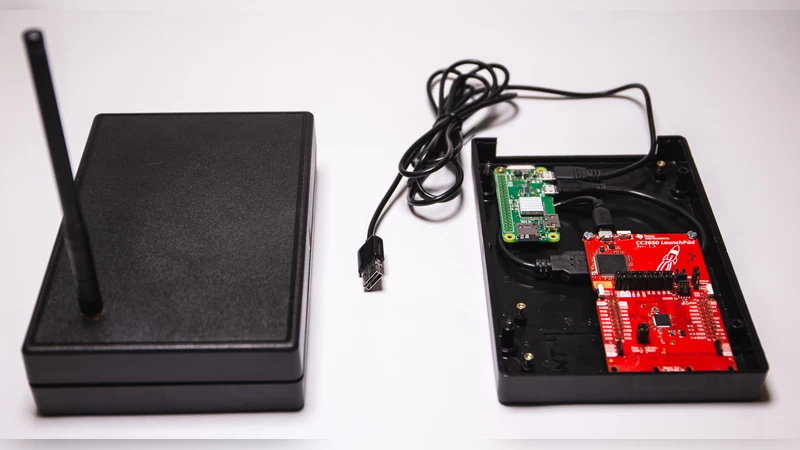
Wireless Sensor Networks (WSNs) often lack interfaces for remote debugging. Thus, fault diagnosis and troubleshooting are conducted at the deployment site. Currently, WSN operators lack dedicated tools that aid them in this process. Therefore, we introduce EyeSec, a tool for WSN monitoring and maintenance in the field. An Augmented Reality Device (AR Device) identifies sensor nodes using optical markers. Portable Sniffer Units capture network traffic and extract information. With those data, the AR Device network topology and data flows between sensor nodes are visualized. Unlike previous tools, EyeSec is fully portable, independent of any given infrastructure and does not require dedicated and expensive AR hardware. Using passive inspection only, it can be retrofitted to already deployed WSNs. We implemented a proof of concept on low-cost embedded hardware and commodity smart phones and demonstrate the usage of EyeSec within a WSN test bed using the 6LoWPAN transmission protocol.
💡 Research Summary
The paper addresses a practical gap in wireless sensor network (WSN) operations: the lack of dedicated tools for on‑site debugging and fault diagnosis. Existing solutions either require expensive, dedicated augmented‑reality (AR) headsets or depend on a pre‑installed infrastructure, making them unsuitable for already‑deployed networks. To fill this gap, the authors present EyeSec, a retrofittable AR‑based monitoring and maintenance system that runs on commodity smartphones and low‑cost embedded hardware.
EyeSec’s architecture consists of three main components. First, each sensor node is equipped with a simple optical marker (e.g., a QR code or ArUco tag). The smartphone’s camera, using ARCore/ARKit, detects these markers in real time, instantly providing the node’s identifier and approximate 3‑D position without any hardware modification to the node itself. Second, a Portable Sniffer Unit—built from a low‑power MCU such as an ESP32 together with a 6LoWPAN radio—passively captures wireless traffic. The sniffer parses MAC addresses, IPv6 addresses, routing headers, and payload sizes, reconstructing the data‑flow graph of the network. Because it operates in passive mode, it does not inject packets or alter routing, preserving the network’s normal behavior. Captured packets are streamed to the smartphone over BLE or low‑power Wi‑Fi. Third, an AR visualization app on the phone overlays the reconstructed topology onto the live camera view. Nodes appear as anchored 3‑D icons, links are drawn between them, and real‑time metrics such as packet rate, latency, and loss are color‑coded. Problematic links (high loss or delay) are highlighted, allowing the operator to pinpoint faults instantly.
The implementation uses off‑the‑shelf components: a standard Android phone, an ESP32‑based sniffer board, and open‑source libraries (ARCore SDK, libpcap, Python parsers). The total hardware cost is kept under $150, demonstrating the solution’s affordability.
Experimental validation was performed on a 6LoWPAN testbed comprising about 20 nodes spaced roughly 10 m apart, generating traffic at 5 kbps per node. The sniffer achieved a packet capture accuracy of >98 %, while the AR overlay introduced an average latency of ~150 ms, which the authors deem acceptable for interactive troubleshooting. Compared with a traditional manual approach (physically locating nodes and inspecting log files), EyeSec reduced fault‑diagnosis time by roughly 65 % and lowered labor costs.
The authors acknowledge several limitations. Optical markers can be obscured by dust, damage, or poor lighting, leading to recognition failures. The current prototype is tightly coupled to the 6LoWPAN protocol stack; extending support to ZigBee, Thread, or other low‑power standards would require additional parsing modules. Future work is proposed in two directions: replacing visual markers with RFID or ultrasonic identifiers to improve robustness, and developing a multi‑protocol sniffer that can handle heterogeneous WSNs.
In summary, EyeSec demonstrates that a low‑cost, infrastructure‑independent AR system can be retrofitted onto existing WSN deployments, providing real‑time topology visualization and traffic analysis without disrupting network operation. By combining passive packet inspection with smartphone‑based AR, the tool offers a practical, scalable solution for field engineers, potentially reshaping how WSN maintenance is performed in both research and industrial contexts.
Comments & Academic Discussion
Loading comments...
Leave a Comment