HotStuff: BFT Consensus in the Lens of Blockchain
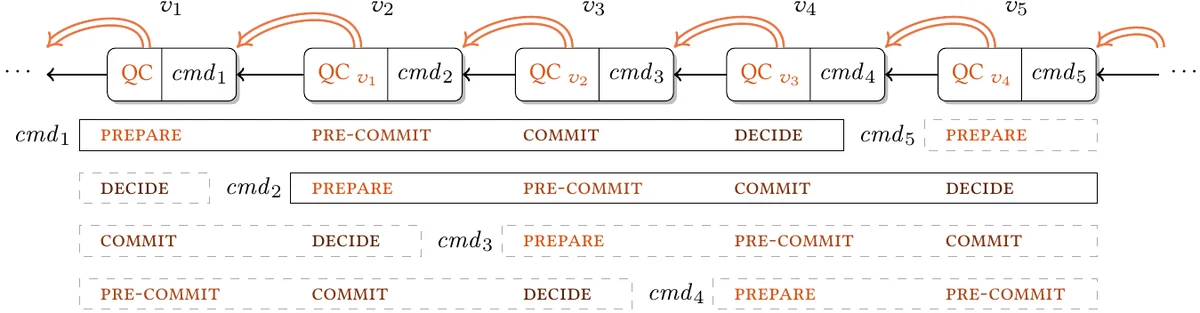
We present HotStuff, a leader-based Byzantine fault-tolerant replication protocol for the partially synchronous model. Once network communication becomes synchronous, HotStuff enables a correct leader to drive the protocol to consensus at the pace of actual (vs. maximum) network delay–a property called responsiveness–and with communication complexity that is linear in the number of replicas. To our knowledge, HotStuff is the first partially synchronous BFT replication protocol exhibiting these combined properties. HotStuff is built around a novel framework that forms a bridge between classical BFT foundations and blockchains. It allows the expression of other known protocols (DLS, PBFT, Tendermint, Casper), and ours, in a common framework. Our deployment of HotStuff over a network with over 100 replicas achieves throughput and latency comparable to that of BFT-SMaRt, while enjoying linear communication footprint during leader failover (vs. quadratic with BFT-SMaRt).
💡 Research Summary
This paper introduces HotStuff, a novel leader-based Byzantine Fault-Tolerant (BFT) state machine replication protocol designed for the partially synchronous model. The primary motivation stems from the scalability challenges faced by existing practical BFT protocols, like PBFT, when applied to large-scale permissioned blockchains with hundreds or thousands of replicas. These protocols suffer from high communication complexity—often O(n^3) or O(n^4) authenticators—during leader replacement (view-change), creating a significant bottleneck.
HotStuff’s key contribution is being the first partially synchronous BFT protocol to achieve two combined properties: Linear View Change and Optimistic Responsiveness. After the Global Stabilization Time (GST), a correct leader can drive consensus with communication complexity linear in the number of replicas (O(n)), even when taking over from a failed leader. Furthermore, after GST, a correct leader only needs to wait for the actual network delay (not a pre-configured maximum Δ) to collect enough responses to make progress, making the protocol responsive under good conditions.
The protocol achieves this through a three-phase voting core (Prepare, Pre-commit, Commit). The introduction of the Pre-commit phase is crucial. It allows replicas to “lock” and then “unlock” their votes in a safe manner, enabling a new leader to simply pick the highest known Quorum Certificate (QC)—a threshold-signed proof of votes from 2f+1 replicas—without needing to gather and relay extensive proofs from other replicas. This dramatically simplifies the view-change protocol and reduces its communication overhead.
Beyond the protocol itself, the paper presents a unifying framework for BFT replication. In this framework, the protocol state is represented as a directed graph of nodes (blocks), linked by QCs. Safety is ensured by simple, local voting and commit rules applied to this graph. Liveness is achieved by a separate, modular component called the Pacemaker, which is responsible for extending the graph with new nodes and advancing the view/leader. This separation of concerns enhances simplicity and clarity. The authors demonstrate that this framework is expressive enough to model not only HotStuff but also classical protocols like DLS and PBFT, as well as modern blockchain-inspired protocols like Tendermint and Casper.
The paper includes a prototype implementation and evaluation. In a wide-area network deployment with over 100 replicas, HotStuff achieved throughput and latency comparable to the mature BFT-SMaRt library. Crucially, under stress tests with frequent leader rotations, HotStuff’s communication footprint (measured in authenticators) remained linear in the number of replicas, while BFT-SMaRt’s grew quadratically, validating HotStuff’s superior scalability for large, dynamic consortium blockchain settings.
Comments & Academic Discussion
Loading comments...
Leave a Comment