Scalable Topological Data Analysis and Visualization for Evaluating Data-Driven Models in Scientific Applications
With the rapid adoption of machine learning techniques for large-scale applications in science and engineering comes the convergence of two grand challenges in visualization. First, the utilization of black box models (e.g., deep neural networks) cal…
Authors: Shusen Liu, Di Wang, Dan Maljovec
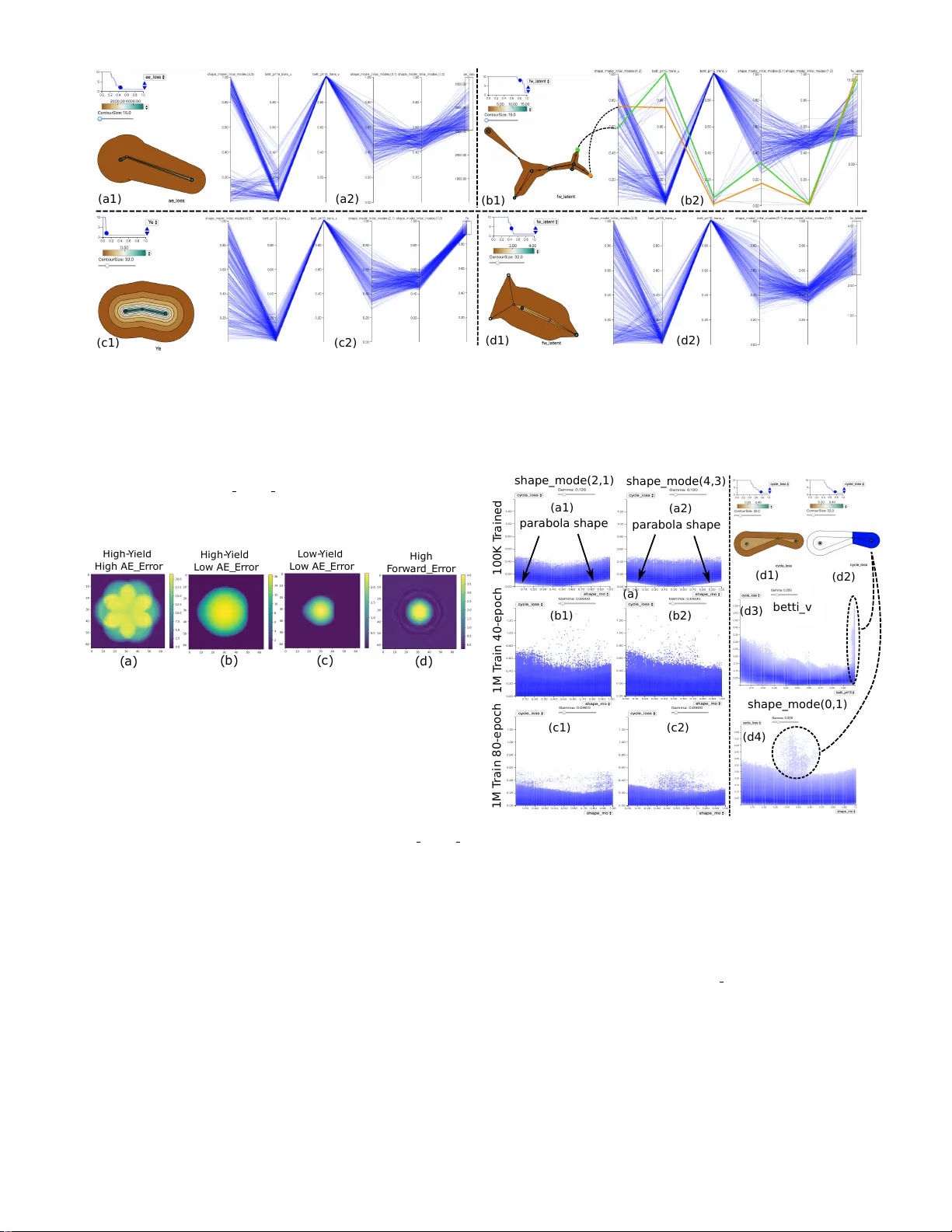
T o appear in IEEE T ransactions on V isualization and Computer Graphics Scalab le T opological Data Analysis and Visualization f or Ev aluating Data-Dr iv en Models in Scientific Applications Shusen Liu, Di W ang, Dan Maljovec , Rushil Anir udh, Ja yaraman J . Thiagarajan, Sam Ade J acobs Brian C. V an Essen, David Hysom, J ae-Seung Y eom, Jim Gaffney , Luc P eterson, P eter B. Robinson Harsh Bhatia, V aler io P ascucci, Brian K. Spears and P eer-Timo Bremer Abstract — With the rapid adoption of machine lear ning techniques for large-scale applications in science and engineer ing comes the conv ergence of two grand challenges in visualization. First, the utilization of b lack bo x models (e.g., deep neural netw orks) calls for advanced techniques in e xploring and inter preting model behaviors. Second, the rapid gro wth in computing has produced enormous datasets that require techniques that can handle millions or more samples. Although some solutions to these interpretability challenges hav e been proposed, they typically do not scale be yond thousands of samples, nor do the y provide the high-lev el intuition scientists are looking f or. Here, we present the first scalab le solution to explore and analyze high-dimensional functions often encountered in the scientific data analysis pipeline. By combining a new streaming neighborhood graph construction, the corresponding topology computation, and a nov el data aggregation scheme, namely topology aware datacubes , we enable interactiv e exploration of both the topological and the geometric aspect of high-dimensional data. F ollowing two use cases from high-energy-density (HED) physics and computational biology , we demonstrate how these capabilities ha ve led to crucial new insights in both applications. 1 I N T R O D U C T I O N Driv en by growing computing power and ev er more sophisticated diagnostic instruments, many scientific applications hav e turned from being data poor to data rich. As a result, progress in these fields increasingly depends on our ability to understand and learn from data that are o verwhelming in both size and richness. Scientists and analysts hav e turned to data-driv en models, particularly those based on deep neural networks, to handle this increase in volume and complexity . These models e xploit the complex nonlinear relationships in such lar ge- scale data to learn ef fective predictiv e models. They allo w us to deal with multi variate and multimodal data (i.e., images, time-series, scalars, etc.) in ways inconceiv able a decade ago. Howev er, these flexible models create ne w challenges, especially in scientific applications. In commercial AI systems, sheer performance, measured by predictive power or classification accurac y , is paramount. Science and engineering practitioners require satisfactory performance, but they also demand insights and understanding. Y et, the very complexity that increases model performance often obscures our understanding and hence fails to provide new insights. This scenario has produced a gro wing need for techniques to interpret the results of data-driv en models and to explore their training process and final error landscape to assess their reliability . Despite a recent surge in techniques for model interpretation [28, 31, 37, 38], most approaches focus on explaining a given prediction and often only for a specific problem domain, such as natural language processing or computer vision. Although these techniques are useful to understand individual predictions, they provide few insights into the ov erall behavior of a model or its internal representations. In this paper , we are concerned with two large-scale applications: a high-energy-density physics ensemble e xploring inertial confinement fusion and a multiscale simulation of a human cell membrane. In the former application, some members of our team hav e built a sophisti- cated surrogate model to explore a lar ge ensemble of simulations with up to 10 million members. The latter is dri ven by a sampling process in a high-dimensional latent space, and scientists are interested in under - standing and comparing sample distributions. In both cases the goal is • Shusen Liu, Rushil Anirudh, J ayaraman J . Thiagarajan, Sam Ade J acobs, Brian C. V an Essen, David Hysom, Jae-Seung Y eom, Jim Gaffney , Luc P eterson, P eter B. Robinson, Harsh Bhatia, Brian K. Spears, P eer-T imo Br emer ar e with Lawrence Livermor e National Laboratory . E-mail: { liu42, anirudh1, jayaraman1, jacobs32, vanessen1, hysom1, yeom2, gaf fney3, peterson76, r obinson96, bhatia4, spears9, br emer5 } @llnl.gov . • Di W ang, Dan Maljovec, V alerio P ascucci ar e with SCI Institute, University of Utah. E-mail: { orpheus92, maljovec, pascucci } @sci.utah.edu. not only to understand the gross simulation results, e.g., the dependence of fusion yield on design parameters, but also, more importantly , to provide insight and establish confidence in the model itself. Therefore, we need techniques to e valuate the errors and uncertainties in the model with a special emphasis on their variation within the model domain. For e xample, complex physics models are kno wn to have strong non- linearities that often lead to a rapidly changing response in a very small region of the input domain of the simulation (also referred to as the parameter space). This sharp nonlinear behavior can lead to models that exhibit low global errors and good model conv ergence, while at the same time producing wildly incorrect results in localized re gions of parameter space that are often most interesting to the scientists. Moreov er , scientists typically use these models and their predictions to design new experiments. They need tools that can discriminate between regions of parameter space where the model has errors small enough to make the model useful for design w ork. Likewise, the y need to kno w where errors hav e grown large enough to make the model unreliable for predicting real-world conditions. Such requirement highlights the need in the scientific community to augment global loss functions and response metrics with methods that can steer the scientific user to- ward regions of high v alue and confidence. Especially for the complex models considered in this paper, with multiple, interdependent loss functions and millions of training and ev aluation samples, it is critical to understand the impact of different loss functions and ho w the errors might be correlated to the underlying physics. None of the existing techniques are particularly suited for the anal- ysis of these scientific models because they either do not scale to the required sample sizes or do not provide the necessary details. For example, due to the curse of dimensionality , it is not uncommon for en- sembles, ev en with a large number of samples, to have a small number of salient observations [21] that are crucial for interpretation, yet are not easily detected automatically . Preserving such observations creates conflicting objectives, as the data size demands aggregating information into global trends, yet doing so obscures small-scale details. As discussed in more detail in Section 3, many of the questions raised abov e can be expressed as the analysis of a high-dimensional function. For scientific analysis, this function might be a quantity of interest, such as the yield, whereas for model interpretation and vali- dation, it might be a loss function or another indicator of prediction quality . In general, we are giv en a high-dimensional domain , i.e., a set of input parameters or a latent space, as well as a scalar function on that domain, to analyze. W e propose to use topological techniques to address this challenge. In general, computing the topology of a gi ven 1 function provides insights into both its global behavior and it local features, since the measure of importance is variation in its function value, i.e., persistence, rather than the size of a feature. Furthermore, topology provides a con venient abstraction for both analysis and vi- sualization, whose complexity depends entirely on the function itself rather than the number of samples used to represent it. Howe ver , topo- logical information alone can provide only limited insight because, for example, knowing that there exist two significant modes is of little use without kno wing where in the domain these modes e xist and ho w much volume the y account for . W e, therefore, propose to augment the topological information with complementary geometric information by introducing the notion of topological datacubes. These datacubes are sampled representations linked directly to the topological struc- ture, which provide capabilities for join e xploration among scatterplots, parallel coordinates, and topological features. Finally , we introduce new streaming algorithms to compute both the topological information and the corresponding datacubes for datasets ranging from hundreds of thousands to eight million data points. More specifically , we hav e • identified the shared analysis challenges posed by many data- driv en modeling applications; • dev eloped a rob ust topological data analysis computation pipeline that scales to millions of samples; • dev eloped an interactive visual analytics system that lev erages both topological and geometric information for model analysis; • addressed the model analysis challenges of a data-dri ven inertial confinement fusion surrogate and solved the adapti ve sampling ev aluation problem for a large-scale biomedical simulation. 2 R E L AT E D W O R K S Since we focus on addressing specific application challenges, there are limited works aiming to solv e the exact problem. Here we revie w sev eral topics that relate to the individual components of the system or provide rele vant background for the ov erall application. Scientific Machine Learning. Data analysis has always been one of the driving forces for scientific discovery . Many statistical tools, i.e., hypothesis testing [2], hav e co-developed with many scientific disci- plines. The application of modern machine learning tools in scientific research has long attracted scientists’ attention [27]. Machine learning has been successfully utilized for solving problems in a v ariety of fields, such as bioinformatics [4], material science [8], and physics [29]. In a recent high-energy-density physics application [29], a random forest re- gressor has been adopted for identifying a pre viously unkno wn optional configuration for the inertial confinement fusion experiments (more background on inertial confinement fusion is included in Section 6). W ith recent advances of po werful learners (i.e., deep neural network), coupled with the data analysis challenge, scientists are increasingly interested in lev eraging these models for scientific discovery . Deep Learning Model Interpretation. The opaque nature of deep neural networks has prompted many efforts to interpret them. In the machine learning community , many approaches hav e been proposed, notably for common architecture such as the conv olution neural netw ork (CNN) [31, 37, 38], to probe into the mechanism of the model. Similarly , visual analytics systems that focus on interactiv e explorations of model internals have also been introduced in the visualization community , for vision [20], te xt [22], reinforcement learning [36], and more [26]. Howe ver , these model-specific techniques are closely tied to particular architectures or setups, making them less flexible to a variety of ap- plication scenarios. Alternatively , we can approach the interpretation challenge from a model agnostics perspectiv e. Recently , a few stud- ies [17, 24, 30] hav e focused on building a general interpretation engine. For example, the LIME [30] e xplains a prediction by fitting a localized linear model that approximates the classification boundary around the giv en example. Considering the high-dimensional nature of the internal state of the neural network models, we believ e there is a unique oppor- tunity to build a general purpose neural-network-interpreting tool by exploiting high-dimensional visualization techniques. In this work, we demonstrate a firm step tow ard this goal, where we provide valuable diagnostic and v alidation capabilities for designing a surrogate model of a high-energy-density physics application. T opological Data Analysis. Compared to traditional statistical analy- sis tools, topological data analysis employs quite different criteria that allow it to pick up potentially important outliers that would otherwise get ignored in standard statistical analysis, making topological data analysis tools uniquely suitable for man y scientific applications. The topology of scalar v alued function has been utilized for analyzing sci- entific data in previous w orks [5, 15, 16]. The scalability challenge for handling functions defined on the large 3D volumetric domain has also been addressed in se veral pre vious works, e.g., parallel merge tree com- putation [18]. Howev er, in man y scientific applications, scientists are also interested in studying the properties defined in a high-dimensional domain. T o address such a challenge, the HDV is work [13] was in- troduced for computing the topology of a sampled high-dimensional scalar function. Unfortunately , the applications of the high-dimensional scalar topology we see so far contain only a relatively small number of samples. An apparent mismatch exists between the scalability of the existing high-dimensional scalar function topology implementation and the large datasets for our target applications. This work aims to fill the gap by addressing both the computational and visualization challenges. For background on topological data analysis, please refer to Section 4. Data Aggr egation Visualization. As the number of samples increases in a dataset, a visual analytics system not only needs to cope with the computational/rendering strain but also to handle the visual encoding challenges. For example, if we simply plot millions of points in a parallel coordinate or scatterplot, besides the speed consideration (i.e., drawing each point as an SVG object using d3.js will not be ideal), the occlusion and crowding could potentially eliminate an y possibility of extracting meaningful information from the data. Many previous works in visualization ha ve been proposed to address these scalability challenges, ranging from designing novel visual encoding (e.g., splatter - plot [25], stacking element plot [11]) to directly modeling and rendering the data distrib ution (e.g., Nanocubes [19], imMens [23], density-based parallel coordinate [3]). Howe ver , most existing approaches aggregate information globally or according to certain geological indexing for faster queries. In this w ork, the proposed system combines visualization components for both topological and geometric features. Therefore, in order to scale the linked vie w visualization system beyond millions of points, we adopt a topology-aware datacube design for aggre gating large data according to their topological partition. 3 A P P L I C ATI O N T AS K S A N A LYS I S This section provides the application background and identifies: (i) the analysis tasks shared by many data-driv en applications; (ii) why these tasks are important; and (iii) how we can solve these tasks by combining topological data analysis with interactive data visualiza- tion. The system has been de veloped jointly through a continuing collaboration with two application teams in high-energy physics and computational biology , respecti vely . In both cases we are tasked with solving the analysis challenges encountered throughout the processing pipeline, including sample acquisition, sampling, modeling, and analy- sis. Despite the disparate application domains, we have encountered a number of recurring analysis tasks, which often lie at the v ery heart of the scientific interpretation. This has motiv ated the de velopment of dedicated visual analysis tool to streamline the analysis process and accelerate discov ery . Data is at the center of any analysis task. Experimental data is typically considered the gold standard, but it is often too costly or time consuming to perform all desired experiments, and/or the phenomenon in question cannot be directly observed. In these cases, computer simulations at various fidelities ha ve become indispensable to plan and interpret observations. Howev er, such simulations are rarely completely accurate and often rely on educated guesses of parameters or known approximations of physical processes. T o deal with such uncertainties and calibrate the simulations, scientists turn to simulation ensembles in which the same (computational) experiment is simulated thousands or millions of times with v arying parameters, initial conditions, etc. The corresponding computational pipeline typically has three main stages: sampling, simulation, and modeling. W e start by generating samples in the input parameter space. W e then run simulations on all input 2 T o appear in IEEE T ransactions on V isualization and Computer Graphics parameter combinations and gather the outputs to create the ensemble. Finally , in the modeling stage, the simulation results are used to train a cheaper surrogate for one or multiple of the output quantities to enable statistical inference, uncertainty quantification, or parameter calibration. Both the sampling and the modeling stage can benefit significantly from visual analytics. In particular , we hav e identified four generic tasks we typically encounter independent of the specific application: • T1: Analyze the sampling pattern to ensure uniform coverage or verify a sampling objecti ve • T2: Explore quantities of interest with respect to the input param- eter space • T3: V erify model conv ergence, explore residual errors, and e val- uate local and global reliability • T4: Explore the sensitivities of the model with respect to the input parameters How we sample the high-dimensional input space has a significant impact on the downstream analysis. Depending on the nature of the application, we may have dif ferent preferences in the sample pattern and thus need to verify whether the sampling pattern satisfies the re- quired properties ( T1 ). Gi ven the simulation outputs, we then need to identify where we achieved or failed to achiev e our objective, i.e., induce nuclear fusion, how stable successful solutions are, etc. T yp- ically , such process requires us to explore some quantity of interest, i.e., energy yield of the physical simulation, in the high-dimensional input parameter space ( T2 ). Once we obtain the simulation and build a surrogate model, we need to be able to ev aluate the model behavior and interpret the model’ s internal representations ( T3 ). The T2 , T3 focus on identifying regions in the high-dimensional space correspond- ing to certain meaningful measures. As discussed in the introduction, topological data analysis that identifies local peaks of a function can be an effectiv e tool for discovering and exploring these regions in a multiscale manner . Howe ver , due to the high-dimensional nature of the space, a large number of samples are often required to provide adequate cov erage of the space. As a result, we need to make sure the topological data analysis computation pipeline can reliably scale to lar ge sample sizes (i.e., beyond tens of millions of points). W e address the scalability challenges by adopting a streaming computation pipeline (discussed in in Section 4). Aside from studying the behavior of functions in certain high- dimensional space ( T2, T3 ), we also want to understand the relationship between specific input parameters and model output ( T4 ), for example, judge sensitivities. A global regression will often not yield the desired result, because the relationships can be both complex and highly local- ized. An alternative is to leverage the topology-guided partition ( T2, T3 ) and examine the localized and potentially simpler trend. Howe ver , the topological data analysis does not really capture any geometric structure nor can it help reason about individual dimensions. There- fore, to fully utilize the re vealed topological information, we need to provide complementary geometric information. In the proposed sys- tem, we adopted scatterplots and parallel coordinates, which intuitively encode data dimensions and support fle xible selection operations that benefit from the linked view visual exploration. In order to scale the combined topological and geometrical explorations for large sample size and support interactiv e query with respect to topological feature (i.e., dif ferent extrema), we de vised a topology-aware datacube to en- able the interacti vely linked exploration between topological features and the corresponding samples’ geometric information (see details in Section 5). 4 S T R E A M I N G T O P O L O G I C A L D AT A A N A L Y S I S As discussed abov e, the exploration and analysis introduced in this work rely on high-dimensional topology and in particular high- dimensional extremum graphs [10, 33]. T opological information pro- vides insight into the ov erall structure of high-dimensional functions and is a con venient handle for per-e xtremum localized analysis. Here, we first introduce the necessary background in Morse theory and revie w the original algorithm to approximate extremum graphs for sampled high-dimensional functions. W e then discuss a new streaming algo- rithm to compute e xtremum graphs and the corresponding streaming neighborhood graph construction approach, which mainly aim to over - come the memory bottleneck that hinders the scalability of the existing implementation. 4.1 Morse Comple x and Extremum Graphs Let M be a smooth, d -dimensional manifold and f : M → R be a smooth scalar function with gradient ∇ f . A critical point is any point x ∈ M where ∇ f ( x ) = 0 , and all other points are r e gular . Starting from a regular point p ∈ M and following the gradient forward and backward traces an integr al line that begins at a local minimum and ends at a local maximum. The set of points whose integral line ends at a critical point defines the stable/unstable manifold for that point, and the Morse comple x is defined as the collection of all stable manifolds. For dimensions beyond three, computing the entire Morse complex is in- feasible [14], so we follo w [7, 10] and concentrate on extremum graphs. An extremum graph contains all local maxima of the function together with the saddles connecting them. T o approximate the extremum graph for sampled functions, we define an undirected neighborhood graph on all input vertices to approximate M . Given a graph, we approximate the gradient as the steepest ascending edge incident to a gi ven verte x and construct the ascending integral line by successively follo wing steepest edges to a local maximum. In practice, this trav ersal is implemented as a short-cut union-find at near linear complexity per vertex. In this process, each vertex is labeled by the index of its corresponding stable manifold, and saddles are identified as the highest vertex connecting two neighboring maxima [14]. Subsequently , we form the e xtremum graph by considering arcs between saddles and neighboring maxima. Fig. 1. Left: the performance compar ison between the CPU baseline streaming implementation and the CUDA accelerated version (5D sample with varying sizes). Right: a plot showing the total edges e xtracted from a symmetric, relaxed Gabriel graph computed on the same dataset as a function of the k used in the initial k -nearest neighbor graph. 4.2 Streaming Extremum Graph One major road block for scaling the existing algorithm to large point count is the size of the neighborhood graph. As the dimension of M increases, more vertices are required to reliably approximate f . T o identify the correct edges for topological computation, we often need to build neighborhood graphs that require se veral magnitude more storage space than the verte x alone, which may quickly reach the memory limitation of most desktop systems. T o address this challenge, we present a two-pass streaming algo- rithm for constructing extremum graphs that store only the vertices and an appropriate neighborhood look-up structure to av oid keeping the massiv e neighborhood graph in memory . W e can then obtain the necessary neighboring information on the fly to construct edges for each verte x. A verte x always maintains its currently steepest neighbor , which is initialized to be the vertex itself. Once all edges hav e been seen, a near-linear union-find is used as a short-cut to the steepest neigh- bor link to point to the corresponding local maximum of each v ertex, thereby constructing the sampled Morse complex. Even though this structure can be constructed in a single pass, note that the identification of saddles and the subsequent cancellation of saddles and maxima also require the neighborhood information. Consequently , we reiterate the steaming graph in a second pass to assemble the complex. T o support streaming extremum graph computation, we introduce a new approach to compute neighborhood graphs in a streaming manner . For densely sampled space (i.e., sampling of simulation input param- eters), Correa et al. [9] hav e demonstrated that β -skeletons and their relaxed v ariants provide significantly more stable results for computing topological structure [9], in which an approximated k -nearest neighbor 3 graph of sufficiently large k is computed first and then pruned using the empty region test defined by β . In this work, we b uild upon their work [9] and employ a streaming scheme to a void storing the full graph in memory by doing neighborhood lookup and edge pruning for each point individually . W e then store the steepest direction for topology computation. In our implementation, we utilize GPU to exploit the parallelism in the neighborhood query and the edge-pruning steps. A comparison between the baseline CPU implementation and the GPU accelerated version is sho wn in the left plot of Fig. 1 on a test function with a 5D domain and v arying sample sizes (note the log scale in the y-axis, for the 1M case, the GPU v ersion is approximately 70% faster than the CPU counterpart). T o determine a suitable k , as illustrated in the right plot of Fig. 1, we gradually increase k in the initial k -nearest neighborhood query stage and observe at which point the number of true edges of the empty region graph begins to stabilize. W e can see, in 5D space, that the curve starts to level off beyond k ∼ 500 , indicating that adding more k neighbors will not result in many more edges being discovered in the pruned graph. Note that the saturation point will vary based on the distribution of the data in the domain; the results are shown for data drawn from a uniform random distrib ution. 5 D AT A A G G R E G ATI O N A N D V I S UA L I Z AT I O N W e have described ho w to extend the scalability of the topological data analysis to handle large datasets. Despite its strength, topolog- ical data analysis alone rev eals little geometric information outside the location of critical points in parameter space. Howe ver , this infor- mation can be crucial to interpret data, and thus we propose a joint analysis of topological features and their corresponding geometric data as expressed through parallel coordinates and scatterplots. Here, we introduce topology-awar e datacubes , which not only aggregate data to enable interactiv e visual exploration but also maintain the topological feature hierarchy that allows interactive linked view exploration. As illustrated in Fig. 2, the o verall visualization interf ace (built on top of an existing high-dimensional data e xploration framew ork N D 2 A V [6]) consists of three views of the dataset: topological spines (a), scatterplots (b), and parallel coordinates plots (c). The topological spine shows the relativ e distance and size of the peaks in the function of interests. During an exploration session, the user can first assess the global re- lationship presented in the topological spine and parallel coordinate, and then focus on individual peaks of the function in the topological spine by selecting the local e xtrema, which will trigger updates in the parallel coordinates plot and scatterplot that re veal the samples corre- sponding to that extrema. By examining the parallel coordinates plot / scatterplot patterns that correspond to different selected extrema, we are able to discern the locations of the peaks in the function that make them different. 5.1 T opology-Aware Data Cubes When dealing with large datasets, visualization systems often need to address the scalability challenge from two aspects. On one hand, as the number of sample increases, the standard visual encodings, such as scatterplots and parallel coordinates, become increasingly ineffecti ve due to overplotting and thus o verwhelm users’ perceptual capacity . On the other hand, the increasing data size induces a heavy computational cost for processing and rendering, which may create latency that hin- ders the interactivity of the tool. One strategy to address this problem is datacubes (OLAP-cubes) style aggregation techniques [19, 23], which provide summary information (i.e., density/histogram) to overcome the ov erplotting while preserving joint information to enable linked selec- tion and interactiv e exploration. Howev er, such aggreg ation techniques are not directly applicable here as the y summarize the dataset’ s entire domain without considering the topological segmentation. Instead, we aim to aggregate information with respect to the topological structure of the data because the ability to interactively e xplore the topological hier- archy at dif ferent granularities is central to our analysis task. Therefore, to achiev e the design goal, the data aggregation structure should allo w efficient query on different topological partitions of the data, which motiv ates us to introduce a topology-aware datacube design. The extremum graph (Section 4) can be simplified by mer ging ex- trema (each corresponding to a segment of the data) and removing less significant saddles based on the persistence value (i.e., the function value dif ference between the saddle and extremum pair: the higher the value, the more significant the topological feature). Since we often do not care about extrema with low persistence (i.e., corresponding to a less topologically significant structure), we can presimplify the topo- logical segmentation hierarch y and focus only on the top le vels (i.e., up to a dozen segments) for our analysis. During the exploration, the user can explore different le vels of granularity by altering the persistence threshold. In Fig. 2(a1), the number of peaks is shown (y-axis) for a giv en persistence value (x-axis). The persistence values at the plateau regions (longer horizontal line se gments in the diagram) signify more stable topological structures. A suitable persistence value is the one that can produce significant and stable topological structures. For the topology-aw are datacubes, we precomputed datacubes for samples in each leaf segment in the simplified topology hierarchy , where each datacube preserv es the localized geometric features. The segments with lower persistence will be merged into a topologically more significant partition of the data. Since we already precomputed the datacubes for each leaf segment, we can generate summary information for any higher le vel partition by aggregating the summary data in leaf segments on the fly . Despite the effecti veness of the datacube for range queries, storing a full joint distribution in the datacube form can be extremely expensi ve. For our intended exploration and interaction (displaying parallel coordinates plots and scatterplots), we do not need access to all the joint distribution information. Therefore, we compute and store lower dimensional data (up to three dimensions) cubes to reduce the storage while still supporting the interactiv e visualization. (a) (b) (c) (a1 ) Function R ange Extrema Count Fig. 2. The proposed visualization interf ace consists of three views: topological spine (a), density scatter plot (b), density parallel coordinates plot (c). These views provide complementary information, and the linked selection enables a joint analysis of both geometr ic and topological features . In (a1), we show the persistence plot, which controls the number of e xtrema displayed in the topological spine . 2D T er ra in Me ta phor HD F unction Sa ddle Extr ema Fig. 3. T opological spine. A 2D terrain metaphor of high-dimensional topological information [10]. T opological Spine. The topological spine [10] view (see Fig. 2(a)) visually encodes the extremum graph of a scalar field by sho wing the connectivity of the e xtrema and saddles together with the size of local peaks. As illustrated in Fig. 3, the spine utilizes a terrain metaphor to illustrate the peaks (local extrema) and their relationships in the 4 T o appear in IEEE T ransactions on V isualization and Computer Graphics giv en function. Here, the contours around the extrema or across saddles indicate the level sets of the function, similar to the contour line in a topographic map. In [10], the size of the contour C f i is the number of samples above the contour function value f i . In our implementation, we computed the size as d / 2 p C f i to better reflect the relati ve “volume” these points cover in the high-dimensional space ( d is the dimension of the function domain). The layout of the critical points (the extrema and saddles) is a 2D approximation of the location of critical points in the high-dimensional domain. Since the function may hav e many small local structures, we simplify the extremum graph to focus on important topological features. W e consider a giv en local extremum less significant when the function v alue difference between the e xtremum and the nearby saddle (i.e., the persistence of the local extremum) is small. The extremum graph can be simplified by merging e xtrema with small persistence values. As illustrated in Fig. 2(a1), the number of extrema in the topological structure is controlled by the persistence plot, where the x-axis is the normalized function range, and the y-axis sho ws the number of local extrema at the current simplification lev el. W e can identify the stable topological configuration by finding the widest plateau in the blue line along the x-axis. Since the complexity of the spine does not depend on the number of samples used to define the function, the topological spine is a perfectly scalable visual metaphor that can easily be obtained from the precomputed datacubes instead of the raw samples. Density Scatterplots. By querying the datacube, we can directly ob- tain the 2D histogram and render the estimated joint distrib ution density to av oid the overplotting issue in the standard scatterplot. Due to the topology-aware datacube, the user can explore the density scatterplot (see Fig. 2(b)) for any topological segments by aggregating leaf dat- acubes on the fly . T o better visualize the potentially large dynamic range of the density v alue, we applied a gamma correction on the den- sity value: α = Ad γ , where α denotes the opacity and d denotes the density of each bin. Density Parallel Coordinates. Similarly , the parallel coordinates plot (see Fig. 2(c)) can be dra wn with selected 2D joint distrib utions from the datacube. T o draw the density parallel coordinates plots, we first discretize each axis according to the resolution ( r ) of the datacube; thus, there would be r bins on each axis. W e then draw lines from each bin to every other bin on the adjacent axis; thus, there would be r 2 lines between ev ery two adjacent axes. T o draw each line, we query the corresponding density from the 2D joint distrib ution of the neighboring axes and map the v alue to the opacity (with gamma correction). Since ev ery line between two adjacent axes requires only the information of corresponding dimensions, we need only the bi variate distrib ution of those two dimensions (or 3D if we want to support function range selection in PCP). Due to the discretization, the time to draw the parallel coordinates plot depends only on the resolution and the total number of dimensions. Lasers Capsule Fuel Fig. 4. Iner tial confinement fusion (ICF). Lasers heat and compress the target capsule containing fuel to initiate controlled fusion. 6 A P P L I C ATI O N : I N E RT I A L C O N FI N E M E N T F U S I O N In this section, we will discuss the application of the proposed analy- sis framew ork for analyzing simulations of inertial confinement fusion (ICF). Controlled fusion has often been considered to be a highly effec- tiv e energy source. At the National Ignition Facility (NIF) (at Lawrence Liv ermore National Laboratory), one of the k ey objecti ves is to provide an experimental en vironment for controlled fusion research and thus laying the groundwork for using fusion as a clean and safe energy source. Scientists utilize high-energy lasers to heat and compress a millimeter-scale target filled with frozen thermonuclear fusion fuel (see Fig. 4). Under ideal conditions, the fusion of the fuel will produce enough neutrons and alpha particles (helium nuclei) for the target to self-heat, e ventually leading to a runaway implosion process referred to as ignition. Howe ver , achieving an optimal condition by adjusting the target and laser parameters in response to the experimental output (e.g., energy yield) is extremely challenging due to a v ariety of factors, such as the prohibitiv e cost of the actual physical e xperiment and incomplete diagnostic information. Consequently , ICF scientists often turn to nu- merical simulations to help them postulate the physical conditions that produced a giv en set of experimental observations. In this application, we focus on a lar ge simulation ensemble (10M samples) produced by a recently proposed semianalytic simulation model [12, 32]. W e capitalize on the abundance of simulations by building a complex multiv ariate and multimodal surrogate based on deep learning architectures. More specifically , the surrogate replicates outputs from the numerical physics model, including an array of sim- ulated X-ray images obtained from multiple lines of sight, as well as diagnostic scalar output quantities (see Fig. 5). As discussed in more detail belo w , this comple x deep learning model is the first of its kind, at least in this area of science. The model and the corresponding training dataset hav e been made publicly available [1]. P ar ame t er Space La t en t Space Fig. 5. System diagram of the deep learning-based surrogate modeling used in the ICF study . A 5D input parameter space X is mapped onto a 20D latent space L , which is f ed to a multimodal decoder D returning the multiview X-r a y images of the implosion as well as diagnostic scalar quantities. 6.1 Deep Learning for Inertial Confinement Fusion Although describing all the architectural details of the model is beyond the scope of the paper , Fig. 5 illustrates the key components. In this study , the input to the simulation code is a 5D parameter space X ⊂ R . For each combination of input parameters x i ∈ X , the simulation code produces 12 mulitchannel images I j = { I 0 j , ..., I 11 j } , each of size 64 × 64 × 4 in the image space I , as well as 15 scalar quantities y j = { y 0 j , ..., y 14 j } ∈ S = R 15 . T o jointly predict the images and scalars, the model uses a bow-tie autoencoder [34] ( I × S → L → I × S , not shown in the figure) to construct a joint latent space L ⊂ R 20 that captures all image and scalar variations. The forward model X → I × S is comprised of tw o components: a multiv ariate regressor F : X → L and the decoder from the pretrained autoencoder: D : L → I × S . In other words, the forward model does not directly predict the system output I × S , but instead predicts the joint latent space L of the autoencoder . The decoder D : L → I × S can then produce the actual outputs from the predicted L . Such a setup allo ws us to more effecti vely utilize relationships in the output domain I × S and improve the ov erall predictive performance. Furthermore, the model simultaneously considers the inv erse model G : L → X and uses self-consistency to regularize the mapping, by minimizing || x − G ( F ( x )) || 2 in addition to the prediction loss. All submodels are implemented using deep neural networks (DNNs), and the entire system is trained jointly to obtain the fitted models ˆ F and ˆ G , assuming that we hav e access to a pretrained autoencoder . In order to enable neural network training at such large scales, and to support the system integration needs, we adopted the parallel neural network training toolkit, LB ANN [35], for training the surrogate. 6.2 Surrogate Model Anal ysis Although the ability of the model to produce accurate and self- consistent predictions of multimodal outputs pro vides fundamentally new capabilities for scientific applications, the complexity of the result- ing model naturally leads to challenges in its ev aluation and exploration. Firstly , the application requirement for scientific deep learning is vastly 5 (a ) (b1) (c1) (b2) (c2) sha pe mode (4,3) betti_u betti_v sha pe mode (2,1) sha pe mode (1,0) Fig. 6. Joint explor ation of both topological and geometric characteristics of the surrogate’s errors as functions in the input parameter space. In (a1), the topological spine shows two local peaks of the output error ( F o ( x ) ). The user can select the high error samples through parallel coordinates plot in (b2). These samples will also be highlighted in topological spine (b1). Also, the user can f ocus on an individual extremum (see c1, c2). different from that of its commercial counterparts. Compared to tra- ditional applications such as image recognition and text processing (where a human user can easily provide the ground truth), in scientific problems, ev en an expert has limited knowledge about the beha vior of an e xperiment, due to the inherent comple xity of the physical system as well as the exploratory nature of the domain. Secondly , these models are intended for precise and quantitativ e experimental designs that, we hope, can lead to scientific discovery . Consequently , physicists care about not only the ov erall prediction accurac y , but also the localized be- haviors of a model, i.e., whether certain regions of the input parameter space produce more error than others. T o address these challenges, we include the proposed visualization tool as an integral part of the model design/training process. As dis- cussed in Section 3, the ability to interpret a high-dimensional function is central for obtaining the localized understanding of a gi ven system. In this application, the functions of interest are the high-dimensional error landscapes of the surrogate model. By adopting the proposed function visualization tool, we aim to provide the model designers and the physicists with intuitive feedback on the prediction error distri- bution in the input parameter space. For over five months, we have worked closely with the machine learning team to iteratively debug and fine-tune the training process. W e have detected a crucial issue with the normalization strategy applied to the x-ray images and iden- tified the problem with the batch scheduler based on the visualization provided by the proposed tool. The following analysis is carried out on a “well-behav ed” model, where the aforementioned problems have already been addressed, according to the traditional ev aluation metrics (e.g., av erage prediction accuracy , loss con vergence behavior). Here, we illustrate ho w the e xploration of localized error beha viors can re veal some important yet unexpected issues of the surrogate model that are not possible with the traditional summary metrics. Exploring surrogate error in the input parameter space. T radition- ally , the machine learning community has relied on global summary statistics to assess a model, i.e., global loss curves, that do not re- veal localized properties. By utilizing the proposed tool, we vie w the predicativ e error as a function in the input domain, which can then be analyzed as a high-dimensional scalar function (see T2-4 in Section 3). Such a line of inquiry is not only essential for scientific analysis b ut also can provide a critical feedback loop for v alidating and fine-tuning the actual machine learning model. In order to perform an elaborate as well as unbiased study , we carry out our analysis on an 8 million validation set, hold-out during the training process. Despite the large sample size, due to the scalable design considerations, we are able to show that the proposed system allo ws an interactiv e linked-vie w exploration once the topological structure and the corresponding datacube are obtained. The precomputation of the 8 million sample dataset took around 1.5-3.5 hours to complete, depending on the initial neighborhood query size as well as the hardware setup (i.e., utilizing GPU or not). During the model training process, a global average loss function is considered, which in this case consists of a weighted sum of the losses in L (forward model), S (decoder), and X (in verse model). Each term addresses a different aspect of the ov erall training objectiv es. More specifically , we are given: (1) the autoencoder reconstruction error , R ( l ) = || y − D ( l ) || , for l ∈ L and l = E ( y ) denoting the encoder of the autoencoder; (2) the forward error in latent space F l at ( x ) = || ˆ F ( x ) − E ( y ) || , where ˆ F ( x ) is the fitted forward model; (3) the forward error in output space F o ( x ) = || y − D ( ˆ F ( x )) || ; and (4) the c yclic self- consistency error G ( x ) = || x − ˆ G ( ˆ F ( x )) || . T o gauge the overall error of the surrogate, let us first look at the for- ward error in output space F o ( x ) (i.e., the error in the predicted images and diagnostic scalars of the surrogate). W e compute the topological structure of the error in the input parameter space. As shown in Fig. 6 (a), from the topological spine, we can see that there are two distinct local extrema of high errors in the 5D parameter space. W e highlight the relationships between those samples through an aggregated parallel coordinate plot shown in (b2). W e can also equiv alently show where these samples are in the topological spine as shown in (b1). Note, a different shade of blue is used to indicate the fraction of the selected samples associated with each contour of the “topological terrain”. A darker shade indicates a larger fraction. T o understand the relationship between the patterns in the PCP and the peaks in the topological spine, we can focus on one of the peaks in the topology spine (c1), which will also trigger an update of the PCP . As sho wn in (c2), the left peak appears to correspond to samples with low values in the first dimen- sion (shape mode (4, 3)), indicating that the two peaks are maximally separated in that direction. Interaction between different types of errors. The error in the output space F o ( x ) is affected by both forward error in the latent space F l at ( x ) and the autoencoder error in R ( l ) . Hence, we subsequently examine all three error components side by side. Let us first look at the error in the autoencoder , which is trained separately from the forward/in verse models. As shown in Fig. 7(a1), interestingly , the spine also contains two peaks, and they are maximally separated by the first dimension (Fig. 7(a2)), which is similar to the topology of forward error in the output space (Fig. 6(b1, b2)). Howe ver , the error in latent space F l at ( x ) , as illustrated in Fig. 7(b1), has a much more complex, yet stable, topological structure. When we focus on an individual topological segment (in Fig. 7(b1, b2), we use orange and green to highlight two of the e xtrema (b1) and their corresponding lines in the parallel coordinate (b2)). W e notice the extrema corresponds to outlying patterns in the parallel coordinate plot that will be often ignored by typical statistical analysis techniques. By viewing all three error patterns together , we find that (1) despite similar overall similarity between the PCP plots, the majority of the local extrema of F l at ( x ) (such as the one highlighted in (b1,b2)) do not reappear in the F o ( x ) (see Fig. 6); (2) the R ( l ) and F o ( x ) hav e a similar div erging pattern in the first dimension (see PCP plots), which is not found in F l at ( x ) . Such an observation seems to indicate that the autoencoder error has a very strong influence on the output error of the surrogate. As a result, it is important to further explore the potential cause of the high error in autoencoder . In addition, the forward error in the latent space F l at ( x ) has some very out-of- ordinary local extrema (b2) - it would also be interesting to understand the cause (is the error due to faulty outputs in the simulation, or are the image features more challenging to predict, e.g., high-frequency content) and potentially fix the errors. What contributes to the high error? Upon examination of the be- havior of the prediction error in the input domain, we are curious to understand the possible causes for the observed patterns ( T3 ). Interest- ingly , from the PCP plot of the simulated energy yield (see Fig. 7(c2)), we find patterns (especially in the last three dimensions) similar to that 6 T o appear in IEEE T ransactions on V isualization and Computer Graphics (a 1) (a 2) (c1) (c2) (d1) (d2) (b1) (b2) Fig. 7. The autoencoder error ( R ( l ) ) and the latent space error ( F l at ( x ) ) is shown in (a),(b) respectively . The yield of the simulation is sho wn in (c). In (d), we illustrate the latent space error ( F l at ( x ) ) of the model that are trained f or 80 epochs instead of 40. of the previously e xplored error components. This interesting discov ery could hav e a significant impact on the application since the physicists are interested in the transition regions between low and higher yield. Despite the similarity between the high yield and high error in the autoencoder (see Fig. 7(a2, c2), there is a clear discrepancy in the first dimension (i.e., shape model (4, 3) ), where the autoencoder error exhibits a clear binary pattern (higher error corresponds to high or lo w values). Apparently , then, another factor besides the yield is correlated with the autoencoder error . Hig h- Y i e ld Hig h AE_ Er r o r Hig h- Y i e ld L o w AE_ Er r o r L o w- Y ie ld L o w AE_ Er r o r Hig h F o r wa r d _ Er r o r ( a ) ( b ) ( c ) ( d ) Fig. 8. X-ray images with diff erent energy and error conditions. W e need to examine the difference between x-ray images correspond- ing to high/low yield and high/lo w error conditions, as the autoencoder error directly indicates how well the model can reconstruct the images and scalars from the latent representations. As shown in Fig. 8, we iden- tify two images (a, b) with high and lo w autoencoder error , respectiv ely . Although both correspond to high yield conditions, image (a) has a much more complex pattern, which is more challenging to reconstruct, thus leading to a larger autoencoder error when compared to the image (b). According to the physicists, the first parameter ( shape model (4, 3) ) encodes the higher order shape information. As a result, the sim- ulator is expected to generate image patterns similar to (b) when the parameter v alue is closer to 0 . Larger de viation from 0 induces more complex patterns, as we observ e in the image (a). How many samples do we need to train the surrogate? As noted previously in Fig. 7 (b2), a number of local e xtrema in dif ferent parts of the domain are characterized by a high forward model error F l at ( x ) . T o analyze this behavior , we identify the corresponding images (see Fig. 8(d)), which exhibit high-frequency patterns around the central circular regions, making it harder to predict. The natural question is, does this mean we need more training data to better learn these patterns or did we not train the model until con vergence? T o answer these questions, we carried out experiments by v arying the training size and training time. By increasing the training time from 40 to 80 epochs, we observ e that the out-of-ordinary local e xtrema in Fig. 7(b2) disappear (see Fig. 7(d2)), which indicates that the model had not con verged suf ficiently . This result was quite surprising since the av erage loss curve appeared to have reached a steady state, long before the 40 epochs, and we still chose to continue training. Based on feedback from the physicists, we realized that the “cloud” around the high-density center may not reflect the true physics, and could be an artifact of the simulator or the image rendering process. This discov ery is crucial because it is not otherwise feasible to examine these large datasets for such anomalous behaviors. 100K T ra ined 1M T ra in 40 -epoc h 1M T ra in 80 -epoc h par a bola sh a pe par a bola sh a pe (a 1) (a ) (a 2) (b1) (b2) (c1) (c2) betti_v sha pe_m ode(2,1) sha pe_m ode(4,3) sha pe_m ode(0,1) (d1) (d2) (d3) (d4) Fig. 9. The compar ison of cyclic loss (a measure of surrogate self- consistency) among models with different training sets and training times. As shown in (a), the 100K samples trained model exhibits a peculiar parabola patter n, which indicates the lack of self-consistency f or a cer tain parameter range . By increasing the training set (from 100K to 1 Million), we are able to eliminate these empty regions (see (b)), but the model ends up with larger errors, especially among outliers, which can be mitigated by increasing the training time (from 40 to 80 epochs, see (c)). In (d), w e show the topological str ucture of the self-consistency loss of the best model and re veal that the highly inconsistent region is character ized by high v alues of physical parameter betti v of the surrogate input. Similar to the training time, we found that changes to training size also drastically affect error behaviors. In Fig. 9, we show a comparison of the cyclical errors in three different training setups (in the plot, the y-axis is the error , and the x-axis is marked for each column at the top of the figure). The cyclic error G ( x ) provides a way to enforce/e valuate model self-consistency , which is crucial for building physically mean- ingful models. For the model trained using 100k samples (Fig. 9(a)), we can see the error exhibits a rather peculiar parabolic shape along certain dimensions (see (a1, a2)). The empty region in the error plots rev eals that for certain parameter combinations, the model will always 7 be inconsistent to a certain extent, which is not desirable. Howe ver , by increasing the training set to 1 million samples (e ven without increas- ing the training epochs), as shown in Fig. 9(b), we no longer see those empty regions in the parameter space. Howe ver , with more data, the ov erall errors do not improve; in f act, the outliers become more sev ere (all plots on the left panel have the same y-axis scale). As expected, we could reduce the discrepancies by increasing the training duration (Fig. 9(c)). The deep learning experts postulate that certain modes of the images (i.e., more complex ones) likely require larger number examples to learn, which the 100k training samples cannot provide. Finally , in Fig. 9(d), we show the topological structure of the cyclic error of the (1M training samples, 80-epoch) model, where one of the peaks corresponds to a high-error region characterized by large v alues for one of the physics parameters betti v . As noted by our collaborators, the instability of the surrogate is most likely due to the volatile nature of physics around the point of implosion, where the diagnostic quantities can change drastically . The abo ve analysis for the ICF surrogate model clearly demonstrates that scientific applications require a new suite of e valuation strategies, based on both statistical characterization and exploratory analysis. The insights provided by our approach cannot be obtained otherwise by using aggregated statistics of errors. For analyzing similar surrogate models, as a general guideline, we belie ve it is crucial to first e xplore the relationship between the input parameter space and the correspond- ing localized errors. W e can then dive into the contributors of the ov erall error and examine their causes to infer unintended behaviors of the model. Lastly , to fully ev aluate the model, we also need to understand how the error distribution in the input space impacts the target application. For example, a high concentration of localized error may not always indicate an undesirable model, as the application may require precision only where the model is highly accurate. 7 A P P L I C ATI O N : M U LT I S C A L E S I M U L ATI O N F O R C A N C E R R E - S E A R C H Although surrogate modeling is a natural use case for our approach, high-dimensional functions appear in man y other applications, some- times in unexpected contexts. Here, we discuss another ongoing col- laboration with computational biologists, who are interested in un- derstanding a particular type of cancer-signaling chain through both experimental and computational means. Specifically , they focus on analyzing how the RAS protein interacts with the human cell mem- brane to start a cascade of signals, leading to cell gro wth. Most types of aggressiv e-cancers, such as pancreatic, are known to be linked to RAS mutations that cause unre gulated, i.e., cancerous, gro wth of the affected cells. Ho we ver , so far , the attempts to affect RAS function through drugs have led to complete disruption of signals and have ultimately prov en fatal to the patient. The cell membrane is made up of tw o layers of lipids that constantly mov e, driv en by complex dynamics dependent on lipid type, surround- ing proteins, local curvatures, etc. Scientists suspect that the local lipid composition underneath the RAS protein plays a major role in the signaling cascade. Unfortunately , the relev ant length scales are not accessible experimentally . Therefore, molecular dynamics (MD) simulations are the only source of information. Using the latest gen- eration of computer models and resources, it is now possible to study the interaction of the RAS protein with the cell membrane for both the atomistic and the so-called coarse-grained MD simulations. Howe ver, such simulations are costly and typically restricted to micro-second intervals at nano-meter scales. The challenge is that at these time and length scales, seeing changes in RAS configuration or unusual lipid mixtures is extremely rare, and thus the chances of simulating ev en one ev ent of interest using a pseudo-random setup are very low . Instead, scientists are interested in simulating micro-meter-sized lipid bilayers for up to seconds of time, which w ould not only make ev ents of interest more likely , but also reach experimentally observ able scales, which is crucial to calibrate and verify computational results. T o address these seemingly contradictory requirements, our collaborators are dev eloping a multiresolution simulation frame work (Fig. 10). At the coarse lev el, a continuum simulation is used that abstracts individual lipids into spatial concentrations and models RAS proteins as individual parti- cles. Such simulations are capable of reaching biologically relev ant length and timescales and are expected to provide insights into local lipid concentrations as well as clustering of RAS proteins on the cell membrane. Howe ver , such models cannot deliv er an analysis of the molecular interactions. For such detailed insights, MD simulations are performed using much smaller subsets of the bilayer in regions that are considered “interesting. ” The key challenge is to determine which set of fine-scale simulations must be executed to provide the greatest chances for new insights. 7.1 Analysis of Importance Sampling As shown in Fig. 10, the current approach uses an autoencoder - style setup similar to the one discussed in the previous section. Each local patch underneath a RAS protein in the continuum simulation is projected into a 15D latent space formed by the bottleneck layer of an autoencoder . In the context of this paper , the latent space is a nonlinear dimensionality reduction of the space of all patches onto 15 dimensions. Given limited computational resources, the goal is to determine which of these patches must be examined more closely , using MD simulations. T o this end, our collaborators are using a farthest-point sampling approach in the latent space. As resources become av ailable, they choose the patches (yellow) that are farthest away in the latent space from all pre viously selected patches (green). The intuition is that this strategy , in the limit, will ev enly sample the space of all patches rather than repeatedly executing common configurations. In this manner , it will provide maximal information for the av ailable computing resources and drive the process toward rare configurations. In this context, “rare” refers to the simulation length and timescales, which are still very small, i.e., seconds and micrometers scale. The practical challenge is to determine ho w well this sampling strategy is working and what its practical ef fects are (see T1 in Section 3). Initial attempts used nonlinear embeddings, e.g., t-SNE, to compare a hypothetical random sample to the optimized farthest-point sampling. Due to the inherent nonlinear distortion, howe ver , the results were inconclusiv e and difficult to interpret. Other straightforward approaches, e.g., comparing distribution of neighborhood distances between random and optimized samples, also provided little insight. V aria � onal Aut oenc oder La t en t Space Backmapping � me � me Con � nuum Model Molec ular Dynami cs Simula � ons P a t ches Fig. 10. Multiscale simulation of RAS-membrane biology f or cancer research. As the continuum model (left) ev olves, patches around the RAS proteins (shaded balls) are projected into a high-dimensional latent space, which is used to drive an importance sampling. Patches that are different from pre vious simulations (yellow) are used to initialize new MD simulations, whereas patches too close to existing samples (red) are discarded. Significant challenges e xist in the analysis of high-dimensional latent spaces to improv e the sampling. W e use our tool to e xplore these sampling patterns. In particular , our collaborators estimate the point density in the latent space as the inv erse of the mean distance to 20 nearest neighbors. The density is computed for three sets of points: 1) all av ailable patches (2 million points); 2) a uniform random subselection of all patches (100K points); and 3) an optimized subselection using farthest-point sampling (100K points). Giv en this density estimate, we compute the e xtrema graph for all three sets. As sho wn on the top ro w of Fig. 11, the set of all patches results in multiple high-persistence plateaus (a2), which indicates well-separated density maxima, the smallest of which has a persistence of ∼ 50% . Note that these modes are not apparent in the parallel coordinates (a1) nor in the scatterplot of the latent dimension ((a3) sho ws the first two 8 T o appear in IEEE T ransactions on V isualization and Computer Graphics R a ndom Su bset F ull Da ta A da ptive Subset (a 1) (a 2) (a 3) (b1) (b2) (b3) (c1) (c2) (c3) Fig. 11. Visualization of different sampling patterns (middle and bottom) when compared to the overall distribution (top) highlights that the adaptive impor tance-based approach has a wider cov erage and low er and f ewer modes , as required to ex ecute the targeted multiscale simulation. latent dimensions). The mid-row plots show the random selection, which creates fewer modes (b2) with lo wer persistence ∼ 30% , which are also significantly less stable. The figure shows four major modes for illustration, but a more pragmatic interpretation is that there exists only a single mode of density , and the remaining maxima are due to noise, which is surprising since the random sample is e xpected to mimic the full distribution. In fact, our collaborators typically rely on analyzing the random subset assuming their equiv alence. One current hypothesis is that the modes are simply too small to be reliably sampled with 100K points. Another possibility is that the high-dimensional density estimation introduces artifacts. The bottom-ro w plots sho w the result of the adaptiv e importance-based sampling with even smaller modes and lower overall density peaks. Furthermore, the parallel coordinates sho w a substantially wider distribution, ev en though the highest density peak ( ∼ 0 . 82 ) remains, which is surprisingly similar to the one of the random sample ( ∼ 0 . 95 ). Again, the similarity is likely a consequence of the density estimation (which applies a nonlinear scaling factor). Ne ver- theless, our analysis and visual representations have provided direct and intuitiv e evidence to our collaborators regarding the ef fectiv eness of their sampling strategy , which was not apparent in their previous analyses (e.g., tSNE plots). The team has executed this sampling as part of a large multiscale simulation using a parallel workflo w for sev- eral days utilizing all 176,000 CPUs and 16,000 GPUs of Sierra , the second-fastest supercomputer in the w orld, aggregating ov er 116,000 MD simulations. 8 D I S C U S S I O N A N D F U T U R E W O R K In this work, we have identified a set of common tasks often en- countered in analyzing data deri ved from computational pipelines for scientific discovery and introduced a scalable visual analytic tool to address these challenges via a joint exploration of both topological and geometric features. T o achieve the analysis objectiv es and facil- itate large-scale applications, we employed a streaming construction of extremum graphs and introduced the concept of topological-aw are datacube to aggregate large datasets according to their topological structure for interacti ve query and analysis. W e highlight the fact that scientific deep learning requires a dif ferent set of ev aluation and diag- nostic schemes due to the drastically dif ferent objecti ves. In scientific applications, it is often not sufficient to obtain the best average per- formance or identify the typical simulation results. Instead, it is more important to provide insight and establish confidence in the model itself and understand where or why the model may be unreliable for real- world scenarios. As demonstrated in the application, the proposed tool helps us not only ev aluate and finetune the surrogate model but also identify a potential issue in the physical simulation code that would otherwise be omitted. W e believ e the application-aware error landscape analysis demonstrated in this work is both v aluable and necessary for many similar deep learning applications in the scientific domain. For future work, we plan to further exploit the parallelism in the neighborhood query process by partitioning the problem domain and then merging the query results on the fly . Also, we plan to extend the current topology-aware datacube to support online queries of a wide range of joint distribution representations (e.g., parametric den- sity model, copulas) and incorporate ef ficient compression strategies. Finally , we are in the process of releasing the proposed tool as part of a general purpose high-dimensional data analysis package to better facilitate the analysis and e valuation of similar applications. A C K N OW L E D G M E N T S This work was performed under the auspices of the U.S. Depart- ment of Energy by Lawrence Livermore National Laboratory under Contract DE-A C52-07NA27344. The work was also supported in part by NSF:CGV A ward: 1314896, NSF:IIP A ward: 1602127, NSF:A CI A ward:1649923, DOE/SciD AC DESC0007446, PSAAP CCMSC DE- N A0002375 and NSF:OA C A ward: 1842042. Additional support comes from Intel Graphics and V isualization Institutes of XeLLENCE program. R E F E R E N C E S [1] Jag icf dataset for scientific machine learning. https://github.com/ rushilanirudh/icf- jag- cycleGAN . Accessed: 2019-07-15. [2] T . W . Anderson. An intr oduction to multivariate statistical analysis , vol. 2. W iley New Y ork, 1958. [3] A. O. Artero, M. C. F . de Oliveira, and H. Le vkowitz. Uncovering clusters in crowded parallel coordinates visualizations. In — , pp. 81–88. IEEE, 9 2004. [4] P . Baldi, S. Brunak, and F . Bach. Bioinformatics: the machine learning appr oach . MIT press, 2001. [5] J. C. Bennett, H. Abbasi, P .-T . Bremer, R. Grout, A. Gyulassy , T . Jin, S. Klasky , H. Kolla, M. Parashar , V . Pascucci, et al. Combining in- situ and in-transit processing to enable e xtreme-scale scientific analysis. In Proceedings of the International Conference on High P erformance Computing, Networking, Storage and Analysis , p. 49. IEEE Computer Society Press, 2012. [6] P .-T . Bremer, D. Maljovec, A. Saha, B. W ang, J. Gaffney , B. K. Spears, and V . Pascucci. Nddav: N-dimensional data analysis and visualization analysis for the national ignition campaign. Computing and V isualization in Science , 17(1):1–18, 2015. [7] P .-T . Bremer, V . Pascucci, and B. Hamann. Maximizing adaptivity in hierarchical topological models using cancellation trees. In T . Moeller , B. Hamann, and B. Russell, eds., Mathematical F oundations of Scientific V isualization, Computer Graphics, and Massive Data Exploration , p. to appear . Springer, 2006. [8] K. T . Butler , D. W . Da vies, H. Cartwright, O. Isaye v , and A. W alsh. Ma- chine learning for molecular and materials science. Natur e , 559(7715):547, 2018. [9] C. Correa and P . Lindstrom. T owards robust topology of sparsely sam- pled data. IEEE T ransactions on V isualization and Computer Graphics , 17(12):1852–1861, Dec. 2011. doi: 10 . 1109/TVCG . 2011 . 245 [10] C. Correa, P . Lindstrom, and P .-T . Bremer . T opological spines: A structure- preserving visual representation of scalar fields. IEEE Tr ansactions on V isualization and Computer Graphics , 17(12):1842–1851, Dec. 2011. doi: 10. 1109/TVCG . 2011 . 244 [11] T . N. Dang, L. Wilkinson, and A. Anand. Stacking graphic elements to av oid over -plotting. IEEE Tr ansactions on V isualization and Computer Graphics , 16(6):1044–1052, 2010. [12] J. Gaffney , P . Springer, and G. Collins. Thermodynamic modeling of uncertainties in nif icf implosions due to underlying microphysics models. In APS Meeting Abstracts , 2014. [13] S. Gerber , P .-T . Bremer , V . Pascucci, and R. Whitaker . Visual e xploration of high dimensional scalar functions. IEEE transactions on visualization and computer graphics , 16(6):1271, 2010. [14] S. Gerber , P .-T . Bremer , V . Pascucci, and R. Whitaker . Visual e xploration of high dimensional scalar functions. IEEE T ransactions on V isualization and Computer Graphics , 16(6):1271–1280, 2010. [15] A. Gyulassy , P .-T . Bremer, B. Hamann, and V . Pascucci. A practical approach to morse-smale complex computation: Scalability and generality . IEEE T ransactions on V isualization and Computer Graphics , 14(6), 2008. [16] A. Gyulassy and V . Natarajan. T opology-based simplification for feature extraction from 3d scalar fields. In V isualization, 2005. VIS 05. IEEE , pp. 535–542. IEEE, 2005. [17] J. Krause, A. Perer , and K. Ng. Interacting with predictions: V isual inspection of black-box machine learning models. In Pr oceedings of the 2016 CHI Confer ence on Human F actors in Computing Systems , pp. 5686–5697. A CM, 2016. [18] A. G. Landge, V . Pascucci, A. Gyulassy , J. C. Bennett, H. K olla, J. Chen, and P .-T . Bremer . In-situ feature extraction of large scale comb ustion sim- ulations using segmented mer ge trees. In High P erformance Computing, Networking, Stora ge and Analysis, SC14: International Conference for , pp. 1020–1031. IEEE, 2014. [19] L. Lins, J. T . Klosowski, and C. Scheidegger . Nanocubes for real-time exploration of spatiotemporal datasets. IEEE T ransactions on V isualization and Computer Graphics , 19(12):2456–2465, 2013. [20] M. Liu, S. Liu, H. Su, K. Cao, and J. Zhu. Analyzing the noise robustness of deep neural networks. arXiv pr eprint arXiv:1810.03913 , 2018. [21] S. Liu, K. Humbird, L. Peterson, J. Thiagarajan, B. Spears, and P .-T . Bremer . T opology-driv en analysis and exploration of high-dimensional models. In Resear ch Challenges and Opportunities at the interface of Machine Learning and Uncertainty Quantification , 2018. [22] S. Liu, Z. Li, T . Li, V . Srikumar , V . Pascucci, and P .-T . Bremer. Nlize: A perturbation-driv en visual interrogation tool for analyzing and interpreting natural language inference models. IEEE transactions on visualization and computer graphics , 25(1):651–660, 2019. [23] Z. Liu, B. Jiang, and J. Heer . immens: Real-time visual querying of big data. In Computer Graphics F orum , vol. 32, pp. 421–430. W iley Online Library , 2013. [24] S. M. Lundberg and S.-I. Lee. A unified approach to interpreting model predictions. In Advances in Neural Information Pr ocessing Systems , pp. 4768–4777, 2017. [25] A. Mayorga and M. Gleicher . Splatterplots: Overcoming overdra w in scatter plots. IEEE transactions on visualization and computer graphics , 19(9):1526–1538, 2013. [26] Y . Ming, H. Qu, and E. Bertini. Rulematrix: V isualizing and understanding classifiers with rules. IEEE transactions on visualization and computer graphics , 25(1):342–352, 2019. [27] E. Mjolsness and D. DeCoste. Machine learning for science: state of the art and future prospects. science , 293(5537):2051–2055, 2001. [28] C. Olah, A. Mordvintse v , and L. Schubert. Feature visualization. Distill , 2017. https://distill.pub/2017/feature-visualization. doi: 10 . 23915/distill . 00007 [29] J. Peterson, K. Humbird, J. Field, S. Brandon, S. Langer , R. Nora, B. Spears, and P . Springer . Zonal flow generation in inertial confine- ment fusion implosions. Physics of Plasmas , 24(3):032702, 2017. [30] M. T . Ribeiro, S. Singh, and C. Guestrin. Why should i trust you?: Explaining the predictions of any classifier . In Pr oceedings of the 22nd ACM SIGKDD International Confer ence on Knowledge Discovery and Data Mining , pp. 1135–1144. A CM, 2016. [31] K. Simonyan, A. V edaldi, and A. Zisserman. Deep inside con volutional networks: V isualising image classification models and saliency maps. arXiv pr eprint arXiv:1312.6034 , 2013. [32] P . Springer , C. Cerjan, R. Betti, J. Caggiano, M. Edwards, J. Frenje, V . Y . Glebov , S. Glenzer , S. Glenn, N. Izumi, et al. Integrated thermodynamic model for ignition tar get performance. In EPJ W eb of Confer ences , vol. 59, p. 04001. EDP Sciences, 2013. [33] D. M. Thomas and V . Natarajan. Detecting symmetry in scalar fields using augmented extremum graphs. IEEE Tr ansactions on V isualization and Computer Graphics , 19(12):2663–2672, Dec 2013. doi: 10 . 1109/TVCG . 2013. 148 [34] I. T olstikhin, O. Bousquet, S. Gelly , and B. Schoelkopf. W asserstein auto-encoders. arXiv preprint , 2017. [35] B. V an Essen, H. Kim, R. Pearce, K. Boakye, and B. Chen. Lbann: Liv ermore big artificial neural network hpc toolkit. In Proceedings of the W orkshop on Machine Learning in High-P erformance Computing En vironments , p. 5. A CM, 2015. [36] J. W ang, L. Gou, H.-W . Shen, and H. Y ang. Dqnviz: A visual analytics ap- proach to understand deep q-networks. IEEE transactions on visualization and computer graphics , 25(1):288–298, 2019. [37] J. Y osinski, J. Clune, A. Nguyen, T . Fuchs, and H. Lipson. Under- standing neural networks through deep visualization. arXiv preprint arXiv:1506.06579 , 2015. [38] M. D. Zeiler and R. Fergus. V isualizing and understanding conv olutional networks. In Eur opean conference on computer vision , pp. 818–833. Springer , 2014. 10
Original Paper
Loading high-quality paper...
Comments & Academic Discussion
Loading comments...
Leave a Comment