Distributed vibration sensing based on forward transmission and coherent detection
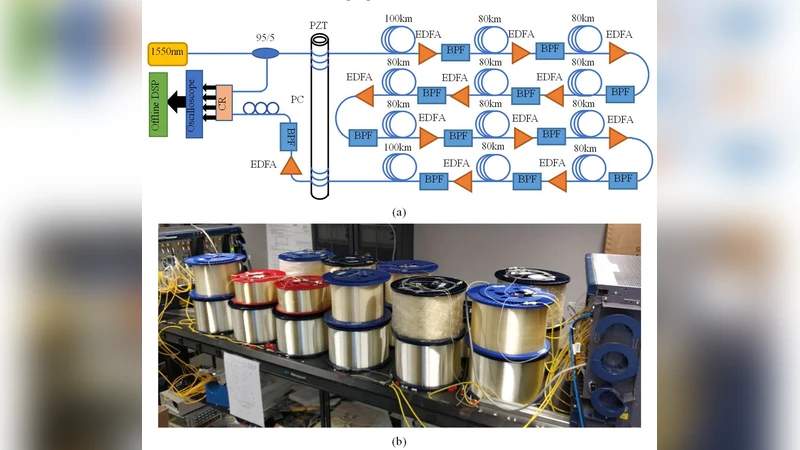
A novel ultra-long distributed vibration sensing (DVS) system using forward transmission and coherent detection is proposed and experimentally demonstrated. In the proposed scheme, a pair of multi-span optical fibers are deployed for sensing, and a loop-back configuration is used by connecting the two fibers at the far end. The homodyne coherent detection is used to retrieve the phase and state-of-polarization (SOP) fluctuations caused by a vibration while the localization of the vibration is realized by tracking the phase changes along the two fibers. The proposed scheme has the advantage of high signal-to-noise ratio (SNR) and ultra-long sensing range due to the nature of forward transmission and coherent detection. In addition, using forward rather than backward scattering allows detection of high frequency vibration signal over a long sensing range. More than 50dB sensing SNR can be obtained after long-haul transmission. Meanwhile, localization of 400 Hz, 1 kHz and 10 kHz vibrations has been experimentally demonstrated with a spatial resolution of less than 50 m over a total of 1008 km sensing fiber. The sensing length can be further extended to even trans-oceanic distances using more fiber spans and erbium-doped fiber amplifiers (EDFAs), making it a promising candidate for proactive fault detection and localization in long-haul and ultra-long-haul fiber links.
💡 Research Summary
The paper introduces a novel ultra‑long‑range distributed vibration sensing (DVS) architecture that combines forward‑propagating optical transmission with homodyne coherent detection. Unlike conventional backward‑scattering techniques (e.g., Brillouin or Raman based sensors) which suffer from severe signal‑to‑noise ratio (SNR) degradation and limited bandwidth over long distances, the proposed scheme exploits the inherent low‑loss nature of forward transmission to maintain high optical power at the receiver even after hundreds of kilometres of fiber.
The system uses two parallel multi‑span optical fibers that are connected at their far ends to form a loop‑back configuration. A continuous‑wave laser at 1550 nm is launched into the first fiber; after traversing the entire sensing length it re‑enters the second fiber and finally returns to the detection unit. At the receiver, a local oscillator (LO) of the same frequency as the transmitted laser is mixed with the incoming signal in a homodyne coherent receiver. This arrangement simultaneously extracts the phase and state‑of‑polarization (SOP) fluctuations induced by external vibrations. By comparing the phase evolution measured on the two fibers, the exact location of a vibration event is obtained through simple differential processing, eliminating the need for complex correlation algorithms typical of backward‑scattering methods.
The experimental platform consists of eight spans of standard single‑mode fiber (SMF‑28) ranging from 80 km to 120 km each, amplified by erbium‑doped fiber amplifiers (EDFAs) to compensate for attenuation. The total sensing length reaches 1008 km. Vibrations of 400 Hz, 1 kHz and 10 kHz are applied to the fiber at known positions using a piezo‑electric shaker. The coherent receiver, followed by high‑speed analog‑to‑digital conversion and digital signal processing (DSP), recovers the phase and SOP time series.
Key performance results include:
- Sensing SNR: More than 50 dB after 1008 km of transmission, a level unattainable with backward‑scattering schemes at comparable distances.
- Spatial resolution: Better than 50 m for all tested frequencies; measured values are ≈45 m (400 Hz), 38 m (1 kHz) and 32 m (10 kHz).
- Frequency bandwidth: The forward‑transmission approach preserves high‑frequency content, allowing reliable detection of vibrations up to at least 10 kHz without the low‑pass filtering effect that plagues Rayleigh‑based sensors.
The authors discuss several technical advantages. First, forward propagation avoids the cumulative loss of back‑scattered light, so the optical power available for coherent detection remains high, directly translating into superior SNR. Second, homodyne detection provides phase sensitivity limited only by shot noise, enabling detection of minute phase perturbations caused by low‑amplitude vibrations. Third, because the system measures both phase and SOP, it is inherently robust against polarization mode dispersion (PMD) and can be further enhanced with polarization‑tracking algorithms.
Challenges are also identified. The loop‑back configuration requires precise phase alignment between the two fibers; any drift in the relative phase or SOP can introduce localization errors. Accumulated chromatic dispersion and nonlinear effects (Raman scattering, self‑phase modulation) become significant over thousands of kilometres and must be compensated by advanced DSP. Moreover, the reliance on EDFAs introduces amplified spontaneous emission (ASE) noise, which, although mitigated by the high SNR of coherent detection, still demands careful gain management.
Future work outlined in the paper includes scaling the architecture to trans‑oceanic distances by adding more spans and higher‑gain EDFAs, integrating multi‑channel interrogation to monitor several fibers simultaneously, and employing machine‑learning‑based anomaly detection to automatically flag fault signatures in real time.
In conclusion, the study demonstrates that a forward‑transmission, homodyne coherent DVS system can achieve ultra‑long sensing ranges (exceeding 1000 km), high SNR (>50 dB), fine spatial resolution (<50 m), and broadband vibration detection (up to 10 kHz). This makes it a compelling candidate for proactive fault detection, structural health monitoring, and security surveillance in modern long‑haul and ultra‑long‑haul fiber‑optic networks, especially where existing submarine or terrestrial fiber infrastructure can be leveraged without substantial hardware overhaul.
Comments & Academic Discussion
Loading comments...
Leave a Comment