Connectivity-Preserving Swarm Teleoperation Over A Tree Network With Time-Varying Delays
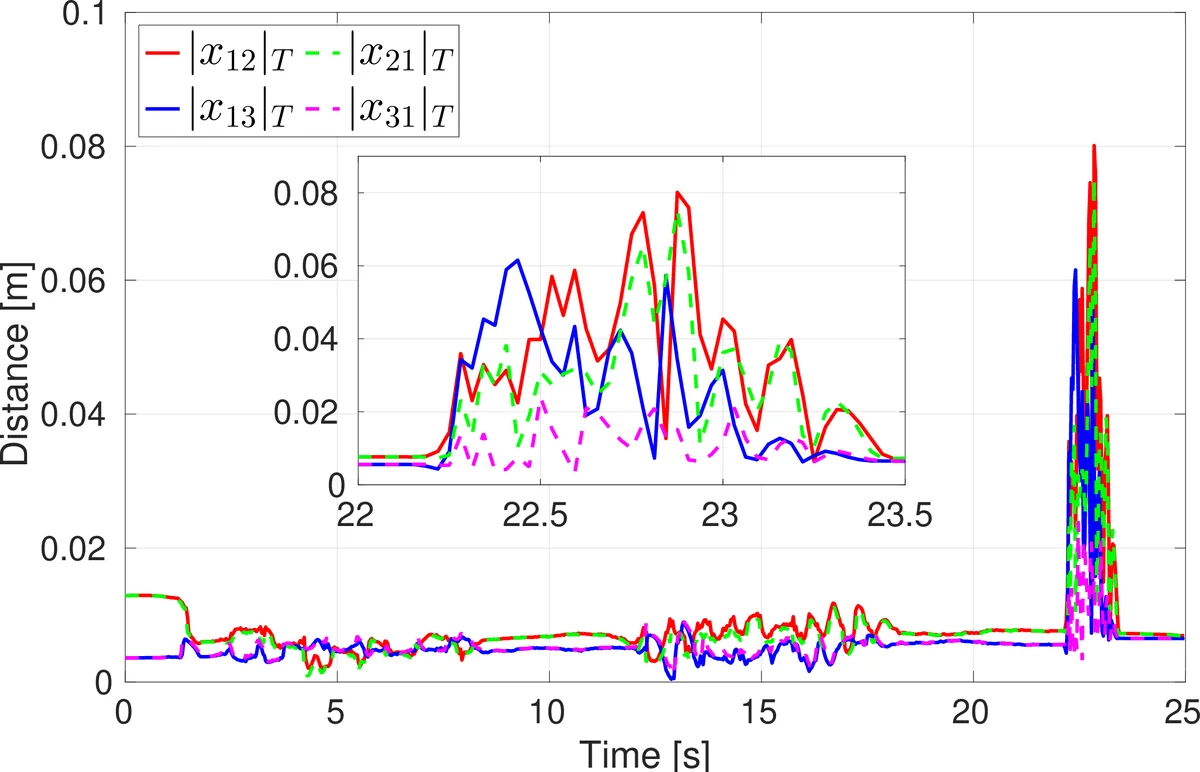
A teleoperated swarm must follow the unpredictable commands of its human operator while remaining connected. When the swarm communications are limited by distance and affected by delays, both the user input and the transmission delays endanger the connectivity of the swarm. This paper presents a constructive control strategy that overcomes both threats. The strategy modulates the intra-swarm couplings and the damping injected to each slave in the swarm based on a customized potential. Lyapunov-based set invariance analysis proves that the proposed explicit gain updating law limits the impact of the operator input and preserves the initial tree connectivity of a delay-free swarm. Further augmentation with stricter selection of control gains robustifies the design to time-varying delays in intra-swarm communications. The paper also establishes the input-to-state stability of a teleoperated time-delay swarm under the proposed dynamic control. Experiments validate connectivity maintenance and synchronization during time-delay swarm teleoperation with the proposed control.
💡 Research Summary
This paper addresses the challenging problem of maintaining connectivity in a teleoperated robot swarm when both unpredictable human commands and time‑varying communication delays are present. The authors consider a swarm of N Euler‑Lagrange (EL) agents forming an undirected tree graph G(t) with a single “informed slave” directly connected to a master device. All agents share the same communication radius r, and a link (i, j) exists whenever the Euclidean distance ‖x_i – x_j‖ is strictly less than r. The initial network is assumed to be a spanning tree and all initial edges are strictly inside the communication range (by a margin ε). The human operator’s command f is bounded, and each inter‑agent communication suffers a time‑varying delay T_ij(t) bounded above by a known constant.
The control objectives are threefold: (1) guarantee bounded velocities and inter‑agent distances in the presence of the operator input; (2) achieve asymptotic synchronization (positions and velocities converge to zero relative differences) when the operator input is absent; and (3) preserve every edge of the initial tree for all future time, thereby guaranteeing global connectivity.
Delay‑free control design
The authors first construct a distance‑dependent artificial potential V(·) that penalizes inter‑agent separations approaching the communication limit. The gradient of V yields attractive/repulsive coupling forces, while a state‑dependent damping term is added to each agent. Crucially, the coupling gains and damping coefficients are not fixed; they are updated online as functions of the current inter‑agent distances and the value of V. By expressing V̇ in terms of the weighted Laplacian L and the incidence matrix D, the authors apply a Lyapunov‑based set‑invariance analysis. They prove that V(t) never exceeds a pre‑specified safe bound, which directly implies that all edge distances remain below r‑ε, thus preserving the tree structure.
Extension to time‑varying delays
When communication delays are present, the agents act on outdated neighbor states, creating a mismatch between actual and perceived distances. To counteract this, the authors introduce two augmentations: (i) a stricter distance margin δ that accounts for the worst‑case position error induced by the maximum delay T_max and the maximum agent speed; (ii) a Lyapunov‑Krasovskii functional V̂ that incorporates the delayed state segment φ_t(·) over the interval
Comments & Academic Discussion
Loading comments...
Leave a Comment