Cooperative Intersection Crossing over 5G
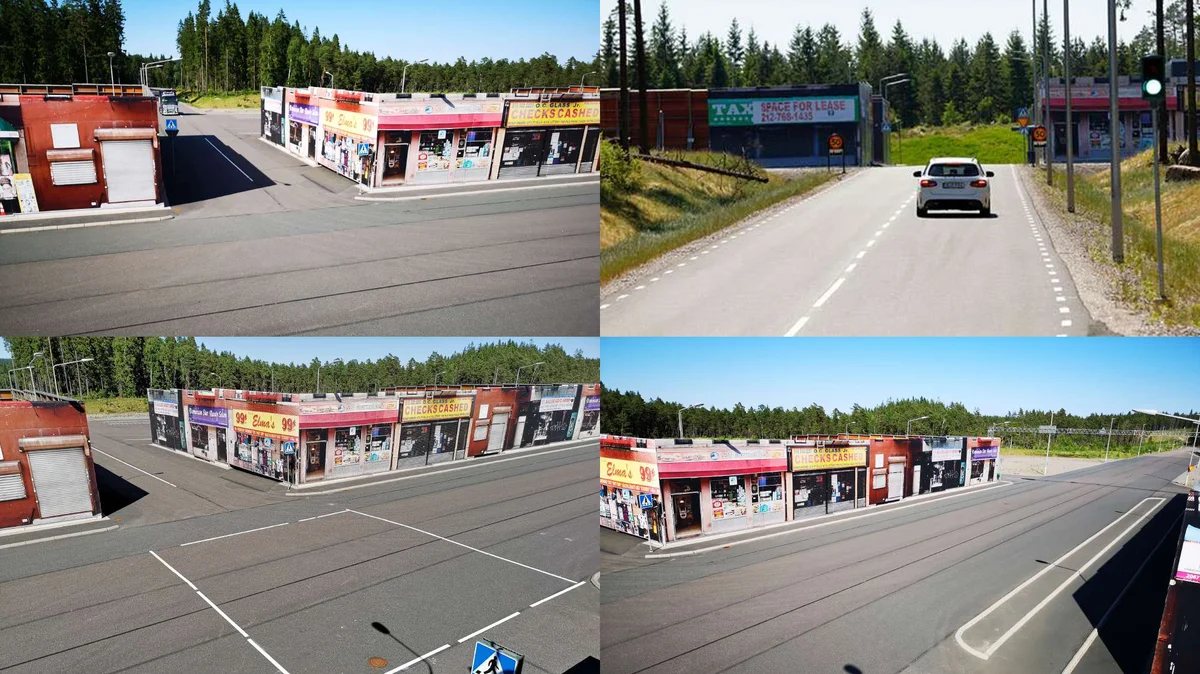
Autonomous driving is a safety critical application of sensing and decision-making technologies. Communication technologies extend the awareness capabilities of vehicles, beyond what is achievable with the on-board systems only. Nonetheless, issues typically related to wireless networking must be taken into account when designing safe and reliable autonomous systems. The aim of this work is to present a control algorithm and a communication paradigm over 5G networks for negotiating traffic junctions in urban areas. The proposed control framework has been shown to converge in a finite time and the supporting communication software has been designed with the objective of minimising communication delays. At the same time, the underlying network guarantees reliability of the communication. The proposed framework has been successfully deployed and tested, in partnership with Ericsson AB, at the AstaZero proving ground in Goteborg, Sweden. In our experiments, three autonomous vehicles successfully drove through an intersection of 235 square meters in a urban scenario.
💡 Research Summary
The paper presents a comprehensive solution for cooperative intersection crossing (CIC) of autonomous vehicles using a 5G‑based vehicle‑to‑vehicle (V2V) communication framework and a finite‑time distributed control algorithm. Recognizing that on‑board sensors alone cannot guarantee situational awareness in dense urban environments, the authors argue that cellular networks, specifically 5G with Ultra‑Reliable Low‑Latency Communication (URLLC), can overcome the shadowing and coverage limitations inherent to IEEE 802.11p/802.11a Wi‑Fi solutions. A side‑by‑side comparison (Table I) highlights 5G’s superior reliability, latency (sub‑5 ms round‑trip), and the advantage of leveraging existing cellular infrastructure without the need for additional roadside access points.
The system model treats each vehicle as a node in an undirected communication graph G_N = (V_N, E_N). Edges exist when two vehicles can exchange state information via the 5G network. The vehicle dynamics are simplified to a double integrator: (\dot p_i = v_i), (\dot v_i = u_i), where (p_i) is the distance from the vehicle to the centre of its intended trajectory and (v_i) its longitudinal speed. The cooperative objective is to form a virtual platoon inside a Cooperation Zone (CZ) surrounding the Conflict Area (CA). Within this virtual platoon, each pair of neighboring vehicles (i, j) must achieve a prescribed safe inter‑vehicular gap (p^*{ij}=r{ij}+h v_i) (with (r_{ij}) the stand‑still distance and (h) a headway time) while synchronising their velocities to a common value, thereby guaranteeing that at most one vehicle occupies the CA at any instant.
To enforce these constraints, the authors design a nonlinear distributed control law based on the signum‑type “sig” function and a finite‑time Lyapunov framework. By constructing a Lyapunov candidate (V(x)) and showing that (\dot V + c V^{\alpha} \le 0) for some (c>0) and (\alpha\in(0,1)), they invoke the finite‑time stability theorem to prove that the error dynamics converge to zero within a calculable finite time (T). This guarantees that the desired formation is reached before the first vehicle enters the CA, satisfying hard real‑time safety requirements. Because the control law only requires information from immediate neighbours, computational load scales linearly with the number of adjacent vehicles, making the approach suitable for dense traffic scenarios.
The communication stack is implemented on Ericsson’s pre‑5G proof‑of‑concept (PoC) platform, which combines LTE‑Advanced radio with a 5G Evolved Packet Core (EPC). Experiments were conducted at the AstaZero proving ground in Gothenburg, Sweden, using three autonomous vehicles (Volvo XC90, Volvo S90, and a Volvo FH‑16 truck). The test scenario involved a 235 m² four‑way intersection without traffic lights. Measured network performance showed an average one‑way latency of 3.8 ms and a packet loss rate of 0.02 %, confirming the ultra‑reliable nature of the link. The vehicles successfully negotiated crossing order based on their distances to the centre, applied the distributed control law, and traversed the intersection in an average of 2.8 seconds without collisions or abrupt braking. The control inputs remained within actuator limits, and the inter‑vehicular gaps converged to the prescribed values well before any vehicle entered the CA.
The authors discuss limitations and future work. The experimental validation involved only three vehicles and a simple rectangular intersection; extending the methodology to multi‑lane, multi‑directional junctions, incorporating pedestrians, and scaling to larger fleets are identified as next steps. Moreover, integration with standardized V2X protocols (e.g., C‑ITS, ETSI ITS‑G5) and a deeper analysis of security, cost, and deployment strategies for 5G‑based V2X in real cities are suggested. Nonetheless, the paper demonstrates that 5G URLLC combined with finite‑time distributed control can meet the stringent safety and latency demands of cooperative autonomous driving, providing a viable pathway toward large‑scale, city‑wide intersection management.
Comments & Academic Discussion
Loading comments...
Leave a Comment