Structured Dictionary Learning for Energy Disaggregation
The increased awareness regarding the impact of energy consumption on the environment has led to an increased focus on reducing energy consumption. Feedback on the appliance level energy consumption can help in reducing the energy demands of the consumers. Energy disaggregation techniques are used to obtain the appliance level energy consumption from the aggregated energy consumption of a house. These techniques extract the energy consumption of an individual appliance as features and hence face the challenge of distinguishing two similar energy consuming devices. To address this challenge we develop methods that leverage the fact that some devices tend to operate concurrently at specific operation modes. The aggregated energy consumption patterns of a subgroup of devices allow us to identify the concurrent operating modes of devices in the subgroup. Thus, we design hierarchical methods to replace the task of overall energy disaggregation among the devices with a recursive disaggregation task involving device subgroups. Experiments on two real-world datasets show that our methods lead to improved performance as compared to baseline. One of our approaches, Greedy based Device Decomposition Method (GDDM) achieved up to 23.8%, 10% and 59.3% improvement in terms of micro-averaged f score, macro-averaged f score and Normalized Disaggregation Error (NDE), respectively.
💡 Research Summary
Energy disaggregation – the process of extracting appliance‑level consumption from a household’s aggregate power signal – has become a key tool for providing consumers with actionable feedback and for enabling demand‑side management. Existing approaches, ranging from deep neural networks to sparse coding and matrix factorization, typically treat each appliance independently and rely on learned “dictionary atoms” (or powerlets) that represent the appliance’s various operating modes. While effective in many cases, these methods struggle when different appliances exhibit similar power signatures, leading to ambiguous assignments and degraded performance.
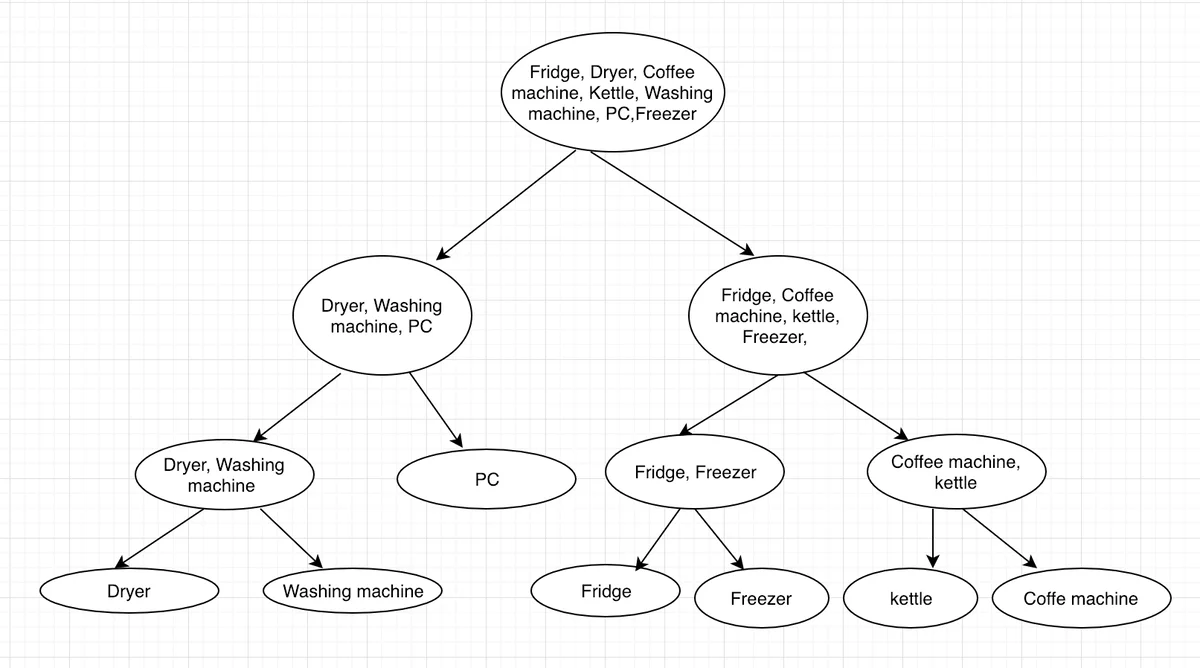
The paper by Pandey and Karypis tackles this core limitation by exploiting the observation that many appliances tend to be used together in specific operational contexts (e.g., a stove and its exhaust fan, or a refrigerator and a microwave during food preparation). Rather than attempting to separate all devices simultaneously, the authors propose a hierarchical decomposition of the device set into smaller, more informative sub‑groups. Each sub‑group’s aggregate power pattern is learned as a set of powerlets, thereby capturing the joint behavior of co‑operating devices at particular modes.
Two algorithms for constructing the hierarchical device decomposition are introduced:
-
Greedy based Device Decomposition Method (GDDM) – Starting from the full device set, GDDM recursively splits a node into two halves, selecting the split that yields the greatest reduction in reconstruction error on the training data. The split is guided by the presence of distinctive joint powerlet patterns, effectively grouping devices that co‑occur at characteristic modes.
-
Dynamic Programming based Device Decomposition Method (DPDDM) – This approach exhaustively evaluates all possible binary partitions using dynamic programming to find a globally optimal tree structure. While more computationally intensive, DPDDM provides a benchmark for the quality of the greedy heuristic.
Once the binary tree is built, the learning phase proceeds in two steps. First, powerlets for each node (i.e., each device subset) are extracted from the raw time series using a simple k‑medoid clustering of sliding‑window vectors, which is computationally cheaper than the DS3 algorithm used in the original PED framework. Second, the disaggregation problem at each node is formulated as a semi‑definite programming (SDP) problem and solved with the Alternating Direction Method of Multipliers (ADMM). This SDP‑ADMM pipeline is more scalable than the non‑convex optimization employed by prior recursive models such as DSCRDM.
Experimental evaluation on two publicly available datasets (e.g., REDD and UK‑DALE) demonstrates that the hierarchical approach consistently outperforms baseline methods, including the original Powerlet‑based Energy Disaggregation (PED) and Deep Sparse Coding based Recursive Disaggregation Model (DSCRDM). The Greedy method (GDDM) achieves up to 23.8 % improvement in micro‑averaged F‑score, 10 % in macro‑averaged F‑score, and a striking 59.3 % reduction in Normalized Disaggregation Error (NDE). DPDDM yields comparable gains but at higher computational cost.
Key contributions of the work are:
- Introduction of a joint‑mode aware hierarchical decomposition that transforms a difficult many‑to‑many disaggregation problem into a series of simpler sub‑problems.
- Development of the GDDM heuristic, which balances performance and efficiency, making the approach viable for real‑time or resource‑constrained deployments.
- Adoption of ADMM‑based SDP optimization, providing a scalable solution that can handle large‑scale power data without sacrificing accuracy.
The authors acknowledge limitations: the binary tree depth grows with the number of appliances, potentially increasing inference latency; hyper‑parameters such as window length and number of clusters influence results and currently require manual tuning. Future directions include exploring multi‑way (non‑binary) trees, integrating Bayesian model selection for automatic structure learning, and combining the hierarchical framework with deep learning encoders for richer feature representations.
In summary, the paper presents a novel, practically effective strategy for energy disaggregation by leveraging concurrent appliance operation modes within a hierarchical dictionary‑learning framework, achieving substantial accuracy gains over state‑of‑the‑art baselines and opening avenues for more intelligent, user‑centric energy management systems.
Comments & Academic Discussion
Loading comments...
Leave a Comment