Pareto Optimal Demand Response Based on Energy Costs and Load Factor in Smart Grid
Demand response for residential users is essential to the realization of modern smart grids. This paper proposes a multiobjective approach to designing a demand response program that considers the energy costs of residential users and the load factor…
Authors: Wei-Yu Chiu, Jui-Ting Hsieh, Chia-Ming Chen
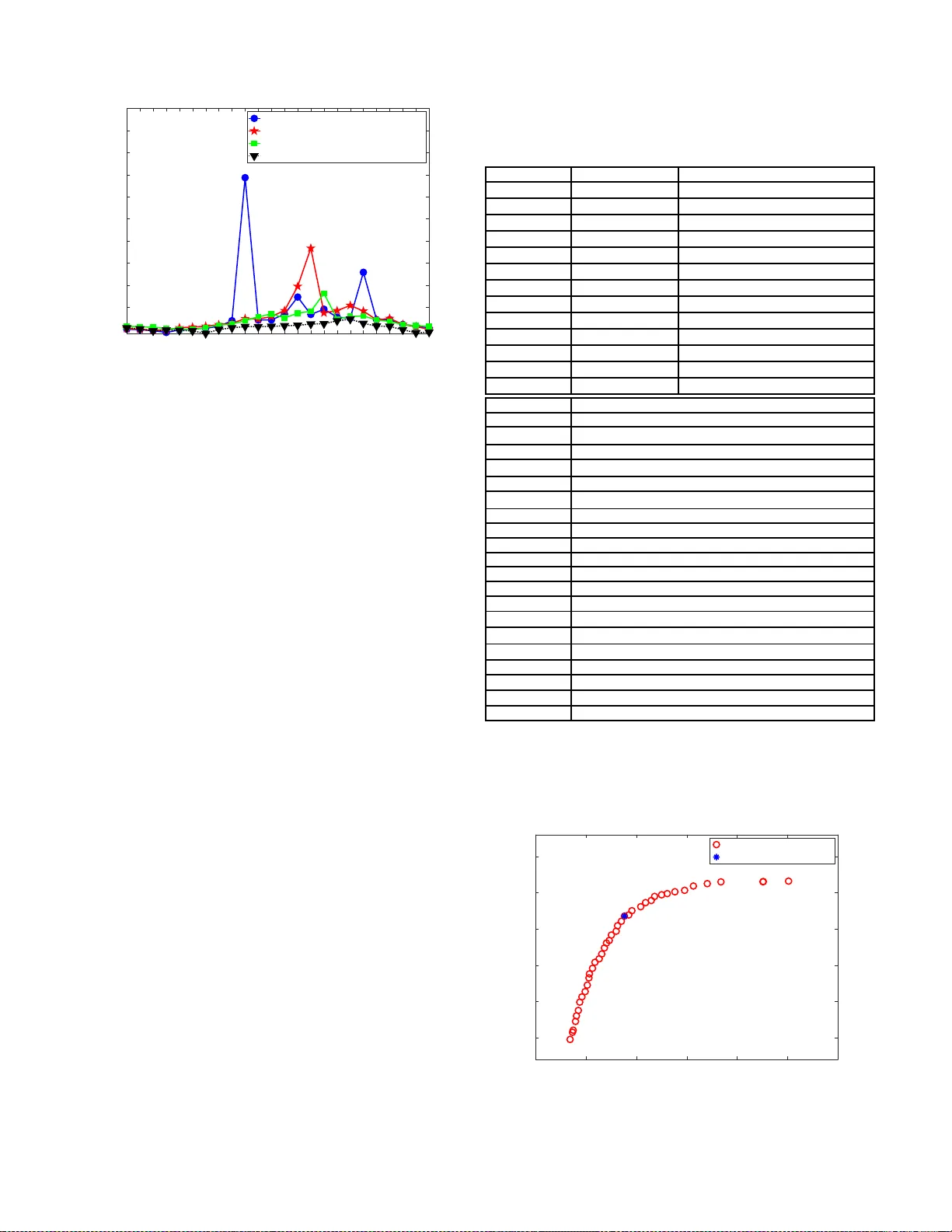
1 P areto Optimal Demand Response Based on Ener gy Costs and Load F actor in Smart Grid W ei-Y u Chiu, Member , IEEE , Jui-Ti ng Hsieh, and Chia-Ming Chen Abstract —Demand response f or residential users is essential to the realization of modern smart grids. This paper proposes a multiobjective appro ach to designing a demand re sponse program that consid ers the energy costs of residential users and the load factor of the und erlying grid. A multiobjectiv e optimization problem (MOP) is formulated and Pare to optimality is adopted. Stochastic sear ch methods of generating feasible values f or decision variables are p roposed. Theore tical analysis is perf ormed to show that the p roposed methods can effectiv ely generate and p reser ve f easible points during the solution p rocess, which comparable methods can hardly achiev e. A multiobjective ev olutionary algorithm is developed to solve the M OP , producing a Par eto optimal demand r esponse (PODR) progra m. Simulations re veal th at the proposed method outperfo rms th e comparable methods in terms of energy costs while pro ducing a satisfying load factor . The propose d PODR program is abl e to systematically balance the needs of the grid and residential users. Index T erms —Cost minimization, day-ahead pricing, demand response, energy consumption schedu ling, EV charging, load factor maximization, Pareto optimality , Pareto optimal demand response. I . I N T RO D U C T I O N I N e xisting power grids, power plants usually deliver a unidirectio nal power fl ow to customers, converting only one-thir d of the total energy in th e ir fuel into electr icity and wasting the heat p rodu c e d. T wenty percent of a power grid’ s gen e ration cap a city is o f ten u sed only to cover peak loads that acco u nt for approx imately five percent of the time [1], [2]. When n atural disasters occur , conv entional power grids are unab le to r esist or self-h eal. Next-g eneration p ower grids, k nown as smart g rids, h ave been proposed an d d e sig ned to replace traditio nal power grid s with the aim of redu c- ing transmission loss, generating electricity mo r e e fficiently , and resisting or self-healing after natural d isasters. A few governments hav e ad opted p roactive policies to popula r ize smart grids and co nstruct related in frastructur e. Smar t grids are expected to have higher electricity transmission stability , detect faults and self-h e al, allow bid ir ectional energy an d inf ormation This work wa s supported by the Ministry of Scien ce and T e chnology of T ai wan under Grant MOST 108-2221-E-007-10 0. (Correspondi ng author: W e i-Y u Chiu.) W .-Y . Chiu and C.-M. Chen are with the Department of Electrica l En- gineeri ng, Nationa l T sing Hua Univ ersity , Hs inchu 30013, T aiw an (e-mail: chiuwei yu@gmail.com). J.-T . H s ieh is with the Depa rtment of Electrical Enginee ring, Y uan Ze Uni versit y , T ao yuan 32003, T aiwa n. c 2019 IEEE. Personal use of this materi al is permitted. Permission from IEEE must be obtained for all other uses, in any current or future media, includi ng reprinting/re publishing this materi al for adverti sing or promotional purposes, creating new collect iv e works, for resale or redistri butio n to servers or lists, or reuse of any copy righted component of this work in other works. Digital Objec t Ide ntifier 10.1109/TII.2019.2928 520 flow between customers and suppliers, and reliab ly defend against attacks o r natur al disasters [3], [4]. In a smart grid, the real-time energy co nsumptio n profiles of residential users are crucial to power supplier s [5]. W ith this informa tio n, suppliers or local tradin g cen ters can design a dynamic pricing scheme that stren gthens m arket mec h anisms and encou rages users to shif t their pe a k loads [6] , [7]. Power scheduling can then be achieved through the direc t m inimiza- tion of energy consumption costs [8]–[15]. The change of demand cu rves in respo nse to pricing signals is term ed deman d response. Common pricing models include real-time pricing, day- ahead pricing, time-of- use pr icing, and critical-peak pricin g models [1 6]. Regardless of wh ich dy namic pricing sche m e is employed, suppliers can lower the cost of power gener ation if users’ peak lo ads are shifted. This ca n be achieved throu gh the use of demand response prog rams. Genera lly , shifting pea k loads is r elated to incre a sing t he load factor, which is the reciproca l o f the peak -to-average r atio [17], [18]. Howe ver , to fully utilize the grid capacity , the load factor is a m ore approp riate metric. Sev eral studies have incorp o rated the co ncept of load factor or peak-to- av erage ratio in to p ower schedu ling. Gam e theory approa c h es h ave been widely u sed for design ing dem and re- sponse p rogra m s [19]–[22]. Alth ough u nder cer tain co n ditions Nash eq uilibrium strategies can be Pareto optimal [23], it is no t always the case: payo ffs o f gam e players m ay b e improved simultaneously af te r a Nash equilib rium is attained [24]. Stochastic op timization su ch as gen etic a lgorithms has been app lied to attain a satisfactory load factor as well [25], yielding sing le-objective o ptimization p roblem s. So me draw- backs may inherit from such single-o bjective formulatio ns, such as the n eed of p rior decision making for the trad eoff between objectives [26]. Because demand response is closely related to pr icing signals, a d e mand response pro gram can be derived from a pricing scheme [27]. Kunwar et al. [28] pro posed an area- load b ased p ricing schem e fo r de mand side managem ent. The load factor and energy cost were jo intly optimized. Given pricing signals, the propo sed metho dolog y cou ld produ ce a prom ising deman d response program addr e ssing the two objectives. In contrast with single - objective optimizatio n, such a mu ltiobjective appr o ach could avoid, for example, the need of heur istic assignm ent for weightin g coe fficients and the need of pr io r decision making for tradeoffs ind uced by conflict- ing objectiv es. T here are, howe ver , a fe w importan t issues that were not covered by [28]. First, althou gh the approach considered shiftab le load s, they were addressed statistically . 2 In this c ase, n o integer or discrete decision variables wer e in volved in optimization , but they ar e importan t f or explicit control of shiftable loads. Second , owing to th e employed statistical mo delling, the impact of electric vehicles (EVs) was not explicitly examined. In gene r al, EVs pose different physical constraints and shou ld be distinguished from ordin ary home app liances. Third, renewable energy sourc es (RESs) th at have b een wid ely ad opted in residen tial comm unities wer e no t considered . Motiv ated by [ 28], we pro pose a m ultiobjective appr o ach that addresses the load factor and energy con sumption costs of residential users in separate dimen sions, leadin g to a mul- tiobjective optimiz a tio n pro b lem (MOP). Our system models include EVs and RESs. Regarding the MOP , power sch eduling profiles serve as the decision variables, consisting of c on- tinuous a n d discrete ones. For th ese two types of decision variables, feasible search me chanisms are developed by ex- ploiting constraint a n d variable structures. Relevant analysis is provided to sho w their effecti veness. Solving the MOP yields an ap p roxima te Pareto set and a Pareto front. A Pareto op timal solution is then selected to indicate how power loads should be adjusted over time, yielding a Pareto optimal de m and response (PODR) prog ram. This prog ram can be offered by utilities to residential u sers. The associated algo rithms or technologies are implemented in residen tial homes. The loa d f actor is re late d to gr id reliability fo r utilities while the e n ergy co st pertain s to the p articipation of re sid e ntial users. The main co n tributions of th is study are summarized as follows: First, we examine the grid load factor and en ergy costs of r esidential users using a multiobjective framework, and consider a combin a tio n of various typ e s of applian ces, an EV , and RESs. Th is com bination h as n ot been fully in vestigated in the literature when multiobjective op timization is applied for residential p ower scheduling . Second, we p ropose a few algorithm s that gen erate f e a sible values for decision variables, leading to a solution method for our MOP . Owing to physical constraints inv olving discrete and continu ous variables, this MOP can hardly b e solved by con ventional multiobjective ev olutionary algorithm s. Third, num erical simulations d emon- strate that o u r approach can be b eneficial to residential user s while achieving a satisfy in g load factor as com p ared to co m- parable methods. Finally , in addition to numerical evaluations, the p ropo sed alg orithms ar e the oretically analyz e d, provid ing a rig orous fou ndation for the prop osed PODR pr ogram. The rem ainder of th is paper is organized as follows : Sec- tion II discusses related work. Section III descr ibes mathe- matical mo d els of various h ome app liances, the en ergy co n- sumption costs of re sidential users, and the load factor of the power grid . The PODR program is proposed in Sectio n III. Section IV presents our simulatio n results inv olving compar- isons b etween existing deman d resp onse strategies. Fin ally , the paper conc ludes in Sectio n V . I I . R E L A T E D W O R K This section examines various meth ods employed to design demand respo nse p rogra m s for re sid e ntial users. T o facilitate discussions, the section is divided into two sub sections. The first subsection p r esents existing residential dema n d response methods inv olving the con c e pt o f th e load factor but withou t explicitly addressing it as an o bjective. This in cludes m ethods that have the load factor a s an o p timization co nstraint or hav e the load factor num erically analyzed in the simu lations. The second subsectio n investigates meth o ds that do n ot in volve the concept of the lo ad factor but perta in to ou r theme. A. Method s W ith Loa d F actor Game theo ry , co ntrol methods, mixed integer nonline a r progr amming, conve x optimization , and machine learning methods have been the m o st pro mising techniqu es emp loyed to r ealize residential dem and response inv olving the con c ept of the load factor . When gam e theory is used to m odel deman d re- sponse pro grams [29]–[3 5], two games ar e typically inv olved: one for suppliers such a s utilities and a g gregators, an d the other fo r cu sto m ers. A deman d respon se progr am is realized by attaining the Nash equilibrium of the gam es. Game theo ry approa c h es often inv olve b idding, but a bidding scheme for residential dem a nd respo nse can also be realized u sing other technique s, see, for example, [3 6]. Game theory approaches can be further comb ined with block chain tec h nolog ies to improve network security [37]. Control strategies h ave been applied for demand r esponse services as well [38]. In this case, state-spa c e represen tations are mostly employed to model system dynam ic s. For instance, Luo et al. [39] prop o sed a mu ltistage ho me e n ergy manag e- ment system co nsisting of for ecasting, d a y -ahead schedulin g, and actual oper ation. At the day-ahe a d sched uling stage, a co- ordinated ho me en ergy resourc e sch eduling m odel con strained by the peak-to- av erage ratio was construc te d to m inimize a one-da y home operation c o st. At the actual ope ration stage, a mod el predictive con trol based op erational strategy was propo sed to co rrect ho me en ergy resource op erations with the update of real-time inf ormation . Models for r esidential energy deman d have drawn muc h attention [40], [41]. When mod els are certain o r can be reliably estimated, mixed integer n onlinear pro gramm ing that in volves discrete decision variables can be applied [ 42]–[45]. In this case, discrete or integer decision variables often represent shiftable lo ads that can be adjusted to change demand curves. If a ssociated pro blem form ulations do n ot inv olve discrete or integer decision variables, then c o n ventional line a r pro gram- ming is applicable to residential demand man agemen t [46]. Con vex optimization methods have been applied to solve a subpr o blem fo r demand r esponse pro grams [47], [48]. In [47], fo r example, an optimization pr oblem that addressed a trade-off between paym e nts and the discom fort of u sers was formu late d , yield in g bo th integer an d co ntinuou s variables. The pro blem was further separated into two subpro b lems, an d one of them was solved using co nvex optimizatio n methods. T o relax assump tions on entities in the system or pro bably to ad dress system uncertainties, r einforc ement lear n ing fo r demand respon se has been extensively studied recently [4 9]. Throu g h the learn ing pro cess, an age n t or agents can lear n how to optimize users’ consumption patterns. Con sid e ring the peak-to- av erage ratio, Bahrami et al. [50] p roposed an actor- critic structure th at reduced the expected cost o f users in 3 the a g gregate lo ad. Deh ghanp our et a l. [5 1] co nsidered air condition ing loads as agen ts and optimized their consumption patterns throu gh modify ing the temperature set- p oints of the devices. Both consum ption costs an d users’ comfor t prefer- ences were addr e ssed . Giv en the aforemention e d state- o f-the-a rt me th odolo gies, a few points sho uld be no ted. While shifting loads thr ough demand response pr ogram s proves promising , it is worth mentionin g that load shifting may ha ve impac t on d istribution systems [52], [53]. In additio n to routine oper ations, demand response programs can be utilized for emergen cy ope r ations [54]. For a c ompreh ensive r evie w , the read e r can refer to [55] and [ 5 6] o n resid e n tial dema nd and to [57] on a case study illustrating th e bene fits of demand respon se in c o nsideration of residen tial users and utilities’ load factor . B. Method s W ithout Loa d F actor This subsection examines recent studies on dema nd re- sponse programs withou t explicitly in volving the con c ept of the load factor; an energy manage m ent system has been a dominan t way o f realizing a dem and respon se prog r am in response to utility pr icing sign als in the literature . Here is a list of examples. Hansen et al. [5 8] inv estigated a home energy manag e m ent system th at au tomated the energy usage. Observable Markov d ecision process appro aches were pro- posed to min imize the hou sehold electricity bill. Shafie-Kh ah et al. [59] prop osed a stoch astic energy mana g ement system that considered un c ertainties o f the distributed ren ewable re- sources and th e EV av ailab ility fo r charging and discha rgin g. Adika and W ang [36] examined a day-ahead de m and-side bidding appro ach that m aximized residential users’ benefits. Rastegar et al. [60] constructed a two-lev el framework for residential energy manag ement. Customer s minim ized their paymen t costs and sent out the desired power scheduling of ap p liances at the first lev el; a m ultiobjective op timization framework was employed to improve tech nical ch aracteristics of the distribution system at the seco nd level. Some auth ors fo c uses on the redu ction o f peak lo ads in residential demand respon se. V ivekananthan et al. [61] in- vestigated a reward based demand respo nse alg orithm that could shave network pe aks. Zho u et al. [62] established a multiobjective mod el of time-of-u se and stepwise power tariff for residen tial users, yielding load shifting from p e ak to off- peak pe riods. Most recently , learnin g b ased appro aches to residen tial demand response have em e rged, see, f or example, [ 6 3], [6 4] and [65]. In addition to direct in vestigations on meth o dolog ies, tools have been developed to facilitate existing dem and re- sponse p rocesses. For instance, Paterakis et al. [66] employed artificial neural networks and the wa velet tran sform to predict the r esponse of r e sidential load s to price sign a ls. W ang et a l. [67] developed a method for estima tin g the residen tial demand response b aseline. Finally , it is worth mention ing th at residen tial u ser beh aviors may b e studied in an aggregate manner, thereb y intro ducing the concept of residential demand aggregation [68]. T wo emerging topics a r e dema n d response method s for r e sid en- tial hea tin g, ventilation , and air cond itioning [69]–[7 1] an d /ϴϬ Ϯ ϯ /ϴϬϮϭϭ / ϭϵ Ϭϭ W Žǁ Ğ ƌƉ ůĂŶ ƚƐ ^Ƶ ď Ɛ ƚ Ăƚ ŝŽŶ Ğ ŵĂŶ Ě ƌĞƐƉ Ž Ŷ ƐĞ Ɖ ƌŽŐƌĂŵ ůĞĐ ƚƌ ŝĐŝƚLJ ƚƌĂ ŶƐ ŵ ŝƐ Ɛ ŝŽŶ ůĞ Đƚƌ ŝĐŝƚLJ ƚƌĂ ŶƐ ŵŝƐ Ɛ ŝŽŶ ůĞ Đƚƌ ŝĐŝƚLJ ƚƌĂ ŶƐ ŵŝƐ Ɛ ŝŽŶ ůĞ Đƚƌ ŝĐŝ ƚLJ ƚƌĂ ŶƐ ŵŝ Ɛ Ɛ ŝŽŶ Ă ƚĂ ƚƌĂ ŶƐ ŵŝ Ɛ Ɛ ŝŽŶ Ă ƚĂ ƚƌĂ ŶƐ ŵŝ Ɛ Ɛ ŝŽŶ ĞŶƚƌĂů ĐŽŶƚƌŽů ůĞƌ ŝƌ ĞĐƚ ĐŽŶƚƌŽů ^Ƶ ď Ɛ ƚ Ăƚ ŝŽŶ Ă ƚĂ ƚƌĂ ŶƐ ŵŝƐ Ɛ ŝŽŶ Fig. 1. System diagr am of power suppliers and users in an Internet of T hings based env ironment. demand response methods for residential plug-in EVs [72]– [74]. I I I . S Y S T E M M O D E L S This section discusses math e matical m odels describing the power consump tio n of home appliances, en ergy costs of residential users, and load factor of th e grid. T he day -ahead pricing scheme is con sidered. T o realize an automatic d emand response prog ram, we consider an Internet of Th ings based en viron m ent with home appliances ab le to transmit an d receiv e signals [75], [76]. Th ese home ap pliances can be con trolled by a centra l controller using IEEE standar ds, such as IEEE 802.3, IEEE 8 0 2.11 , or I EEE 19 01. Fig. 1 presen ts the system diagram and T ab le I summarizes n otations and acronym s used throug hout this paper . A. Home A ppliance s Home ap pliances can be classified in to thre e types [77]: unshiftable an d in flexible applian ces (the corr e sp onding set is denoted by A ), shif ta b le and inflexible app lian ces (the correspo n ding set is denoted by A S ), and shiftable and flexible appliances (th e cor respond ing set is denoted by A S F ). Th e loads in duced by u sing those ap pliances can be classified accordin g ly . Let h ∈ H d enote the time slot and ∆ h de note the slot duration . 1) Unshifta ble a nd Inflexible Ap pliances: So me h ome ap- pliances are u sed du ring specific time p eriods. For example, lights must be turned on in the ev ening, and it may not be possible to shif t the time of u se or adju st their switching time. Cooking appliance s, such as elec tric pots, roasters, and microwa ve ovens, a re also used in specific time slots. Residential users may u se en tertainmen t electronics such as 4 T ABLE I N O TA T I O N S h Time slot h where h ∈ H H Observ ation horizon (the size of H ) A Set of unshiftable and infle xible appliance s a Unshiftabl e and inflexible applia nce p h a Amount of power for applianc e a to operate in time slot h A S Set of shiftable and infle xible applianc es b Shiftabl e and inflexibl e appl iance h b W orking time slot of appl iance b s b and e b Start and end time slots of appliance b w b T otal working hours of appli ance b p h b ( h b ) Amount of po wer for applianc e b to operat e in time slot h A S F Set of shiftable and flexi ble appliances c Shiftabl e and flexible appli ance s c and e c Start and end time slots of appliance c p h c Amount of po wer for appli ance c to operat e in time slot h p max c Maximum opera ting power of applianc e c p min c Minimum opera ting power of applianc e c p min c, agr Aggreg ate minimum po wer for using appliance c s ev and e ev Start and end time slots of EV battery char ging p h ev EV char ging po wer in time slot h p max ev Maximum char ging rate of an EV B 0 ev Initia l ca pacity of the EV battery B min ev Minimum capa city of the EV battery B max ev Maximum capa city of the EV batte ry B 0 Initia l ca pacity of the reside ntial energy storage system B h Energy lev el of the residential energ y storage system in time slot h B min Minimum capacity of the residential energy storage system B max Maximum capac ity of the residenti al energy storage system u h Char ging and dischargi ng control for the residenti al energ y storage s ystem in time slot h r h Amount of powe r provided by rene wable energy sources in time slot h televisions and comp uters only after work or scho ol. These appliances are thus regarded as unshiftable and inflexible. For a ∈ A , we deno te p h a as the amount of power for ap p liance a to o perate in time slot h . 2) Sh ifta ble an d Infl exible A p pliances: Shiftable and in- flexible appliances are used at potentially any time, but their power consu mption when perf orming a spe c ified job is fixed (and thus inflexible). V acuum cleaners and w ashing mach ines belong to this type . The time at which a n au tomatic vacuum machine o r a washing m achine is operated may no t be c r ucial (assuming th a t they do not make too m uch no ise; other wise, they should not be o perated at nigh t) . A user co uld prescribe a possible time window , and then the demand response prog ram could d ecide when the device op erates accor d ing to these instructions. The time window mu st be sufficient for the appliance to comp le te the job. Let w b denote the total working hours required b y ap- pliance b ∈ A S . Suppose th at a residential user sets the acceptable star t an d end time slots of applianc e b ’ s opera tion as s b and e b , r espectively ( s b ≤ e b ). Let C s b → e b w b denote the set of all w b -combin ations of workin g time slots within the time wind ow [ s b , e b ] . A d emand respo n se progr am thu s selects certain working time slots represented by h b from C s b → e b w b for appliance b , i.e., h b ∈ C s b → e b w b ∀ b ∈ A S . (1) For instan ce, if s b = 15 , e b = 17 , and w b = 2 ( i.e., a p pliance b n eeds 2 h ours to finish its work), the n C s b → e b w b = {{ 15 , 16 } , { 15 , 17 } , { 16 , 17 }} and h b could be equal to { 15 , 16 } , { 15 , 17 } or { 16 , 17 } . If h b = { 15 , 16 } , then appliance b oper ates f rom 14:00 to 16:0 0 . The associa te d po wer f o r ap pliance b to operate in time slot h is denoted p h b ( h b ) where p h b ( h b ) = 0 if h b ∩ { h } = ∅ . 3) Sh ifta ble and Flexible App liances: The u se o f shiftable and flexible appliances can be adjusted in two d imensions: when the appliances are used an d how much power th ey should consume. Heaters, air con d itioners, and EV charging stations can yield shif table and flexible loads. For example, residential users can lower an air co ndition e r’ s temp erature setting (flexibility) and de lay its u se (shiftability) as they wish [9]. Let p h c denote th e amount of power for appliance c to operate in time slot h , where c ∈ A S F , and s c and e c denote the start and end time slots of ap pliance c , resp ectiv ely . The following constraints are im posed on p h c [13]: p min c ≤ p h c ≤ p max c and e c X h = s c p h c ≥ p min c, agr (2) where p min c and p max c represent the m inimum and maximu m operating power , respectively , and p min c, agr represents the aggre- gate minimum p ower for using appliance c , wh ich pertains to user c o mfort. T o ensur e th at feasible p h c , h = s c , ..., e c , exist, we assume ( e c − s c + 1) p max c > p min c, agr . (3) Although charging an EV can b e consider e d as a shiftable and flexible load, we exclude d EVs fr o m A S F because the charing power of an EV depend s on the rem aining capa c- ity o f the vehicle’ s b attery , which imposes addition al co n- straints [ 7 8]. Let p h ev denote the EV ch arging power in time slot h , and s ev and e ev be the start and e n d tim e slots o f th e battery charging, r espectively . The following constraints on the charging rate and EV ba tter y capac ity m u st be satisfied: 0 ≤ p h ev ≤ p max ev and B min ev ≤ B 0 ev + e ev X h = s ev p h ev ∆ h ≤ B max ev (4) where p max ev represents the maximu m charging rate, B min ev is the minim u m ca p acity of the EV battery , B 0 ev is the initial capacity , an d B max ev is the max imum cap acity . T o ensure that feasible p h ev , h = s ev , ..., e ev , exist, we assume B 0 ev + ( e ev − s ev + 1) p max ev ∆ h > B min ev . (5) B. Energy Cost and Loa d F a ctor A r esidential h ome can be integrated with ren ew able en ergy sources (RESs) and equip ped with a storage system for energy managem ent. Let B h be the en ergy le vel of the sto rage system ( B 0 represents the initial energy level), r h be the expected charging po wer from RESs, and u h be the control law that dictates the amou nt of power bein g charged to o r discharged 5 from the energy storage system. The storage dy n amics can be described as [79] B h = B h − 1 + ( r h − u h )∆ h. (6) The con straints on th e en ergy storage system are 0 ≤ B h ≤ B max ∀ h ∈ H (7) where B max is the maximu m storage capacity . The total energy extracted fr om th e grid in time slot h , denoted by E h total , can be expressed as E h total = max { X a ∈A p h a + X b ∈A S p h b ( h b ) + X c ∈A S F p h c + p h ev − u h , 0 } ∆ h. (8) If u h is greater than the total p ower deman d, then E h total = 0 and the excess energy is discarded. This situation can happen when r h is too large to b e stored in th e energy storage system and consumed by residential appliances. If u h < 0 , then − u h is the amo unt of power delivered to the e n ergy stor age system from the power grid. The total en ergy cost can be obtained by multip ly ing the to tal energy con sumption by the electricity price λ h : X h ∈H E h total λ h . (9) Unlike custom e r s, utilities are principally co ncerne d with the load factor . The load factor is critical because ge n eration cost an d grid quality have a direct connection with th e load factor . A higher load factor implies a m ore stable power grid and a lower cost o f p ower gene r ation [80]. T he loa d factor can be defined as the ratio o f the average demand to the maximum demand [17], [1 8]. The fo llowing p erform ance index can b e used in a dem and r esponse p rogram offered by utilities to improve their load factor: P h ∈H E h total /H max h ∈H E h total (10) where H is the size of H and rep resents the observation horizon . I V . P A R E T O O P T I M A L D E M A N D R E S P O N S E P RO G R A M This section p ropo ses the PODR p rogr a m that can be offered by utilities to residential user s. An MOP pertaining to power scheduling is form ulated. The objectives of the optimization prob lem are to m inimize the energy cost of a residential u ser in (9) and m aximize the load factor in (10). T o construct a stochastic sear c h scheme for explor ation and exploitation of the decision spac e , we analyze the associated decision variables and prop o se a few methods of feasible value gener a tions and mutatio n and cro ssover op erations tha t preserve feasibility . A mu ltiobjective ev olution ary algorithm for constructing the PODR program is de veloped accord ingly . Finally , the algorithm com plexity is discussed. The MOP is fo r mulated as min x f cost ( x ) = X h ∈H E h total λ h max x f LF ( x ) = P h ∈H E h total /H max h ∈H E h total subject to (2) , (4) , and (7) ∀ c ∈ A S F (11) where x denotes the decision variable vector that contains decision variables h b , p h c , p h ev , and u h for all b, c , and h . The objective functions are conflictin g , so the glob al optimal solution that optimizes both ob jectiv e function s simultane o usly does no t exist. T o solve th e M O P in ( 11), Pareto o ptimality is adopted [81]. A feasib le p oint x ′ , i.e., an x ′ that satisfies the co nstraints, d o minates an o ther fe asible p oint x ′′ if the condition s f cost ( x ′ ) ≤ f cost ( x ′′ ) and f LF ( x ′ ) ≥ f LF ( x ′′ ) hold true with at least one stric t inequality . A solutio n is nondo minated (a lso called Pareto optimal or Pareto efficient) if improving one ob je c tive value must y ield a degradation in the other ob jectiv e value [82]. A set of Pareto op timal solutio ns or nondo minated solution s is desired. A nondomin ated solution should b e selected from the set on the basis of its associated perfor mance represented by th e Pareto fr o nt. In the following discussions, we ad o pt a f ew terminolo- gies u sed in genetic alg o rithms [83]. Genetic algorithm s are stochastic search tech n iques that have roots in g enetics and employ a po pulation based method to find solutions to o p- timization p r oblems conventionally with a single o bjective. These algo r ithms begin with a set of points rand o mly in i- tialized. The set is termed the initial population. Poin ts in the populatio n are ev alu ated on the basis o f the o bjective fun ction, yielding function values called the fitne ss. With the h elp of the fitness, a set of new points are gener ated using mutation and crossover oper ations. Th ese opera tio ns togeth er with a selection operation based o n th e fitness ar e applied to improve an a verag e fitn ess value from population to p opulatio n . The aforemen tioned p rocedu re repeats iterati vely to produ ce new populatio ns until a stopping criter io n is satisfied. In genetic algor ithms, the mutation is performed on a candidate poin t and deri ves a new point term ed a mutant. The probab ility of having a mutan t is dictated b y a mutation rate. If the cand idate point is r epresented by a bin ary string using an encodin g scheme, then a typical mutation can be designe d as stochastically complemen ting bits from 0 to 1 or vice versa. While the m utation is applied to one candid ate p o int, the crossover is perfo rmed on a pair o f can didate points called the paren ts and pro d uces a correspond ing pair of poin ts called the o ffspring. T he p robab ility o f performin g the crossover operation is d ictated by a cro ssover rate. In the case of using the binary representation, a typical cr ossover op eration can be realized thr ough an exchan ge of sub strin gs of th e paren ts. T o add r ess con straints o f optimization prob le m s in genetic algorithm s, penalty method s can be u sed. A penalty functio n is added to the objective fu nction for p oint ev aluation. The fitness of a po in t beco mes a sum of the obje c tive functio n value an d a p enalty functio n value. For an infeasible po int, i.e., v iolating th e constraints, its penalty f unction v alue is 6 nonzer o (n egati ve for max imization p roblems an d p o siti ve for minimization problem s) a nd th us p enalizes the o bjective value. Because p oints with better fitness ar e p rone to be kept in populatio ns during the algo rithm iteration s, in feasible p oints can be grad ually removed, leading to a feasible set. Genetic alg orithms pr ovid e a gen eric framework for solvin g optimization problem s. Su itable modifications can r ender them more efficient and powerful. For example, we may use ce rtain schemes dedicated to th e proble m of interest that rand o mly generate feasible points and provide mutation and crossover operation s that preser ve the f easibility o f those p oints. As such, algor ith m effi ciency can be imp roved beca use more computatio ns are spent on impr oving f easible points instead of finding feasible ones. Further more, by inc o rpor a ting the concept of Pareto optimality into the fitness ev aluation, we may design algo rithms that can a d dress multiple objectives, which are termed m ultiobjective ev olution a ry algorithms. Although a few m ultiobjective e volutionary a lg orithms ar e av ailab le for findin g solutions of MOPs, most of the m consider either pure continu ous de cision variables or pure discrete decision v ariables. Th e situation in which both co ntinuou s an d discrete decision variables are in volved, as in our scenario, has n o t b een well add ressed [84]. In addition, the constra in ts in (11) can be difficult to address using con ventional con straint handling techniq ues. Metho ds o f feasible value gene rations and m utation an d crossover o peration s tha t preserve fea sibility are requ ired. T o solve (11), we first co nsider an enco ding scheme for discrete variables and present the associated mutatio n and crossover operation s. Continu ous variables are then addressed. For d iscrete variable h b , a feasib le value can b e readily g en- erated according to (1). Th e fo llowing en coding schem e and associated m utation and crossover opera tions are ado pted. Let φ ( h b ) b e a binary repre sen tation of h b with leng th e b − s b + 1 and [ φ ( h b )] j denote the j th b it of φ ( h b ) . The encod ing sch eme φ ( · ) is design ed as [ φ ( h b )] j = 1 , if j + s b − 1 ∈ h b 0 , otherwise (12) for j = 1 , 2 , ..., e b − s b + 1 . For instance, if s b = 15 , e b = 17 , w b = 2 , and h b = { 15 , 16 } , the n φ ( h b ) = 110; if h b = { 15 , 17 } , then φ ( h b ) = 10 1 . For the mutation oper ation, we rando mly find a pair ([ φ ( h b )] j , [ φ ( h b )] j ′ ) = (0 , 1) and switch their values. For the crossover oper ation, we apply logic operation “OR” to two b inary r epresentatio n s, and then random ly ch oose w b bits with value 1 from the offspring and conv ert the other b its with value 1 to value 0. T he co ndition in (1) is thus satisfied throu gh the use o f the m utation and crossover operations. For con tin uous d ecision variables p h c , p h ev , and u h , we note that th e f o llowing mu tation an d crossover op erations can produ ce feasible points in the decision space if points in volved are all feasible. Theorem 1: Let x h new denote a mutan t or offspring. The mutation or crossover is perf ormed accord ing to x h new = δ x h + (1 − δ ) x ′ h (13) where δ ∈ [0 , 1] is a rand om n umber f or all h . For the mutation operation , x h is a point in the p o pulation and x ′ h is a po int that is randomly generated . For the cr ossover operatio n, x h and x ′ h are d istinc t points in the population . If x h and x ′ h in (1 3) are feasible, then the mutan t or o ffspring x h new is feasible. Proof: Consid e r x h = p h c . If p h c and p ′ h c are f easible, then p h c ∈ [ p min c , p max c ] , p ′ h c ∈ [ p min c , p max c ] , e c X h = s c p h c ≥ p min c, agr , and e c X h = s c p ′ h c ≥ p min c, agr . W e have δ p h c + (1 − δ ) p ′ h c ∈ [ p min c , p max c ] and e c X h = s c δ p h c + (1 − δ ) p ′ h c ≥ p min c, agr for δ ∈ [0 , 1] . Therefo r e, p h new = δ p h c + (1 − δ ) p ′ h c is f easible. A similar argum ent can be per f ormed to show the feasibility proper ty when x h = p h ev . Consider x h = u h . If u h and u ′ h are feasible, then we have B h − 1 + ( r h − u h )∆ h ∈ [0 , B max ] and B ′ h − 1 + ( r h − u ′ h )∆ h ∈ [0 , B max ] . (14) Define B h new = δ B h + (1 − δ ) B ′ h and u h new = δ u h + (1 − δ ) u ′ h . By (1 4), we have B h − 1 new + ( r h − u h new )∆ h ∈ [0 , B max ] . Note that B h new = δ ( B h − 1 + ( r h − u h )∆ h ) + (1 − δ )( B ′ h − 1 + ( r h − u ′ h )∆ h ) = B h − 1 new + ( r h − u h new )∆ h. Therefo re, B h new ∈ [0 , B max ] , which implies that u h new is feasible. If the r e are metho ds of random ly generating f easible p o ints, then the feasibility can be preserved during the solution process using the mutation and crossover o peration s in Th eo- rem 1. Algorithms 1, 2, and 3 presen t th ose meth ods, and th eir effecti vene ss are further con firmed by the f ollowing theorem. Algorithm 1 Gen eration of Feasible p h c Input: s c , e c , p min c , p max c , and p min c, agr . Output: Feasible p h c , h = s c , ..., e c , that satisfy (2). Generate p h c random ly from [ p min c , p max c ] . while P e c h = s c p h c < p min c, agr do p h c := p h c + ( p max c − p h c ) δ h (15) where δ h ∈ [0 , 1 ] is a r andom numb er . end while 7 Algorithm 2 Generatio n of Feasible p h ev Input: s ev , e ev , p max ev , B 0 ev , B min ev , an d B max ev . Output: Feasible p h ev , h = s ev , ..., e ev , that satisfy (4). Generate p h ev random ly from [0 , p max ev ] . while P e ev h = s ev p h ev ∆ h < B min ev − B 0 ev do p h ev := p h ev + ( p max ev − p h ev ) δ h (16) where δ h ∈ [0 , 1 ] is a r andom nu mber . end while if P e ev h = s ev p h ev ∆ h > B max ev − B 0 ev then p h ev := B max ev − B 0 ev P e ev h = s ev p h ev ∆ h p h ev (17) end if Algorithm 3 Generatio n of Feasible u h Input: B 0 and r h . Output: Feasible u h , h ∈ H (i.e., the constrain ts in (7) are satisfied). for h = 1 : H do Randomly gen erate u h such that u h ∈ [ B h − 1 + r h ∆ h − B max ∆ h , B h − 1 + r h ∆ h ∆ h ] . (18) Evaluate B h = B h − 1 + ( r h − u h )∆ h. end for Theorem 2: Under the assump tions described in (3 ) and (5), Algorithms 1 , 2, and 3 pr oduce f e a sible values for p h c , p h ev , an d u h . Proof: Accor ding to (15) an d th e fact that p h c , h = s c , ..., e c , are initially g enerated fr om [ p min c , p max c ] , variables p h c , h = s c , ..., e c , with p h c ≥ p min c approa c h p max c from th e lef t as the number o f iteratio ns in creases. Owin g to the assum ption in (3), the cond itio ns in (2) ho ld tr ue eventually when the values of p h c , h = s c , ..., e c , increase. By a similar argument and ac cord- ing to (5) and (16), we have B min ev ≤ B 0 ev + P e ev h = s ev p h ev ∆ h ev entually when the values of p h ev , h = s ev , ..., e ev , increase; howe ver , it is possible that an increm ent is too large to h av e B 0 ev + P e ev h = s ev p h ev ∆ h ≤ B max ev . T o remedy this, we use (1 7) to r e d uce the values of p h ev , h = s ev , ..., e ev . When (17) is executed, we have the following two resu lts: p h ev on th e left- hand side of (17) satisfies p h ev < p max ev because the term ( B max ev − B 0 ev ) / P e ev h = s ev p h ev ∆ h on the right-h and side of (17) is less than 1; an d p h ev on the lef t-hand side o f ( 17) satisfies P e ev h = s ev p h ev = ( B max ev − B 0 ev ) / ∆ h. The conditions in (4) are then satisfied. Finally , we no te that (18) imp lies (7), illustrating the f easibility of u h . W ith the help of Alg o rithms 1 – 3, Algorithm 4 presents the PODR progr am that can be offered by utilities to residential users. In Algorith m 4, in formatio n about ap pliances and acce p table times of use is set first. Mu ta tio n an d crossover operation s are then performed over X ( t c ) in Step 2.1. I n Step 2 .2, the Algorithm 4 Pareto O p timal Power Scheduling Input: Electricity pr ice λ h ; MOP in (11) with parameters p h a , p h b , w b , s b , e b , p max c , p min c , p min c, agr , s c , e c , p max ev , s ev , and e ev ; mutation r a te µ ; n ominal popu la tio n size N nom ; m aximum populatio n size N max ; an d maximum iteratio n nu mber t max . Output: PODR progra m. Step 1 ) In itialize X (0) : rand omly gener ate working hou rs h b for shiftab le but inflexible app liances; apply Algo- rithms 1, 2, an d 3 to generate feasible values fo r p h c , p h ev , and u h . Remove domina te d p oints fro m X (0) . Step 2) Let t c = 0 . while t c ≤ t max do Step 2.1) Clon e po ints in X ( t c ) with c lone rate N max / N nom . Apply mu tation operatio n with rate µ and crossover op eration with rate 1 − µ d efined in Theorem 1 to cloned points. Store the m utants and offspring in X ( t c ) . Step 2.2) Remove d ominated p oints from X ( t c ) . If | X ( t c ) | > N nom , then use an archive update method to redu c e its size. Step 2.3) Let X ( t c + 1) = X ( t c ) and t c = t c + 1 . end while Step 3) Select the kne e of th e ap prox im ate Pareto fr ont associated with the app roxima te P areto set X ( t max ) . archive is u p dated by removing some nondo minated points if the po pulation size | X ( t c ) | is too large. After a numb er of iterations, an appro x imate Pareto set an d fr ont are obtained in Step 3. In p r actice, the knee of the app roxim a te Pareto fro nt is often prefe r red for several reasons: it can achiev e excellent overall system perfo rmance if th e fro n t is b e nt; it represen ts the solution closest to the ideal one that is not re a c hable; and it has rich geometrical and physical meanings [85], [86]. In Step 3, the kn ee solution is selected accord ing to [8 7]: x ∗ = arg min x ∈ X ( t max ) f cost ( x ) − min x ′ ∈ X ( t max ) f cost ( x ′ ) L cost + max x ′ ∈ X ( t max ) f LF ( x ′ ) − f LF ( x ) L LF (19) where L cost = max x ∈ X ( t max ) f cost ( x ) − min x ∈ X ( t max ) f cost ( x ) and L LF = max x ∈ X ( t max ) f LF ( x ) − min x ∈ X ( t max ) f LF ( x ) (20) are the maximum spread s of th e appro ximate Pareto front in the first and second dimensio n s, respectively , and min x ∈ X ( t max ) f cost ( x ) L cost max x ∈ X ( t max ) f LF ( x ) L LF T is the ideal vector . As sho wn in (19), the final Pareto o ptimal solu tion is se- lected usin g the sy stem’ s knowledge of the maxim um spread s, critical inform a tion in multicriteria decision makin g. Such informa tio n is not obtained usin g conventional single- objective optimization approach es. The knee so lu tion x ∗ correspo n ds 8 1 2 3 4 5 6 7 8 9 10 11 12 13 14 15 16 17 18 19 20 21 22 23 24 Time slot 2 4 6 8 10 12 14 16 18 20 22 Price (cent/kWh) 27 July 2017 (maximum price range) 6 July 2017 (25th percentile) 23 July 2017 (75th percentile) 29 July 2017 (minimum price range) Fig. 2. Pricing schemes used in our s imulati ons. to a P areto optimal power consumption pro file, yielding the PODR p rogra m . The complexity of Algorithm 4 mainly dep ends on the use o f Pareto con cepts that are the most compu tationally expensiv e. The comp lexity can be r ough ly expressed as [84] O (2 t max N nom ( t com + N nom − 1)) where t com represents the average compu tational time for objective evaluation. V . S I M U L A T I O N R E S U LT S This section presents an examina tio n of the power schedu l- ing of 400 residential users. 1 Each residence was equipped with at most thirteen unshiftab le and in flexible applian ces, three shiftab le and inflexible app liances, two shiftable and flexible appliances, o ne EV , and po ssibly one energy stor age system integrated with solar energy sou r ces. The exact n u mber of app liances and associated typ es for a residential user wer e random ly chosen. Solar e n ergy data in [88] were used. Let H = { 1 , 2 , ..., 24 } and ∆ h = 1 . T ab le II presents the a sso- ciated settings, an d the notation “un if ( h 1 , h 2 , t )” therein ind i- cates that an appliance require d t hours of working time start- ing f r om a nu m ber ran domly ch osen f rom { h 1 , h 1 + 1 , ..., h 2 } . For examp le , applian ce a 4 needed 5 h ours to comp lete the task, and th e start time slot could hav e b een 1 6, 1 7, or 18. Most parameter values were ch osen acco rding to [ 89] an d [90]. The day-a head prices illustrated in Fig . 2 were used [9 1]. After analyzin g total energy consump tion o f each mo nth in 2017, we discovered that energy consumptio n peaked in July . Four representative day s in July were selected and listed in a decreasing ord er in terms of their price r ange as follows: 27 July 201 7 (maximum price range), 6 July 201 7 (25th percentile), 23 July 2017 (75 th percen tile), and 29 July 2017 (minimum p rice r ange). Amo ng the m, 27 July 2 017 also had the h ighest price. 1 In [18], the total ava ilable capacit y of a region was set at 2296 kW . In our scenari o, each residentia l user consumes 5.5 kW at most, which thus account s for approxi mately 400 residentia l users in the region. T ABLE II S I M U L AT I O N P A R A M E T E R S Notatio ns Po wer W orking Schedule p h a 1 0.02 kW h ∈ { 17 , 18 , ..., 24 } p h a 2 0.22 kW unif(18, 22, 3) p h a 3 0.2 kW unif(11, 13, 3) p h a 4 0.2 kW unif(16, 18, 5) p h a 5 0.7 kW unif(18, 22, 1) p h a 6 1.3 kW unif(14, 16, 1) p h a 7 0.2 kW unif(18, 22, 1) p h a 8 0.08 kW unif(18, 20, 3) p h a 9 0.05 kW h ∈ { 1 , 2 , ... , 24 } p h a 10 1.5 kW h = 8 p h a 11 1.6 kW h ∈ { 17 , 18 } p h a 12 0.2 kW h ∈ { 1 , 2 , ... , 24 } p h a 13 0.8 kW h = 17 Notatio ns V alues s b 1 , e b 1 Random number from { 10 , 11 , 12 , 13 } , e b 1 = s b 1 + 7 p h b 1 , w b 1 1 kW if h b 1 ∩ { h } 6 = ∅ , w b 1 = 1 s b 2 , e b 2 Random number from { 12 , 13 , 14 , 15 } , e b 2 = s b 2 + 4 p h b 2 , w b 2 1 kW if h b 2 ∩ { h } 6 = ∅ , w b 2 = 2 s b 3 , e b 3 Random number from { 13 , 14 , 15 , 16 } , e b 3 = s b 3 + 7 p h b 3 , w b 3 2 kW if h b 3 ∩ { h } 6 = ∅ , w b 3 = 2 s c 1 12 e c 1 24 s c 2 Random number from { 20 , 21 , 22 , 23 } e c 2 s c 2 + 9 s ev Random number from { 18 , 19 , .. ., 22 } e ev s ev + 11 p max c 1 , p max c 2 3 kW p min c 1 , p min c 2 0.5 kW p min c 1 , agr 29 kW p min c 2 , agr 12 kW p max ev 3 kW B max , B 0 4 kWh, 1 kWh B max ev , B min ev 24 kWh, B min ev = 0 . 8 B max ev B 0 ev Random number from [0 . 3 B max ev , 0 . 6 B max ev ] 175 180 185 190 195 200 205 Cost (cents) 0.6 0.65 0.7 0.75 0.8 0.85 Load factor (%) Approximate Pareto front Knee Fig. 3. Sampled approximate Pareto front obtained by solving (11 ). 9 The PODR pr o gram fo r users was obtain ed using Alg o- rithm 4 with µ = 0 . 8 , N nom = 40 , N max = 40 0 and t max = 400 . Ap prox imate Pareto fronts associated with residential users were produced . Fig . 3 plots a sampled ap prox imate Pareto front. Each p o int on the front c orrespo n ded to two values: energy cost a n d lo ad factor . The sh a pe o f the fr o nt confirmed that minimizin g the co st and m aximizing the load factor were conflictin g objectives. The k nee was selected accordin g to (19). Our multiobjective approach was compared with an area- load method m odified from [28], a paym e n t minimizatio n method mod ified fr o m [18], and load factor maximizatio n and load variance minimization metho ds m odified fr om [92] ( see Append ix ). Ow in g to constra in t structures and different ty p es of variables th at were in volved, conv ention a l stoch astic search methods could hard ly prod uce feasible points. Alg orithms 1 – 3 were thus ap plied to prod uce a portion of initial points that were used throu gh the so lution processes associated with the compara b le meth ods. Fig. 4 presents indi vidual per f orman ce on the representativ e days. T able I II summarizes th e perfor- mance (expressed as a p ercentage ) of ea c h method. For th e energy cost, the p ercentag es were e valuated with respect to our metho d . A sm a ller percentage indicated a lower cost. For the load factor, the pe rcentages were ev alu ated with respect to the load variance min imization method. A larger pe rcentage indicated a higher load factor . Among tho se meth ods, the PODR prog ram balanced th e two conflicting objectives in an advantageo us manner . This should be generally the case because our app roach consider ed join optimization of the two objectives, had robust constrain t handling techniq ues p resented in Algo rithms 1-3, and em- ployed d edicate mutation and crossover oper a tions to p reserve solution f e asibility , a s shown in Th e orem 2 . Th e m odified area-load method also adopted a multiob jective appro ach; as compare d to the PODR, it yielded a small improvement in the load factor by appro ximately 2.8 % (- 7.8%+10 .6%) but a large d egradation in th e energy costs by 14.5%. F or single- objective op timization methods, load variance m inimization and load factor max imization yielded larger load factors than other methods because performa n ce m etrics related to the load factor were optimized ; howe ver, the resulting energy costs for residen tial users, which were n o t considere d dur ing the solution process, were the worst amo ng other m ethods. Finally , the mo dified pay m ent minimization metho d yielded satisfactory costs for r esidential user s b ut the worst load factor; the associated energy cost was h igher th an that o f th e PODR because that metho d lacked suitable constraint handling technique s. V I . C O N C L U S I O N This paper inv estigated two critical aspects of power scheduling : r esidential users’ energy costs an d the power grid ’ s load factor . Th ese two aspects shou ld b e con sidered simu lta- neously when utilities are to o ffer demand response programs to r esidential users. In practice, min imizing the cost and maximizing th e load factor a re two conflicting objectiv es—one cannot b e o ptimized with out worsening the oth e r . T o a ddress 27 July 2017 6 July 2017 23 July 2017 29 July 2017 0 50 100 150 200 250 300 350 400 Cost (cents) PODR Load Variance Minimization Load Factor Maximization Area-load Method Payment Minimization (a) 27 July 2017 6 July 2017 23 July 2017 29 July 2017 0 0.5 1 1.5 Load factor (%) PODR Load Variance Minimization Load Factor Maximization Area-load Method Payment Minimization (b) Fig. 4. (a) Energy costs and (b) load fac tors of 400 resident ial users. T ABLE III C O M PA R I S O N O F V A R I O U S P O W E R S C H E D U L I N G M E T H O D S Cost Increase Wi th Respect to PODR Program Date Load V ariance L oad Factor Area-load Payment Minimization Minimization Maximization Me thod July 27, 2017 26.4% 30.6% 14.4% 8.5% July 6, 2017 18.6% 26% 15.5% 2.9% July 23, 2017 15% 23.1% 14.1% 7.3% July 29, 2017 12.4% 19.6% 14% 6.7% average 18.1% 24.8% 14.5% 6.4% Load Fac tor Reductio n W ith Respect to Modified Load V ariance Minimizat ion Met hod Date PODR L oad Factor Area-load Payment Minimization Program Maximization Method July 27, 2017 -13.1% -4.1% -10.6% -24.5% July 6, 2017 -8.2% -3.8% -6.5% -23.6% July 23, 2017 -12.7% -4.4% -9.3% -31.4% July 29, 2017 -8.4% -4.4% -4.7% -18.8% average -10.6% -4.2% -7.8% -24.6% 10 this challen g e, we prop osed a Pareto optima l demand respon se progr am that d etermined the Pareto op timal power schedu lin g. This p r ogram was constructed by solv ing a multiobjective optimization problem. T o explore and exploit the d ecision space a ssocia ted with the p roblem, a f ew algor ith ms were developed to gen erate feasible v a lu es f or decision v ariables. Rele vant analysis w as p erform ed to show the effecti veness of the algor ithms. Com pared with existing methods for power scheduling , the Pareto optimal deman d response p rogr a m found a satisfying balance between the two objectives by sacrificing one objective slightly while substantially imp roving the other . This stud y was mainly focu sed on deman d response for r esidential users. Our fu ture work includ es the in vestigation on multiob jectiv e app roach e s to the d esign of d emand respon se progr ams f or co mmercial o r industrial custome rs and for vehicle-to-gr id systems. A P P E N D I X D E S C R I P T I O N S O F C O M PA R A B L E M E T H O D S For mo dified area- load and pay ment minimiz a tion metho ds, the co nstraints in (11) w e r e addr essed using the following constraint f unction : U ( x ) = X c ∈A S F max { p min c, agr − e c X h = s c p h c , 0 } + max { B min ev − B 0 ev − e ev X h = s ev p h ev ∆ h, 0 } + max { B 0 ev + e ev X h = s ev p h ev ∆ h − B max ev , 0 } + X h ∈H max { B h − B max , − B h , 0 } . If U ( x ) > 0 , th e n the power scheduling profile x violates the constraints an d x is infe a sib le. For the ar ea-load meth od modified fr om [28], we solved min x f cost ( x ) + σ 1 U ( x ) + σ 2 f Penalty ( x ) max x f LF ( x ) − σ 1 U ( x ) (21) where σ 1 and σ 2 represent th e weightin g factors o f the co n- straint violation an d pena lty , respectively . Con straint handling was not discussed in [28], but it is essential because ph ysical systems always induce constra in ts. W e m odified the objec tives by including U ( x ) . The penalty of ene rgy load deviating from the average load was evaluated as f Penalty ( x ) = X h ∈H | E h total − E av | (22) where E av = X h ∈H E h total /H . (23) The n ondo minated sorting g enetic a lg orithm- II was used to solve (21). For the paym ent minimization metho d mod ified from [18], we solved min x f cost ( x ) + σ 1 U ( x ) (24) using par ticle swarm optimiza tio n. The load factor m aximization me th od from [92] was mo d - ified as max x f LF ( x ) subject to (2) , (4) , and (7) ∀ c ∈ A S F . (25) For th e load variance minimization meth od modified fr o m [92], we solved min x X h ∈H ( E h total − E av ) 2 /H subject to (2) , (4) , and (7) ∀ c ∈ A S F (26) where E av is defined in (2 3). R E F E R E N C E S [1] H. Farha ngi, “The pat h of the smart grid, ” IEEE P ower Energy Mag. , vol. 8, no. 1, pp. 18–28, Jan. 2010. [2] A. Ipakchi and F . Albuyeh, “Grid of the future, ” IEEE P ower Energ y Mag . , vol. 7, no. 2, pp. 52–62, Mar . 2009. [3] M. Erol-Kantarci and H. Mouftah, “Energy-e ffic ient infor mation and communicat ion infrastruc tures in the smart grid: A survey on intera ctions and open issues, ” IEEE Commun. Surve ys T uts. , vo l. 17, no. 1, pp. 179– 197, Jul. 2015. [4] R. Ma, H. H. Chen, an d W . Meng, “Dynamic spectrum sharing for the coexistenc e of smart utility network s and WLANs in smart grid communicat ions, ” IEEE Netw . , vol . 31, no. 1, pp. 88–96, Jan./Feb . 2017. [5] A. Boustani, A. Maiti, S. Y . Jazi, M. Jadliwala , and V . Namboodiri , “Seer grid: Priv acy and utility implica tions of two-le vel load predict ion in smart grids, ” IEEE T rans. P arallel Distrib . Syst. , vol. 28, no. 2, pp. 546–557, Feb. 2017. [6] Y . Wu, X. T an, L. Qian, D. H. K. T sang, W . Song, and L. Y u, “Optimal pricing and energ y scheduling for hybrid energy trading market in future smart grid, ” IEEE T rans. Ind. Informat. , vol. 11, no. 6, pp. 1585–1596, Dec. 2015. [7] W .-Y . Chiu, H. Sun, and H. V . Poor , “Energy imbala nce management using a robust prici ng scheme, ” IEEE T rans. Smart Grid , vol. 4, no. 2, pp. 896–904, Jun. 2013. [8] M. Parv ania, M. Fotuhi-Fir uzabad, and M. Shahide hpour , “Optimal demand response aggregati on in wholesal e electricit y m arke ts, ” IEEE T rans. Smart Grid , vol. 4, no. 4, pp. 1957–1965, Dec. 2013. [9] J. H. Y oon, R. Baldick, and A. Novosela c, “Dynamic demand response control ler based on real-time retail price for residenti al buildings, ” IEEE T rans. Smart Grid , vol. 5, no. 1, pp. 121–129, Jan. 2014. [10] W . L iu, Q. Wu, F . W en, and J. Østerg aard, “Day-a head congestion management in distributi on systems through household demand response and distrib ution conge stion prices, ” IE EE T rans. Smart Grid , vol. 5, no. 6, pp. 2739–2747, Nov . 2014. [11] C. Chen, J. W ang, Y . Heo, and S. Kishore, “MPC-based appl iance scheduli ng for residential buildin g energy management controll er , ” IEEE T rans. Smart Grid , vol. 4, no. 3, pp. 1401–1410, Sep. 2013. [12] X. Chen, T . W ei, and S. Hu, “Unc ertaint y-aw are household applianc e scheduli ng considering dynamic electrici ty pricin g in smart home, ” IE E E T rans. Smart Grid , vol. 4, no. 2, pp. 932–941, Jun. 2013. [13] A.-H. Mohsenian-Rad and A. Leon-Garcia , “Optimal residential load control with price prediction in real-time ele ctricit y pricing en viron- ments, ” IEE E T rans. Smart Grid , vol. 1, no. 2, pp. 120–133, 2010. [14] S. Salinas, M. L i, and P . Li, “Multi-obj ecti ve optimal energy consump- tion schedul ing in smart grids, ” IEEE T rans. Smart Grid , vol. 4, no. 1, pp. 341–348, Mar . 2013. [15] H. Lu, M. Zhang, Z. Fei, and K. Mao, “Multi-obje cti ve ener gy consump- tion schedulin g in smart grid based on Tchebychef f decompositi on, ” IEEE Tr ans. Smart Grid , vol. 6, no. 6, pp. 2869–2883, Nov . 2015. [16] P . Y i, X. Dong, A. Iwayemi, C. Zhou, and S. Li, “Real-time opportunistic scheduli ng for residential demand response, ” IEEE T rans. Smart Grid , vol. 4, no. 1, pp. 227–234, Mar . 2013 . [17] B. Ramanatha n and V . V ittal, “ A frame work for e valua tion of advanc ed direct load control with minimum disrupti on, ” IE E E T rans. P ower Syst. , vol. 23, no. 4, pp. 1681–1688, Nov . 2008. [18] M. A. A. Pedrasa, T . D. Spooner , and I. F . MacGill, “Scheduling of demand side resources using binary particle swarm optimizatio n, ” IEEE T rans. P ower Syst. , vol. 24, no. 3, pp. 1173–1181, Aug. 2009. 11 [19] Z. M. Fadl ullah, D. M. Quan, N. Kato, and I. Stojmenovi c, “GTE S: An optimize d game-the oretic demand-side managemen t scheme for sm art grid, ” IEEE Syst. J . , vol. 8, no. 2, pp. 588–597, Jun. 2014. [20] A. H. Mohsenian-Rad, V . W . S. W ong, J. Jatske vich, R. Schober , and A . L eon-Garci a, “ Autonomous demand-side m anagement based on game-theoreti c energy consumption scheduling for the future smart grid, ” IEEE T rans. Smart Gr id , vol. 1, no. 3, pp. 320–331 , Dec. 2010. [21] C. Eksin, H. Delic ¸ , and A. Ribeiro, “Demand response management in smart grids with heterogeneou s consumer prefere nces, ” IEEE T rans. Smart Grid , vol. 6, no. 6, pp. 3082–3094, Nov . 2015. [22] H. K. Nguyen, J. B. Song, and Z. Han, “Demand side managemen t to reduce peak-to-a verage ratio using game theory in smart grid, ” in P roc. IEEE INFOCOM W orkshops , Orlando, FL, Mar . 2012, pp. 91–96. [23] E. R. Stephen s, D. B. Smith, and A. Mahanti , “Game theoretic model predict i ve control for distrib uted energy demand-side management, ” IEEE Tr ans. Smart Grid , vol. 6, no. 3, pp. 1394–1402, May 2015. [24] K. Ma, G. Hu, and C. J. Spanos, “ A coope rati ve demand re sponse scheme using punishment mechanism and application to industrial refriger ated warehouses, ” IEEE T rans. Ind. Informat. , vol. 11, no. 6, pp. 1520–1531, Dec. 2015. [25] Z. Zhao, W . C. Lee, Y . Shin, and K.-B. Song, “ An optimal po wer scheduli ng method for demand response in home energy management system, ” IEEE T rans. Smart Grid , vol. 4, no. 3, pp. 1391–1400, Sep. 2013. [26] H.-H. Chang , W .-Y . Chiu, and C.-M. Chen, “User-ce ntric multiobj ecti ve approac h to pri vac y preserv ation and ener gy cost minimizati on in smart home, ” IEE E Syst. J. , vol. 13, no. 1, pp. 1030–10 41, Mar . 2019 . [27] V . V eniz elou, N. Philippou, M. Hadjipan ayi, G. Makrides, V . Efthymiou, and G. E. Georghiou, “De velopment of a nov el time-of-use tari ff algo- rithm for residential prosumer price-ba sed demand side manage ment, ” Ener gy , vol . 142, pp. 633–646 , Jan. 2018. [28] N. Kunw ar , K. Y ash, and R. Kumar , “ Area-loa d base d pricing in DSM through ANN and heuristic scheduling, ” IEEE T rans. Smart Grid , vol. 4, no. 3, pp. 1275–1281, Sep. 2013. [29] F . Kamyab, M. Amini, S. She ykhha, M. Hasanpour , and M. M. Jalali , “Demand response program in smart grid using supply function bidding mechanism, ” IEEE T rans. Smart Grid , vol . 7, no. 3, pp. 1277–1284, May 2016. [30] N. Forouza ndehmehr , M. Es m alif alak, H. Mohsenia n-Rad, and Z. Han, “ Autonomous demand response using stochast ic dif ferenti al games, ” IEEE Tr ans. Smart Grid , vol. 6, no. 1, pp. 291–300, Jan. 2015. [31] A. Safdarian, M. Fotuhi-Firuz abad, and M. Lehtonen, “Optimal residen- tial load manage ment in smart grids: A decentraliz ed frame work, ” IEEE T rans. Smart Grid , vol. 7, no. 4, pp. 1836–1845, Jul. 2016. [32] N. Zareen, M. W . Mustaf a, U. Sultana, R. Nad ia, and M. A. Khattak, “Optimal real time cost-benefit based demand response with intermitte nt resources, ” Ener gy , vol. 90, pp. 1695–170 6, Oct. 2015. [33] L. Ma , N. L iu, L. W ang, J. Zhang, J. L ei, Z. Z eng, C. W ang, and M. Cheng, “Multi-part y energy management for s mart build ing clu ster with PV systems using automatic demand response, ” E ner gy and Build- ings , vol . 121, pp. 11–21, Jun. 2016. [34] C. Li, X. Y u, W . Y u, G. Chen, and J. W ang, “Ef ficient computation for sparse load shifting in deman d side manage ment, ” IEEE T rans. Smart Grid , vol. 8, no. 1, pp. 250–261, Jan. 2017. [35] A. Safdarian, M. Fotuhi -Firuzabad, and M. L ehtonen , “ A distrib uted algorit hm for managing resident ial demand response in smart grids, ” IEEE Tr ans. Ind. Informat. , vol. 10, no. 4, pp. 2385–2393, Nov . 2014. [36] C. O. Adika and L . W ang, “Demand-side bidding strategy for residential ener gy management in a smart grid en vironment, ” IE EE T rans. Smart Grid , vol. 5, no. 4, pp. 1724–1733, Jul. 2014. [37] S. Noor , W . Y ang, M. Guo, K. H. van Dam, and X. W ang, “Energy demand side manageme nt within micro-grid network s enhance d by blockch ain, ” Applied Energ y , vol . 228, pp. 1385–139 8, Oct. 2018. [38] M. Diek erhof, F . Peterssen, and A. Monti , “Hierarchi cal distrib uted robust optimization for deman d respo nse services, ” IEEE T rans. Smart Grid , vol. 9, no. 6, pp. 6018–6029, Nov . 2018. [39] F . L uo, G. Ranzi, C. W an, Z. Xu, and Z. Y . Dong, “ A multistage home ener gy management system with residentia l photov oltaic penetratio n, ” IEEE Tr ans. Ind. Informat. , vol. 15, no. 1, pp. 116–126, Jan. 2019. [40] V . Pradhan, V . S. K. Murthy Balijepal li, and S. A. Khapa rde, “ An ef fecti ve model for demand response management systems of residential elect ricity consumers, ” IEE E Syst. J . , vol. 10, no. 2, pp. 434–445, Jun. 2016. [41] F . F arzan, M. A. Jaf ari, J. Gong, F . Farza n, and A. Stryk er , “ A multi- scale adapti ve model of residential energy demand, ” A pplied E ner gy , vol. 150, pp. 258–273, Jul. 2015. [42] S. Althaher , P . Mancare lla, and J. Mutale, “ Automated demand response from home ener gy management system under dynamic pricing and po wer and comfort constra ints, ” IEEE T rans. Smart Grid , vol. 6, no. 4, pp. 1874–1883, Jul. 2015. [43] B. V . Solanki, A. Raghuraj an, K. Bhattacharya , and C. A. Ca ˜ nizare s, “Includ ing smart loads for optimal demand response in integrat ed energy management systems for isolated microgrids, ” IEEE T rans. Smart Gr id , vol. 8, no. 4, pp. 1739–1748, Jul. 2017. [44] E. Y ao, P . Samadi, V . W . S. W ong, and R. Schober, “Residenti al demand side management under high penetr ation of rooftop photovo ltaic units, ” IEEE Tr ans. Smart Grid , vol. 7, no. 3, pp. 1597–1608, May 2016. [45] N. G . Paterak is, O . Erdinc ¸ , A. G. Bakirt zis, and J. P . S. Cata l ˜ ao, “Optimal househol d appliance s scheduling under day-a head pricing and load-shap ing demand response strate gies, ” IE E E T rans. Ind. Informat. , vol. 11, no. 6, pp. 1509–1519, Dec. 2015. [46] B. Hayes, I. Melatt i, T . Mancini, M. Prodanovic , and E. Tronc i, “Reside ntial demand management using indi vidualized demand awa re price polici es, ” IEEE T rans. Smart Grid , vol. 8, no. 3, pp. 1284–1294, May 2017. [47] K. Ma, T . Y ao, J. Y ang, and X . Guan, “Residentia l power scheduling for demand response in smart grid, ” E lect. P ower and Energy Syst. , vol. 78, pp. 320–325, Jun. 2016. [48] S. Bahrami, M. H. Amini, M. Shafie-khah, and J. P . S. Catal˜ ao, “ A decen tralize d electric ity market scheme enabli ng demand response deplo yment, ” IEEE T rans. P ower Syst. , vol. 33, no. 4, pp. 4218–4 227, Jul 2018. [49] J. R. V ´ azquez-Cant eli and Z. Nagy , “Reinforc ement learning for demand response: A revi ew of algorithms and modeling techniques, ” Appli ed Ener gy , vol . 235, pp. 1072–1089, Feb . 2019. [50] S. Bahrami, V . W . S. W ong, and J. Huang, “ An online learnin g algorithm for demand response in smart grid, ” IEEE T rans. Smart Grid , vol. 9, no. 5, pp. 4712–4725, Sep. 2018. [51] K. D ehghanpour , M. H. Nehrir , J. W . Sheppard, and N. C. Ke lly , “ Agent-based modeling of retail elect rical energ y markets with demand response, ” IEEE T rans. Smart Grid , vol. 9, no. 4, pp. 3465–3475, Jul. 2018. [52] K. McK enna and A. Keane , “Residential loa d modeling of price-based demand response for network impact studies, ” IEE E T rans. Smart Grid , vol. 7, no. 5, pp. 2285–2294, Sep. 2016. [53] N. G. Pa terakis, I. N. Pappi, O. Erdinc ¸ , R. Godina, E. M. G. Rodrigues, and J. P . S. Catal ˜ ao, “Consid eration of the impacts of a smart neighbor- hood load on transformer aging, ” IEEE T rans. Smart Grid , vol. 7, no. 6, pp. 2793–2802, Nov . 2016. [54] J. Aghaei, M.-I. Alizade h, P . Siano, and A. Heidari, “Contri butio n of emerge ncy demand response programs in power s ystem reliabil ity , ” Ener gy , vol . 103, pp. 688–696, May 2016. [55] H. T . Haider , O. H. See, and W . Elmenreich, “ A re vie w of reside ntial demand response of smart grid, ” Renewable and Sustainabl e Ener gy Rev . , vol. 59, pp. 166–178, Jun. 2016. [56] B. P . Esther and K. S. Kumar , “ A survey on residentia l deman d side management archit ecture, approac hes, optimization models and methods, ” Renewable and Sustainabl e Energy Rev . , vol. 59, pp. 342– 351, Jul. 2016. [57] A. Safdarian, M. Fotuhi-Firuza bad, and M. Lehtonen, “Benefit s of demand response on operat ion of distributi on netw orks: A case study , ” IEEE Syst. J. , vol. 10, no. 1, pp. 189–197, Mar . 2016. [58] T . M. Hansen, E. K. P . Chong, S. Suryanarayanan, A. A. Macieje wski, and H. J. Siege l, “ A partiall y observ able m arko v decision process approac h to residential home energy managemen t, ” IEEE T rans. Smart Grid , vol. 9, no. 2, pp. 1271–128 1, Mar . 2018 . [59] M. Shafie-Khah and P . Siano, “ A stoc hastic home energy m anagemen t system consideri ng satisfa ction cost and response fatigue, ” IEEE T rans. Ind. Informat. , vol. 14, no. 2, pp. 629–638, Feb . 2018. [60] M. Raste gar, M. Fotuhi-Fi ruzabad, and M. Moeini-Aght ai, “De vel oping a two-le vel framewor k for residenti al energ y manage ment, ” IEEE T rans. Smart Grid , vol. 9, no. 3, pp. 1707–1717, May 2018. [61] C. V iv ekananth an, Y . Mishra, G. L edwich, and F . Li, “Demand response for residenti al ap pliance s via customer rew ard scheme, ” IEEE Tr ans. Smart Grid , vol. 5, no. 2, pp. 809–820, Mar . 2014. [62] B. Zhou, R. Y ang, C. Li, Y . Cao, Q. W ang, and J. Liu, “Multiobject i ve model of time-of-use and stepwise powe r tarif f for residenti al consumers in reg ulated power market s, ” IEEE Syst. J. , vo l. 12, no. 3, pp. 2676– 2687, Sep. 2018. [63] A. Ghasemkhani, L. Y ang, and J . Z hang, “Learning-based demand response for priv acy-pre serving users, ” IEEE T rans. Ind. Informat. , 2019, early access. 12 [64] Z. W en, D. O’Neill, and H. Maei, “Optimal demand response using de vice-ba sed reinforcement lea rning, ” IEEE T rans. Smart Grid , v ol. 6, no. 5, pp. 2312–2324, Sep. 2015. [65] F . Ruelens, B. J. Claessen s, S . V andael, B. De Schutter , R. Babuˇ ska, and R. Belmans, “Residen tial demand response of thermostat ically control led loads using batch reinforcement learning, ” IEEE Tr ans. Smart Grid , vol. 8, no. 5, pp. 2149–2159, Sep. 2017. [66] N. G. Pate rakis, A. T as ¸ cıkarao ˘ glu, O. Erdinc ¸ , A. G. Bakirtzi s, and J. P . S. Catal˜ ao, “ Assessment of demand-response -dri ven loa d pattern elastici ty using a combined approach for smart households, ” IEEE T rans. Ind. Informat. , vo l. 12, no. 4, pp. 1529–153 9, Aug. 2016. [67] F . W ang, K. Li, C. Liu, Z. Mi, M. Shafie-Khah, and J. P . S. Catal ˜ ao, “Synchrono us pattern matching principle -based residentia l demand re- sponse baseline estimation : Mecha nism ana lysis and approach descrip- tion, ” IEEE T rans. Smart Grid , vol. 9, no. 6, pp. 6972–6985, Nov . 2018. [68] F . Elghitan i and E . El-Saada ny, “Smoothing net load demand variat ions using resid ential demand management, ” IEEE T rans. Ind. Informat. , vol. 15, no. 1, pp. 390–398, Jan. 2019. [69] K. Ma, Y . Y u, B. Y ang, and J. Y ang, “Demand-side energy manage- ment considering price oscillatio ns for residential bu ilding heating and vent ilatio n systems, ” IEEE T rans. Ind. Informat. , 2019, earl y access. [70] O. Erdinc ¸ , A . T as ¸ cıkarao ˘ glu, N. G. Pateraki s, Y . Eren, and J. P . S. Catal˜ ao, “End-use r comfort oriented day-ahead plann ing for responsi ve resident ial HV A C demand aggregat ion considering weather forecasts, ” IEEE Tr ans. Smart Grid , vol. 8, no. 1, pp. 362–372, Jan. 2017. [71] N. Mahdav i, J. H. Brasla vsky, M. M. Seron, and S. R. W est, “Model predict i ve control of distribute d a ir-cond itioning loads to compensate fluctuat ions in solar power , ” IEEE T rans. Smart Gr id , vol. 8, no. 6, pp. 3055–3065, Nov . 2017. [72] F . Rassaei, W . Soh, and K. Chua, “Di stribut ed scalab le au tonomous market -based demand response via residentia l plug-in elec tric vehic les in smart grids, ” IEEE T rans. Smart Grid , vol. 9, no. 4, pp. 3281–3290, Jul. 2018. [73] S. Pal and R. Kumar, “Electric veh icle schedul ing strate gy in residentia l demand response programs with neighbor connecti on, ” IEEE T rans. Ind. Informat. , vo l. 14, no. 3, pp. 980–988, Mar . 2018 . [74] A. A. Munshi and Y . A. I. Mohamed, “Extracting and defining flexi- bility of residenti al el ectrica l v ehicle charging loads, ” IEE E T rans. Ind. Informat. , vo l. 14, no. 2, pp. 448–461, Feb . 2018. [75] C. Pere ra, C. H. L iu, S. Jaya warde na, and M. Chen, “ A surv ey on Interne t of Things from industrial market perspecti ve, ” IEEE Access , vol. 2, pp. 1660–167 9, Jan. 2015. [76] C. H. Liu, J. Fan, J. W . Branch, and K. K. Leung, “T ow ard QoI and ener gy-ef ficienc y in Internet-o f-Things sensory env ironments, ” IEE E T rans. Emer g. T opics Comput. , vol. 2, no. 4, pp. 473–487, Dec. 2014. [77] C. Chen, K. Nagananda , G. Xiong, S. Kishore, and L. Sn yder , “ A communicati on-based appliance scheduling s cheme for consumer- premise energy management systems, ” IEEE T rans. Smart G r id , vol. 4, no. 1, pp. 56–65, Mar . 2013. [78] K. N. Kumar , B. Siv aneasan, P . H. Cheah, P . L. So, and D. Z. W . W ang, “V2G capa city estimation using dynamic EV scheduling, ” IEEE T rans. Smart Grid , vol. 5, no. 2, pp. 1051–1060, Mar . 2014. [79] L. Park, Y . Jang, S. Cho, and J. Kim, “Resident ial demand response for rene wable energy resources in smart grid systems, ” IEEE T rans. Ind. Informat. , vo l. 13, no. 6, pp. 3165–317 3, Dec. 2017. [80] T . G ¨ onen, Electric P ower Distributi on Engineerin g , 3rd ed. Boca Raton, FL, USA: CRC Press, Jan. 2014. [81] W .-Y . Chiu, H. Sun, and H. V incent Poor , “ A multiobject iv e approach to multimicro grid system design, ” IEEE T rans. Smart Grid , vol. 6, no. 5, pp. 2263–2272, Sep. 2015. [82] W .-Y . Chiu, “Method of reducti on of var iables for bilinear matrix inequal ity proble ms in system and control designs, ” IEEE T rans. Syst., Man, Cybern., Syst. , vol. 47, no. 7, pp. 1241–1256, Jul. 2017. [83] E. K. P . Chong and S. H. ˙ Zak, An Intr oduction to Optimization , 4th ed. Hoboke n, NJ, USA: W ile y , 2013. [84] C. A. Coello Coello , D. A. V an V eldhuizen, and G. B. Lamont, Evolutio nary Algorithms for Solving Multi-Obje ctive P r oblems . Boston, MA, USA: Springer Science+B usiness Medi a, LL C, 2007. [85] X. Zhang, Y . Tian, and Y . Jin, “ A knee point-dri ven evo lutionary algorit hm for many-object iv e optimi zation, ” IEEE T rans. Evol. Comput. , vol. 19, no. 6, pp. 761–776, Dec. 2015. [86] L. Rachmaw ati and D. Srini v asan, “Multiobj ecti ve e volut ionary algo- rithm with con trollabl e focus on the knees of th e Pareto front, ” IEE E T rans. Evol. Comput. , vol. 13, no. 4, pp. 810–824, Aug. 2009. [87] W .-Y . Chiu, G. G. Y en, and T . K. Juan, “Minimum Manhattan distance approac h to multiple criteria decision m aking in multiobjecti ve optimiza- tion problems, ” IEEE T rans. E vol. Comput. , vol. 20, no. 6, pp. 972–985, Dec. 2016. [88] U.S. Energy Information Adm inistratino (eia), Accessed on Jan. 9, 2019. [Online]. A vaila ble: https://www .eia.gov /totalener gy /data/monthly/ [89] Chargi ng s peeds & connect ors. Acc essed on Sep. 1, 2018. [Online]. A v ailable : http s://www .zap- map.com/charge - points/connectors- speeds/ [90] M. A. Alahmad, P . G. Wheeler , A. Schwer , J. Eiden, and A. Brumbaugh, “ A comparati ve study of three feedback de vices for residenti al real-time ener gy m onitorin g, ” IE EE Tr ans. Ind. Electr on. , vol. 59, no. 4, pp. 2002– 2013, Apr . 2012. [91] PJM. Accessed on Sep. 1, 2018 . [Online]. A vai lable: http:/ /www .pjm.com [92] E. Sortomme, M. M. Hindi , S. D. J. MacPherson, and S. S. V enkata, “Coordin ated char ging of plug-in hybri d electri c vehicl es to minimize distrib ution system losses, ” IEEE T rans. Smart Grid , v ol. 2, no. 1, pp. 198–205, Mar . 2011.
Original Paper
Loading high-quality paper...
Comments & Academic Discussion
Loading comments...
Leave a Comment