📝 Original Info
- Title: The Andyrchy-BUST experiment: primary spectrum and composition around the knee
- ArXiv ID: 0911.5679
- Date: 2019-07-12
- Authors: Researchers from original ArXiv paper
📝 Abstract
The main goal of the Andyrchy-BUST experiment is to study the primary cosmic rays spectrum and composition around the knee. The experimental data on the knee, as observed in the electromagnetic and high energy muon components, are presented. The electromagnetic component in our experiment is measured using the "Andyrchy" EAS array. High energy muon component (with 230 GeV threshold energy of muons) is measured using the Baksan Underground Scintillation Telescope (BUST). The location of the "Andyrchy" right above the BUST gives us a possibility for simultaneous measurements of both EAS components.
💡 Deep Analysis
Deep Dive into The Andyrchy-BUST experiment: primary spectrum and composition around the knee.
The main goal of the Andyrchy-BUST experiment is to study the primary cosmic rays spectrum and composition around the knee. The experimental data on the knee, as observed in the electromagnetic and high energy muon components, are presented. The electromagnetic component in our experiment is measured using the “Andyrchy” EAS array. High energy muon component (with 230 GeV threshold energy of muons) is measured using the Baksan Underground Scintillation Telescope (BUST). The location of the “Andyrchy” right above the BUST gives us a possibility for simultaneous measurements of both EAS components.
📄 Full Content
arXiv:0911.5679v2 [astro-ph.HE] 14 Apr 2010
PROCEEDINGS OF THE 31st ICRC, Ł ´OD´Z 2009
1
The Andyrchy-BUST experiment: primary spectrum and
composition around the knee
V.B. Petkov∗
for the Andyrchy-BUST collaboration
∗Institute for Nuclear Research of RAS, Russia
Abstract. The main goal of the Andyrchy-BUST
experiment is to study the primary cosmic rays
spectrum and composition around the knee. The
experimental data on the knee, as observed in the
electromagnetic and high energy muon components,
are presented. The electromagnetic component in our
experiment is measured using the ”Andyrchy” EAS
array. High energy muon component (with 230 GeV
threshold energy of muons) is measured using the
Baksan Underground Scintillation Telescope (BUST).
The location of the ”Andyrchy” right above the
BUST gives us a possibility for simultaneous mea-
surements of both EAS components.
Keywords: EAS, primary spectrum, primary com-
position
I. INTRODUCTION
In the range of primary energies of 1014−1015 eV per
nucleus, direct methods for studying the energy spectrum
and nuclear composition of primary cosmic rays become
inefficient because of a decrease in the flux of primary
particles with an increase in their energy. Therefore, at
these and, of course, higher energies, indirect methods
based on simultaneous measurement of the characteris-
tics of different components of extensive air showers
(EASs), which are initiated by the primary particle
in the atmosphere, are used. But the interpretation of
these measurements requires their comparison with EAS
simulations in the atmosphere. In turn, the calculation
results depend on the hadronic interaction models. The
main problem is the extrapolation of these models
into kinematical and energy regions still unexplored by
present-day collider experiments. So, the measurements
of different EAS components are now used for both
studying the primary composition and testing interaction
models [1] - [7].
In this paper three types of experimental data
are
analyzed:
muon
number
spectrum,
EAS
size
spectrum and correlation between muon number and
EAS size simultaneously measured. Integral muon
number spectrum has been measured using the Baksan
Underground Scintillation Telescope (BUST) [8]. The
EAS size spectrum has been measured using the
”Andyrchy” EAS array [9]. The dependence of the
mean number of high energy muons on EAS size
has been measured by simultaneous operation of both
❍
❍
❍
❍
❍
❍
❍
❍
❍
❍
❍
❍
❍
❍
❍
❍
❍
❍
❍
❍
❍
❍
❍
❍
❍
❍
❍
❍
❍
❍
❍
❍
❍
❍
❍
❍
❍
❍
❍
❍
❍
❍
❍
❍
❍
❍
❍
❍
❍
❍
❍
❍
❍
❍
❍
❍
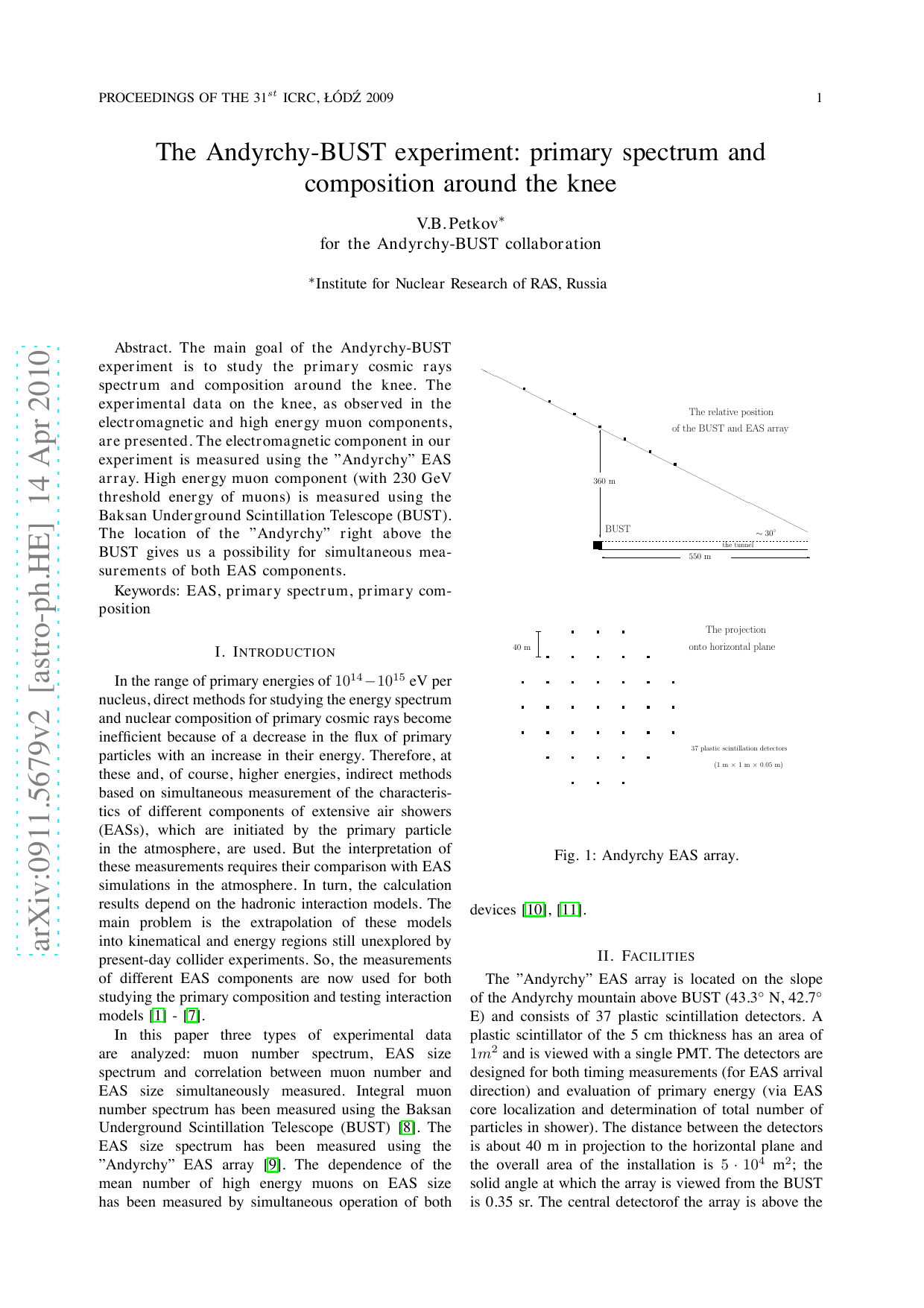
the tunnel
∼30◦
The relative position
of the BUST and EAS array
❄
✻
360 m
BUST
✲
✛
550 m
The projection
onto horizontal plane
40 m
37 plastic scintillation detectors
(1 m × 1 m × 0.05 m)
Fig. 1: Andyrchy EAS array.
devices [10], [11].
II. FACILITIES
The ”Andyrchy” EAS array is located on the slope
of the Andyrchy mountain above BUST (43.3◦N, 42.7◦
E) and consists of 37 plastic scintillation detectors. A
plastic scintillator of the 5 cm thickness has an area of
1m2 and is viewed with a single PMT. The detectors are
designed for both timing measurements (for EAS arrival
direction) and evaluation of primary energy (via EAS
core localization and determination of total number of
particles in shower). The distance between the detectors
is about 40 m in projection to the horizontal plane and
the overall area of the installation is 5 · 104 m2; the
solid angle at which the array is viewed from the BUST
is 0.35 sr. The central detectorof the array is above the
2
V.B. PETKOV THE ANDYRCHY-BUST EXPERIMENT: ...
6
7
8
10
14
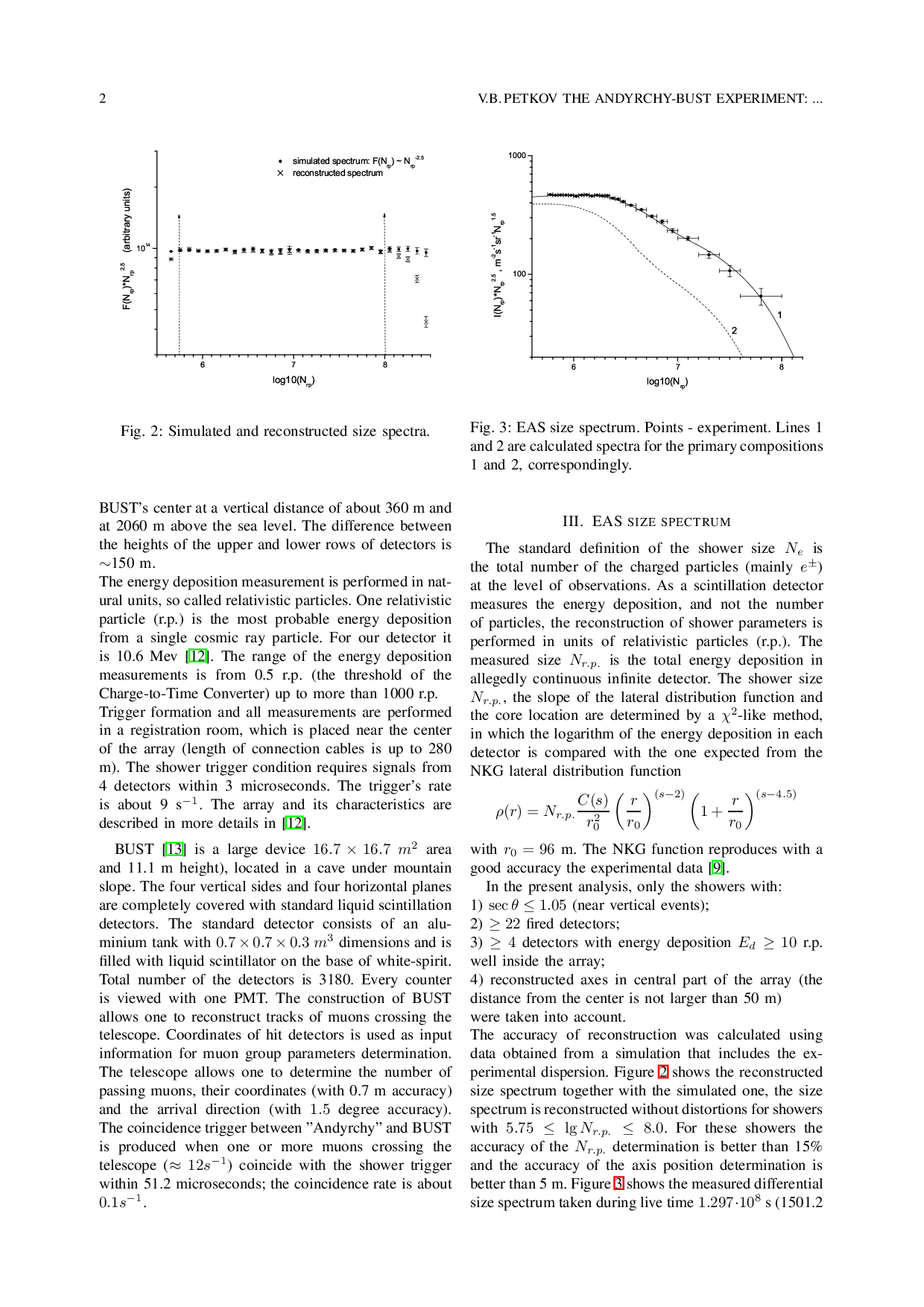
simulated spectrum: F(N
rp
) ~ N
rp
-2.5
reconstructed spectrum
F(N
rp
)*N
rp
2.5
(arbitrary units)
log10(N
rp
)
Fig. 2: Simulated and reconstructed size spectra.
BUST’s center at a vertical distance of about 360 m and
at 2060 m above the sea level. The difference between
the heights of the upper and lower rows of detectors is
∼150 m.
The energy deposition measurement is performed in nat-
ural units, so called relativistic particles. One relativistic
particle (r.p.) is the most probable energy deposition
from a single cosmic ray particle. For our detector it
is 10.6 Mev [12]. The range of the energy deposition
measurements is from 0.5 r.p. (the threshold of the
Charge-to-Time Converter) up to more than 1000 r.p.
Trigger formation and all measurements are performed
in a registration room, which is placed near the center
of the array (length of connection cables is up to 280
m). The shower trigger condition requires signals from
4 detectors within 3 microseconds. The trigger’s rate
is about 9 s−1. The array and its characteristics are
described in more details in [12].
BUST [13] is a large device 16.7 × 16.7 m2 area
and 11.1 m height), located in a cave under mountain
slope. The four vertical sides and four horizontal planes
are completely covered with standard liquid scintillation
detectors. The standard detector consists of an alu-
minium tank with 0.7 × 0.7 × 0.3 m3 dimensions and is
filled with liq
…(Full text truncated)…
📸 Image Gallery
Reference
This content is AI-processed based on ArXiv data.