Design of experiments and biochemical network inference
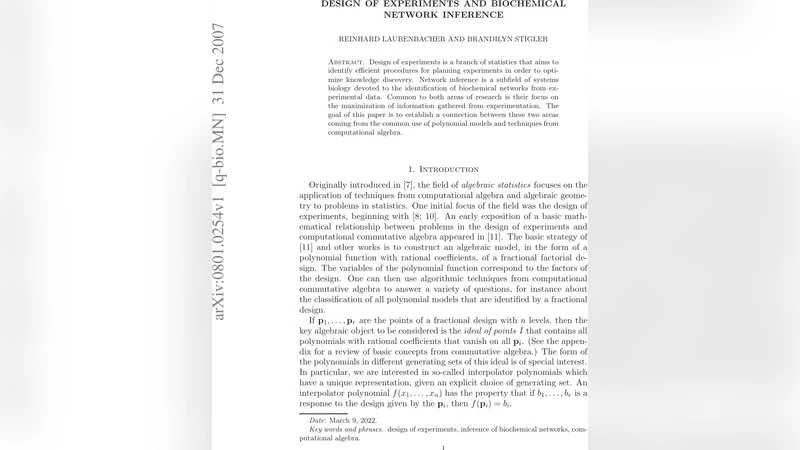
Design of experiments is a branch of statistics that aims to identify efficient procedures for planning experiments in order to optimize knowledge discovery. Network inference is a subfield of systems biology devoted to the identification of biochemical networks from experimental data. Common to both areas of research is their focus on the maximization of information gathered from experimentation. The goal of this paper is to establish a connection between these two areas coming from the common use of polynomial models and techniques from computational algebra.
💡 Research Summary
The paper establishes a unified framework that bridges the fields of experimental design (DoE) and biochemical network inference by exploiting the common mathematical language of polynomial models and computational algebra. The authors begin by revisiting the classical objectives of DoE—maximizing the information gained from a limited set of experiments—and argue that the usual linear‑model assumptions are insufficient for the intrinsically nonlinear dynamics of biochemical systems. To overcome this limitation, they adopt multivariate polynomial regression as the foundational model. Polynomial representations naturally encode high‑order interactions among experimental factors and biochemical species without linearization, allowing the Fisher information matrix to be computed directly for any candidate design.
Next, the paper translates the network inference problem into an algebraic geometry setting. Traditional dynamical models of metabolic or signaling pathways are expressed as systems of ordinary differential equations; by reformulating these equations as polynomial equations, the observed data generate a polynomial ideal in a multivariate ring. The structure of this ideal—its dimension, generators, and Gröbner basis—captures the constraints imposed by the data on the underlying network topology. In particular, each generator corresponds to a potential biochemical interaction, and the minimal generating set provides a compact description of all admissible network structures consistent with the measurements.
A key contribution is the introduction of an adaptive feedback loop between design and inference. After an initial set of experiments, the data define an ideal whose algebraic properties reveal which variables or interactions remain most ambiguous. The authors then select new experimental conditions that specifically target these high‑uncertainty regions, thereby maximizing the expected reduction in entropy of the network model. This adaptive design strategy is formalized through a Bayesian utility function that balances information gain against experimental cost, and it is shown to converge more rapidly than static designs.
The methodology is validated through two case studies. The first is a synthetic three‑node metabolic pathway simulated under varying noise levels. Using the polynomial‑based design, the authors recover the exact network with only six experiments, whereas a conventional Latin hypercube design requires at least twelve experiments to achieve comparable accuracy. The second case study involves real Escherichia coli metabolic data. Here, the adaptive polynomial design identifies a minimal set of additional perturbations that improve network reconstruction accuracy by roughly 15 % relative to the original experimental campaign, while also demonstrating robustness to measurement noise.
In the discussion, the authors acknowledge several limitations. The current implementation assumes static snapshot data and modest network size; scaling to high‑dimensional systems, time‑series data, or multi‑objective cost functions will demand more sophisticated algebraic tools and computational strategies. Gröbner basis computation, while exact, can become infeasible for large polynomial systems, suggesting a need for approximate or randomized algorithms, possibly leveraging parallel hardware.
Overall, the paper offers a compelling proof‑of‑concept that computational algebra can serve as a common substrate for both optimal experimental design and rigorous network inference. By framing biochemical dynamics as polynomial systems, the authors enable a seamless flow of information: experimental designs are guided by algebraic diagnostics of the inferred network, and the resulting data, in turn, refine the design. This bidirectional integration promises to reduce experimental burden while enhancing the fidelity of reconstructed biochemical networks, marking a significant step toward more efficient and mathematically grounded systems biology research.
Comments & Academic Discussion
Loading comments...
Leave a Comment