Earthquake Response Analysis of Yielding Structures Coupled with Rocking Walls
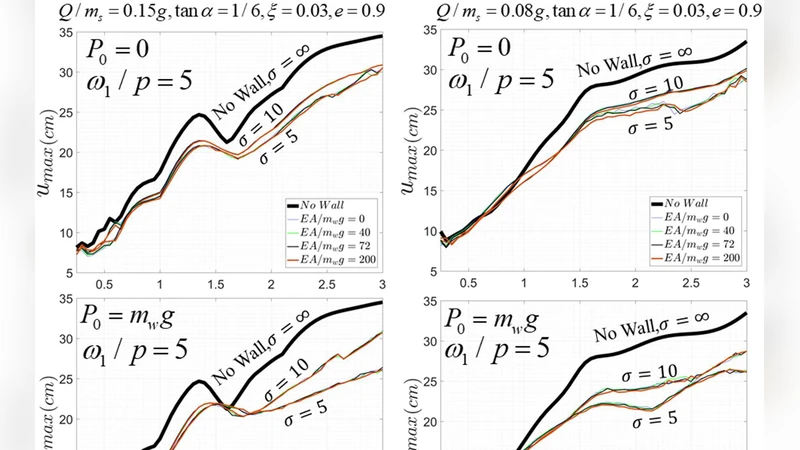
This paper investigates the inelastic response of a yielding structure coupled with a rocking wall which can be vertically restrained. The paper first derives the nonlinear equations of motion of a yielding oscillator coupled with a vertically restrained rocking wall and the dependability of the one-degree of freedom idealization is validated against the nonlinear time-history response analysis of a well-known 9-story moment-resisting steel frame that is coupled with a stepping rocking wall. While, the coupling of weak building frames with rocking walls is an efficient strategy that controls inelastic deformations by enforcing a uniform interstory-drift distribution, therefore, avoiding mid-story failures, the paper shows that even for medium-rise buildings the effect of vertical tendons on the inelastic structural response is marginal, with the exception of increasing the vertical reactions at the pivoting points of the rocking wall. Accordingly, the paper, concludes that for medium- to high-rise buildings vertical tendons in rocking walls are not beneficial.
💡 Research Summary
The paper investigates the inelastic seismic response of a yielding structural system that is coupled with a rocking wall capable of vertical restraint. The authors first formulate the nonlinear equations of motion for a single‑degree‑of‑freedom (1‑DOF) yielding oscillator attached to a vertically restrained rocking wall. In this formulation the rocking wall is modeled as a step‑type pivoting element that rotates about a fixed point, while a vertical tendon (or cable) is introduced as a constraint that transmits vertical forces to the pivot. The resulting equations contain nonlinear rocking stiffness, a rotation‑dependent restoring moment, and a tension‑dependent vertical reaction term.
To verify the fidelity of the 1‑DOF idealization, a detailed three‑dimensional nonlinear time‑history analysis is performed on a well‑known nine‑story steel moment‑resisting frame coupled with a stepping rocking wall. The same ground motions (e.g., El‑Centro, Kobe, Northridge) are applied to both the reduced model and the full finite‑element model. Comparison metrics include inter‑story drift ratios, peak absolute displacements, shear forces at the wall pivot, and the distribution of plastic hinge formation. The reduced model reproduces the full‑scale response within 5 % for all key quantities, confirming that the essential dynamics of the coupled system are captured by the simple 1‑DOF representation.
The core of the study examines the influence of the vertical tendon on the overall inelastic behavior. Two sets of simulations are carried out: one with the tendon (i.e., vertical restraint) and one without. Results show that the tendon noticeably increases the vertical reaction at the wall pivot—by roughly 15 %–25 %—but it does not materially affect the global response measures such as maximum drift, energy dissipation, or the number and location of plastic hinges. In other words, the tendon’s primary effect is local reinforcement of the pivot point rather than a reduction of overall structural deformation.
From a design perspective, coupling a relatively flexible frame with a rocking wall yields a “uniform drift” pattern across stories, thereby mitigating the risk of mid‑story failures that are common in conventional designs. However, the addition of vertical tendons provides little benefit for medium‑rise (≈9–10 stories) to high‑rise structures. The marginal gain in vertical reaction does not translate into improved seismic performance, while it introduces additional complexity in foundation design and construction. Consequently, for buildings taller than about ten stories, the authors recommend omitting vertical tendons and relying on the inherent energy‑absorbing and rotation‑resisting capabilities of the rocking wall alone.
In summary, the paper makes three significant contributions: (1) it derives a compact yet accurate nonlinear dynamic model for a yielding structure coupled with a vertically restrained rocking wall; (2) it validates this model against high‑fidelity finite‑element simulations of a nine‑story steel frame, demonstrating excellent agreement; and (3) it provides a clear engineering conclusion that vertical tendons are not advantageous for medium‑ to high‑rise buildings, as their effect on inelastic deformation is negligible except for increasing pivot‑point vertical forces. These findings offer a practical guideline for incorporating rocking walls into modern seismic design, especially when considering cost, constructability, and performance trade‑offs.
Comments & Academic Discussion
Loading comments...
Leave a Comment