Optimal spline spaces for $L^2$ $n$-width problems with boundary conditions
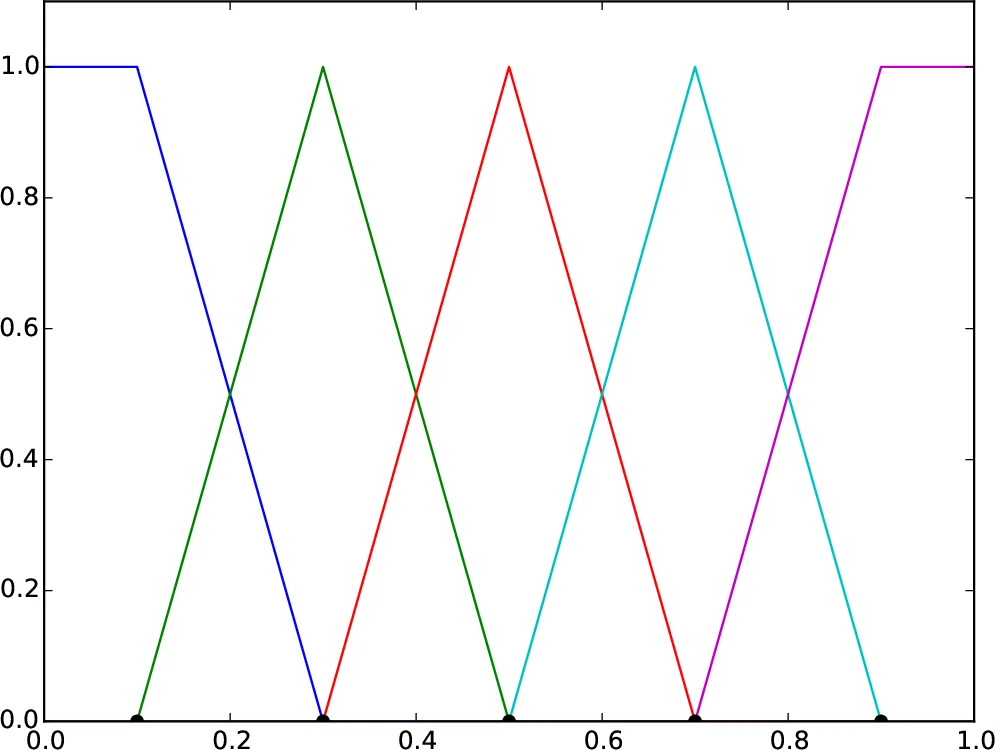
In this paper we show that, with respect to the $L^2$ norm, three classes of functions in $H^r(0,1)$, defined by certain boundary conditions, admit optimal spline spaces of all degrees $\geq r-1$, and all these spline spaces have uniform knots.
💡 Research Summary
This paper investigates the optimal approximation of Sobolev‑type function classes under the L² norm when specific boundary conditions are imposed. For a given integer r ≥ 1, three subspaces of Hʳ(0, 1) are considered:
* Hʳ⁰ = {u ∈ Hʳ : u^{(k)}(0)=u^{(k)}(1)=0 for all even k < r},
* Hʳ¹ = {u ∈ Hʳ : u^{(k)}(0)=u^{(k)}(1)=0 for all odd k < r},
* Hʳ² = {u ∈ Hʳ : u^{(k)}(0)=0 for even k < r and u^{(ℓ)}(1)=0 for odd ℓ < r}.
For each i ∈ {0,1,2} the unit ball
Aʳⁱ = {u ∈ Hʳⁱ : ‖u^{(r)}‖_{L²} ≤ 1}
is studied in the framework of Kolmogorov n‑widths. The authors first compute the exact n‑widths:
dₙ(Aʳ⁰) = π^{‑r}(n + 1)^{‑r}, dₙ(Aʳ¹) = π^{‑r}n^{‑r}, dₙ(Aʳ²) = π^{‑r}(n + ½)^{‑r}.
Corresponding optimal n‑dimensional subspaces are spanned by sine, cosine, or half‑integer sine functions, respectively. These results follow from representing Aʳⁱ as the image of the unit ball under repeated applications of a single‑integration operator K and its adjoint K*. The kernel of K is K(x,y)=1_{x≥y}, and K* has kernel K*(x,y)=1_{y≥x}. When K is non‑degenerate totally positive (NTP), Kellogg’s theorem guarantees simple, positive eigenvalues and eigenfunctions with exactly n interior zeros. Melkman and Micchelli’s construction then yields two families of optimal spaces: X₀ⁿ = span{K(·,ξ_j)} and Y₀ⁿ = span{K*(·,η_j)}.
A key methodological contribution is the recursive generation of higher‑degree optimal spaces by alternating K and K*. Defining L = K K*, the authors prove (Lemma 1) that applying L^i K or L^{i‑1}K to an optimal subspace yields another optimal subspace for the next Sobolev order. Lemma 2 and Theorem 4 formalize the induction: if X₀ⁿ and Y₀ⁿ are optimal for the base class A, then for any r ≥ 1 the families
X_dⁿ = K(Y_{d‑1}ⁿ), Y_dⁿ = K*(X_{d‑1}ⁿ), d ≥ 1
are optimal for the classes Aʳ and Aʳ* (the adjoint class) respectively, for all d ≥ r‑1.
The paper then translates these abstract optimal spaces into concrete spline spaces with uniform interior knots. For a degree d ≥ r‑1 and each i, a knot vector τ_i is defined (equations (7) in the manuscript). The spline space S_{d,i} consists of C^{d‑1} functions that are polynomials of degree ≤ d on each subinterval determined by τ_i and satisfy the same even/odd derivative zero conditions at the endpoints as Hʳⁱ. The dimension of S_{d,i} is n + d + 1, where n is the number of interior knots. Theorem 2 asserts that for every r ≥ 1, i ∈ {0,1,2} and any degree d ≥ r‑1, the spline space S_{d,i} is an optimal n‑dimensional subspace for Aʳⁱ. This extends earlier results that were limited to r = 1 or to specific degrees (e.g., degrees of the form ℓ r − 1). Notably, when i = 1 and d is even, S_{d,1} coincides with the “reduced spline spaces” introduced by Takács and Takács, and the optimal constant 1/π replaces the previously suboptimal √2 in their error estimates.
The significance of these findings lies in providing a complete, constructive description of optimal spline approximants for Sobolev spaces with mixed boundary conditions. The spaces are of maximal smoothness (C^{d‑1}), have uniform knots (facilitating implementation), and achieve the theoretical lower bound given by Kolmogorov n‑widths. This has immediate implications for isogeometric analysis, where such spline spaces are employed as finite‑element bases for PDEs with boundary constraints. Moreover, the analysis based on a single integration operator and total positivity offers a framework that could be adapted to other boundary configurations or higher‑dimensional domains.
Comments & Academic Discussion
Loading comments...
Leave a Comment