Geometric Crossing-Minimization -- A Scalable Randomized Approach
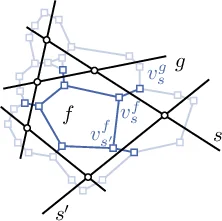
We consider the minimization of edge-crossings in geometric drawings of graphs $G=(V, E)$, i.e., in drawings where each edge is depicted as a line segment. The respective decision problem is NP-hard [Bienstock, ‘91]. In contrast to theory and the topological setting, the geometric setting did not receive a lot of attention in practice. Prior work [Radermacher et al., ALENEX'18] is limited to the crossing-minimization in geometric graphs with less than $200$ edges. The described heuristics base on the primitive operation of moving a single vertex $v$ to its crossing-minimal position, i.e., the position in $\mathbb{R}^2$ that minimizes the number of crossings on edges incident to $v$. In this paper, we introduce a technique to speed-up the computation by a factor of $20$. This is necessary but not sufficient to cope with graphs with a few thousand edges. In order to handle larger graphs, we drop the condition that each vertex $v$ has to be moved to its crossing-minimal position and compute a position that is only optimal with respect to a small random subset of the edges. In our theoretical contribution, we consider drawings that contain for each edge $uv \in E$ and each position $p \in \mathbb{R}^2$ for $v$ $o(|E|)$ crossings. In this case, we prove that with a random subset of the edges of size $\Theta(k \log k)$ the co-crossing number of a degree-$k$ vertex $v$, i.e., the number of edge pairs $uv \in E, e \in E$ that do not cross, can be approximated by an arbitrary but fixed factor $\delta$ with high probability. In our experimental evaluation, we show that the randomized approach reduces the number of crossings in graphs with up to $13,000$ edges considerably. The evaluation suggests that depending on the degree-distribution different strategies result in the fewest number of crossings.
💡 Research Summary
The paper addresses the long‑standing challenge of minimizing edge crossings in straight‑line (geometric) drawings of graphs, a problem known to be NP‑hard. The authors build upon their earlier vertex‑movement heuristic, which repeatedly relocates a single vertex to the position that minimizes the number of crossings incident to that vertex. While effective for small graphs (fewer than 200 edges), the original implementation suffered from super‑quadratic running time because computing the exact crossing‑minimal position required constructing a full arrangement of visibility regions and its dual, operations that scale poorly with graph size.
The first technical contribution is a novel data structure called the “bloated dual.” Rather than constructing the full arrangement of line segments (which would require exact geometric intersection coordinates), the bloated dual only needs the order in which segments intersect a given segment. By directing each segment, sorting its intersection points lexicographically, and inserting edges in a graph that represents adjacency of faces, the authors can compute the crossing‑minimal region for a vertex using only combinatorial information. This reduces the reliance on exact arithmetic (previously handled by CGAL) and enables a simple sweep‑line algorithm for detecting intersecting segment pairs. The resulting implementation achieves roughly a 20× speed‑up over the precise CGAL‑based version across a variety of benchmark families (North, Rome, Community, and triangulated graphs). Memory consumption also drops dramatically, allowing the algorithm to handle graphs with several thousand edges where the original method ran out of memory.
The second contribution tackles the fundamental scalability bottleneck: even with the faster bloated dual, the number of intersecting segment pairs in the arrangement can be on the order of hundreds of millions for high‑degree vertices, making exact computation infeasible. To overcome this, the authors propose a randomized sampling scheme. For a given vertex v, they draw a uniform random subset S of edges of size Θ(k log k), where k is the degree of v, and consider only the constraints induced by edges in S when searching for a new position. They define the “co‑crossing number” of v as the number of edge pairs (uv, e) that do not cross, and prove that, under the assumption that each edge uv and any placement of v incurs o(|E|) crossings, the co‑crossing number can be approximated within any fixed factor δ with high probability using only the sampled edges. The proof leverages VC‑dimension arguments to bound the sample size needed for uniform convergence.
Experimentally, two sampling strategies are evaluated. The “point‑based” approach samples candidate positions in ℝ² and selects the one with the fewest crossings among the sampled points. The “edge‑based” approach samples edges as described above and computes the optimal position with respect to that subset. Results show that the best strategy depends on the degree distribution of the graph: for graphs with relatively uniform degree (e.g., community‑structured graphs) point‑based sampling yields slightly fewer crossings, whereas for graphs with a few high‑degree vertices (e.g., metabolic networks) edge‑based sampling outperforms point‑based. Importantly, the randomized method enables the processing of graphs with up to 13 000 edges—about 60 times larger than the previous limit—while still achieving a substantial reduction in crossing count compared to the initial Stress layout.
Overall, the paper delivers a practical, scalable pipeline for geometric crossing minimization: (1) a 20× faster exact computation of crossing‑minimal regions via the bloated dual, and (2) a provably accurate randomized approximation that reduces the per‑vertex work to Θ(k log k). The combination of rigorous theoretical guarantees, careful engineering, and extensive empirical validation makes the work a significant step toward applying crossing‑minimization heuristics to real‑world large graphs. Future directions suggested include adaptive sampling rates, integration with other aesthetic criteria (such as maximizing crossing angles or preserving graph‑theoretic distances), and parallel implementations that exploit the independence of segment‑pair processing.
Comments & Academic Discussion
Loading comments...
Leave a Comment