Online Charge Scheduling for Electric Vehicles in Autonomous Mobility on Demand Fleets
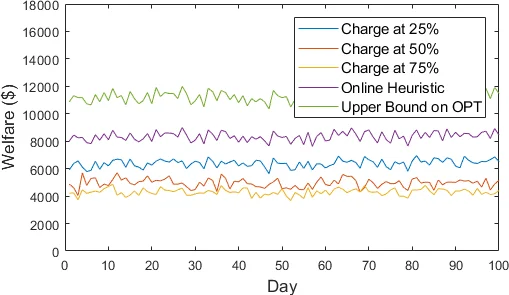
In this paper, we study an online charge scheduling strategy for fleets of autonomous-mobility-on-demand electric vechicles (AMoD EVs). We consider the case where vehicles complete trips and then enter a between-ride state throughout the day, with their information becoming available to the fleet operator in an online fashion. In the between-ride state, the vehicles must be scheduled for charging and then routed to their next passenger pick-up locations. Additionally, due to the unknown daily sequences of ride requests, the problem cannot be solved by any offline approach. As such, we study an online welfare maximization heuristic based on primal-dual methods that allocates limited fleet charging resources and rebalances the vehicles while avoiding congestion at charging facilities and pick-up locations. We discuss a competitive ratio result comparing the performance of our online solution to the clairvoyant offline solution and provide numerical results highlighting the performance of our heuristic.
💡 Research Summary
The paper addresses the real‑time charging and rebalancing problem for large fleets of autonomous‑mobility‑on‑demand electric vehicles (AMoD EVs). When a vehicle finishes a passenger trip it enters a “between‑ride” state during which the fleet operator must decide (i) whether to charge, (ii) how much energy to deliver, (iii) when and at which charging station to do so, and (iv) which region to send the vehicle for its next pickup. These decisions must be made online because the exact sequence of ride completions, traffic conditions, electricity prices, and solar generation are unknown in advance.
System model.
The service area is partitioned into a set of regions D. Each region d has a time‑varying capacity Ω₍d₎(t) limiting the number of vehicles that may be present (e.g., due to congestion or demand forecasts). A subset F ⊆ D contains charging facilities. Facility f has M_f EVSEs, each with C_f cables, so at most M_f·C_f vehicles can be physically connected, while only M_f vehicles can charge simultaneously. Each EVSE can deliver up to E_f units of energy per time slot. Facilities obtain energy from on‑site solar (available amount δ_f(t) ∈
Comments & Academic Discussion
Loading comments...
Leave a Comment