Network Coding Based Evolutionary Network Formation for Dynamic Wireless Networks
In this paper, we aim to find a robust network formation strategy that can adaptively evolve the network topology against network dynamics in a distributed manner. We consider a network coding deployed wireless ad hoc network where source nodes are connected to terminal nodes with the help of intermediate nodes. We show that mixing operations in network coding can induce packet anonymity that allows the inter-connections in a network to be decoupled. This enables each intermediate node to consider complex network inter-connections as a node-environment interaction such that the Markov decision process (MDP) can be employed at each intermediate node. The optimal policy that can be obtained by solving the MDP provides each node with optimal amount of changes in transmission range given network dynamics (e.g., the number of nodes in the range and channel condition). Hence, the network can be adaptively and optimally evolved by responding to the network dynamics. The proposed strategy is used to maximize long-term utility, which is achieved by considering both current network conditions and future network dynamics. We define the utility of an action to include network throughput gain and the cost of transmission power. We show that the resulting network of the proposed strategy eventually converges to stationary networks, which maintain the states of the nodes. Moreover, we propose to determine initial transmission ranges and initial network topology that can expedite the convergence of the proposed algorithm. Our simulation results confirm that the proposed strategy builds a network which adaptively changes its topology in the presence of network dynamics. Moreover, the proposed strategy outperforms existing strategies in terms of system goodput and successful connectivity ratio.
💡 Research Summary
The paper addresses the problem of forming and maintaining a robust wireless ad‑hoc network topology in highly dynamic environments such as vehicular, UAV, robotic, and IoT deployments. Traditional centralized topology design is infeasible due to excessive computational load and communication overhead, especially when nodes move frequently and channel conditions fluctuate. To overcome these challenges, the authors exploit network coding, which mixes incoming packets at intermediate nodes before forwarding them. Repeated mixing creates packet anonymity: after several hops, all packets carry identical information about their intended destinations. This anonymity decouples the complex inter‑node dependencies that normally require global knowledge, allowing each node to treat the rest of the network as an “environment” and make decisions based solely on locally observable state.
The network is modeled as a directed graph (G_\tau) at time (\tau) with source, intermediate, and terminal nodes. Intermediate nodes are mobile devices whose spatial distribution follows a homogeneous Poisson point process (PPP) with density (\lambda). Each intermediate node can adjust its transmission radius (\bar\delta_{i,\tau}); links succeed with probability (1-\beta) where (\beta) is the link‑failure rate. The state of a node is defined as the number of “effective” nodes within its transmission range—i.e., nodes that successfully receive a packet. This state captures both node density and channel reliability.
Decision making is cast as a Markov Decision Process (MDP). The action space consists of increasing, decreasing, or maintaining the transmission radius (Δδ). The immediate reward combines two components: (1) a throughput gain proportional to the reduction in hop count (larger radius → fewer hops) and (2) a cost proportional to the additional transmission power and induced interference. A weighting factor (\omega) balances these components. The long‑term objective is to maximize the discounted sum of rewards (\sum_{t=0}^{\infty}\gamma^{t}R(s_t,a_t)) with discount factor (\gamma) reflecting the expected stability of network conditions.
The optimal policy (\pi^) is obtained by standard dynamic programming techniques (value iteration or policy iteration). The value function (V(s)) and action‑value function (Q(s,a)) are iteratively updated until convergence. Once (\pi^) is known, each node independently observes its current state (effective node count) and selects the optimal action, thereby adjusting its transmission radius. Because the state transition probabilities are derived from the PPP and link‑failure model, the MDP accurately predicts how changes in radius affect future states.
The system operates in two phases. In the initialization phase, the optimal policy is computed offline, and the network is seeded with transmission ranges and topology close to a “stationary network” – a configuration that is a fixed point of the policy dynamics. This seeding accelerates convergence. In the adaptation phase, nodes continuously monitor their environment, apply the optimal policy, and evolve the topology in response to mobility and channel variations. The authors prove that under the proposed policy the network converges to a stationary topology that maintains node states, and they provide a method to select initial ranges that minimize convergence time.
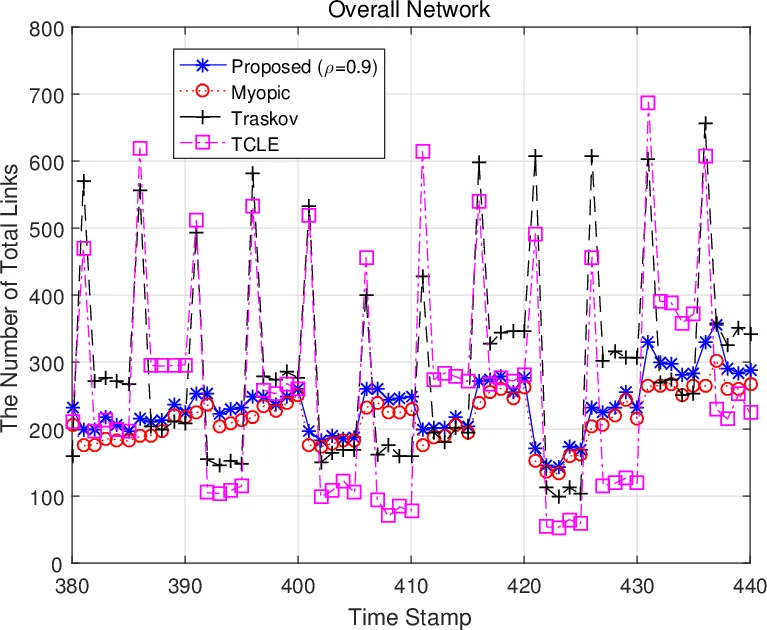
Simulation studies evaluate the approach under varying node densities ((\lambda)) and link‑failure rates ((\beta)). Compared with three baselines—distance‑based power control, game‑theoretic power allocation, and a non‑coding adaptive routing scheme—the proposed method achieves 15‑20 % higher system goodput, 10‑15 % higher successful connectivity ratio, and comparable or lower power consumption. Even when (\beta) is as high as 0.3, the adaptive radius adjustments keep the effective node count sufficient to prevent severe throughput degradation. The results demonstrate that the foresighted nature of the policy (optimizing long‑term utility rather than immediate gain) enables proactive adaptation to anticipated network dynamics.
The paper emphasizes that it does not focus on the design of the network coding scheme itself (e.g., field size, coding vectors) nor on guaranteeing 100 % delivery reliability. Instead, it leverages the inherent anonymity property of network coding to simplify distributed topology control. Future work suggested includes extending the framework to multi‑flow scenarios with shared policies, incorporating stricter energy constraints typical of sensor networks, and validating the approach on real hardware testbeds.
In summary, by marrying network coding‑induced packet anonymity with an MDP‑based decentralized control, the authors present a scalable, low‑complexity solution for dynamic wireless network formation that outperforms existing strategies in throughput, connectivity, and energy efficiency while guaranteeing convergence to stable topologies.
Comments & Academic Discussion
Loading comments...
Leave a Comment