Physarum Can Compute Shortest Paths
Physarum Polycephalum is a slime mold that is apparently able to solve shortest path problems. A mathematical model has been proposed by biologists to describe the feedback mechanism used by the slime mold to adapt its tubular channels while foragi…
Authors: Vincenzo Bonifaci, Kurt Mehlhorn, Girish Varma
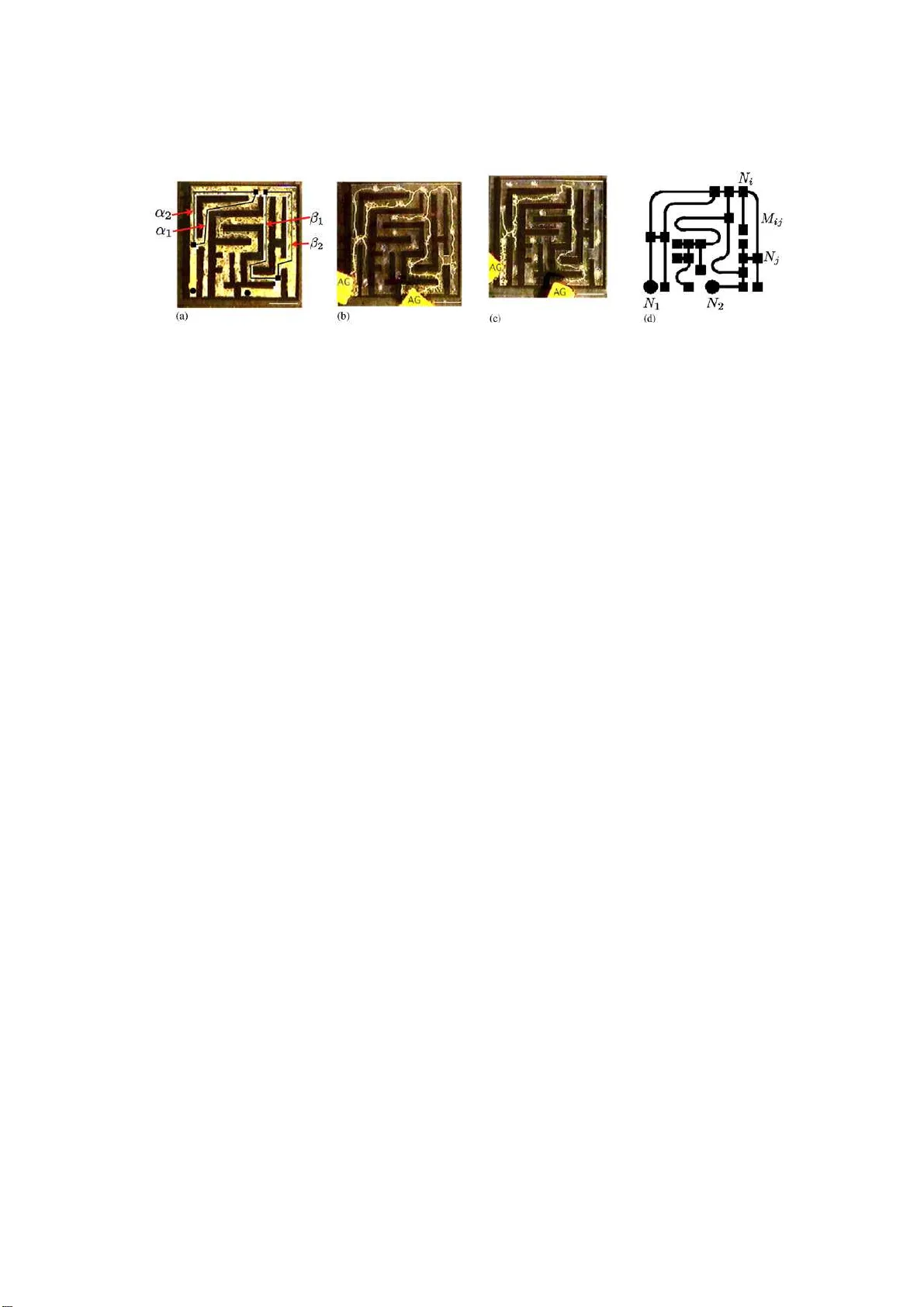
Ph ysarum Can Compute Shortest P aths ∗ Vincenzo Bonifaci † Kurt Mehlhorn ‡ Girish V arma § Octob er 22, 2018 Abstract Physarum Polyc eph alum is a slime mold that is apparently able to s o lv e shortes t path problems. A mathematical mo del has b een propo sed by biologists to des cribe the feedback mechanism used by the slime mold to ada pt its tubular channels while foraging t wo fo o d sources s 0 and s 1 . W e prov e that, under this mo del, the ma ss of the mold will even tually conv erg e to t he shortest s 0 - s 1 path of the net work that the mold lies on, indep endently of the structure o f the netw ork o r of the initial mass distribution. This matches the e x perimental o bserv ations by the biolog is ts a nd can b e seen as an example of a “na tur al algor ithm”, that is, an a lgorithm developed b y ev olution over millions of years. Con ten ts 1 In tro duction 2 2 Related W ork 6 3 Discussion and Op en Problems 6 4 P arallel Links 7 5 Electrical Net works and Simple F acts 9 6 Con vergenc e 11 7 Rate of C on v ergence for Sta ble Flow Directions 18 8 The Wheatstone Graph 25 9 The Uncapacitated T ransp ortation Problem 28 ∗ An exten ded abstract of this pap er app ears in S OD A (ACM-SIAM Symp osium on Discrete A lgori thms) 2012. † Istituto di A n alisi dei S istemi ed Informatica “Antonio Rub erti” – CNR, Rome, Italy . Most of th e work w as done at the MPI for Informatics, Saarbr ¨ uck en, Germany . Email: bonifaci@m pi-inf.mpg.de . ‡ MPI for In forma tics, Saarbr ¨ uc ken, Germany . Email: mehlhorn@mpi-inf .mpg.de . § T ata Institut e of F undamental Research, Mumbai, India. Most of the wor k wa s done at th e MPI for Informatics, Saarbr ¨ uc ken, Germany . Email: girish@tcs.tifr .res.in . Figure 1: The exp eriment in [NYT00] (reprinted from there): (a) shows the maze un iformly co v ered by Physa rum; the y ello w color indicates the presence of Ph ysaru m. F o o d (oatmea l) is p ro vided at the lo cations lab elled A G. After a while, the mold retracts to the shortest path connecting the fo od sources as sho wn in (b) and (c). (d) shows the underlying abstract grap h . The video [Y ou10] shows the exp erimen t. 1 In tro duction Physarum Polyc ephal u m is a slime mold that is apparently able to solv e s h ortest path prob- lems. Na k agaki, Y amada, and T´ oth [NYT00] rep ort on the follo wing exp erimen t, see Figure 1: They built a maze, co v ered it with pieces of Physarum (the slime can b e cut in to pieces that will r eunite if brou ght in to vicinity), and then fed th e slime with oatmeal at tw o lo cations. After a few hours, th e slime retracted to a p ath that follo w s the shortest p ath connecting the fo o d sour ces in the maze. The authors r ep ort th at they r ep eate d the e xp erimen t with d if- feren t mazes; in all exp eriments, Physarum retracted to the shortest path. T here are seve r al videos a v ailable on th e web that sho w the mold in action [Y ou10]. P ap er [TKN07] pr op oses a mathematical m o del for the b eha vior of the s lime and argu es extensiv ely that the mo del is adequ ate. W e will n ot rep eat the discussion here but only defin e the mo del. Physarum is mo deled as an elect r ical n et w ork with time v aryin g resistors. W e ha ve a simple u n directed graph G = ( N , E ) with distinguish ed no des s 0 and s 1 , wh ic h mo del the f oo d sour ces. Eac h edge e ∈ E has a p ositiv e length L e and a p ositiv e diamet er D e ( t ); L e is fi xed, but D e ( t ) is a fun ction of time. The resistance R e ( t ) of e is R e ( t ) = L e /D e ( t ). W e force a cur ren t of v alue 1 from s 0 to s 1 . Let Q e ( t ) b e t h e r esulting curren t o v er edge e = ( u, v ), w here ( u, v ) is an arbitrary orien tation of e . The diameter of any ed ge e ev olve s according to the equation ˙ D e ( t ) = | Q e ( t ) | − D e ( t ) , (1) where ˙ D e is the deriv ativ e of D e with resp ect to time. In equilibriu m ( ˙ D e = 0 for all e ), the flo w through any edge is equal to its diameter. In non -equilibr ium, the diameter gro ws or shrinks if the absolute v alue of the flow is larger or smaller than the diameter, resp ectiv ely . In the sequ el, we will mostly dr op the argument t as is customary in the treatmen t of dynamical systems. The mo del is readily turn ed into a computer sim ulation. In an electrical n et w ork, ev er y v ertex v has a p oten tial p v ; p v is a fun ction of ti me. W e ma y fix p s 1 to zero. F or an e dge e = ( u, v ), the fl o w across e is giv en b y ( p u − p v ) /R e . W e hav e flo w conserv ation in ev ery 2 v ertex except for s 0 and s 1 ; we inject one un it at s 0 and remo v e one un it at s 1 . Thus, b v = X u ∈ δ ( v ) p v − p u R uv , (2) where δ ( v ) is the set of neigh b ors o f v and b s 0 = 1, b s 1 = − 1, and b v = 0 otherwise. T h e no de p oten tials can b e computed by solving a linear system (either d irectly or ite r ativ ely). T ero et al. [TKN07] w ere the fi r st to p erform s imulations of the mo del. They rep ort that the net w ork alwa ys con verge s to the shortest s 0 - s 1 path, i.e., th e diameters of the edges on the sh ortest p ath con verge to one, and the diameters on the edges outside the shortest path con ve r ge to zero. T his holds true for any initial condition and assumes the un iqueness of the shortest path. Miy a ji and Ohnishi [MO07, MO08] initi ated the analytical in vestig ation of the mo del. They argued con vergence against the shortest path if G is a planar graph and s 0 and s 1 lie on the same face in some embedd ing of G . Our main r esu lt is a con verge n ce pr o of f or all graphs. F or a n etw ork G = ( V , E , s 0 , s 1 , L ), where ( L e ) e ∈ E is a p ositiv e length fu nction on the edges of G , w e use G 0 = ( V , E 0 ) to denote the subgraph of all sh ortest source-sink p aths, L ∗ to d enote the length of a shortest source- sink path, and E ∗ to denote th e set of all source-sink fl o ws of v alue one in G 0 . If we defin e the cost of fl o w Q as P e L e Q e , then E ∗ is the set of minim um cost source-sink flows of v alue one. If the shortest source-sink path is u nique, E ∗ is a sin gleto n . The dyn amics are attr acte d b y a set A ⊆ R E if the distance (measur ed in an y L p -norm) b et ween D ( t ) and A con verge s to zero. Theorem [Theorem 2 in Section 6] L et G = ( V , E , s 0 , s 1 , L ) b e an undir e cte d ne twork with p ositive length function ( L e ) e ∈ E . L et D e (0) > 0 b e the diameter of e dge e at time ze r o. The dynamics (1 ) ar e attr acte d to E ∗ . If the shortest sour c e-sink p ath is unique, the dynamics c onver g e to the flow of value one along the shortest sour c e-sink p ath. W e conjecture that the dynamics con v erge to an elemen t of E ∗ but only sh o w attract ion to E ∗ . A ke y part of our p ro of is to sh ow that the function V = 1 min S ∈C C S X e ∈ E L e D e + ( C { s 0 } − 1) 2 (3) decreases along all tra jectories that start in a n on-equilibrium configuration. Here, C is the set o f all s 0 - s 1 cuts, i.e., the set of all S ⊆ N with s 0 ∈ S and s 1 6∈ S ; C S = P e ∈ δ ( S ) D e is th e capacit y of the cut S wh en the capacit y of edge e is set to D e ; and min S ∈C C S (also abbreviated by C ) is the capacit y of the minimum cut. T he fi rst term in the definition of V is the normalized h ardw are cost; for any edge, th e pro duct of its length and its diameter may b e interpreted as the hardware cost of the edge; the normalization is by the capacit y of th e minim u m cut. W e will sho w th at the first term decreases except wh en the ma xim um flo w F in the net work w ith capacities D e is u nique, and moreo v er, | Q e | = | F e | /C for all e . The second term decreases as long as the capacit y of the cut d efined by s 0 is different fr om 1. W e sho w that the capacit y of the m in im um cut con ve r ges to one and that the deriv ativ e of V is upp er b ounded b y − P e ( L min / 4)( D e /C − | Q e | ) 2 , where L min is the minimum length of any edge. Since V is non-negativ e, th is w ill allo w us to conclude that | D e − | Q e || con verge s to zero for all e . In the n ext step, we sho w that the p oten tial difference ∆ = p s 0 − p s 1 b et wee n source and sink con v erges to the length L ∗ of a shortest-source s in k path. W e use this to conclud e 3 P S f r a g r e p l a c e m e n t s e 1 e 2 e 3 e 4 e 5 e 6 s 0 s 1 u v w s 0 u v s 1 a b c e d (a) (b) Figure 2: Part (a) illustrates the path decomp osition. All edges are assumed to ha ve length 1; P 0 = ( e 1 ), P 1 = ( e 2 , e 3 , e 4 ), P 2 = ( e 5 , e 6 ), p ∗ s 0 = 1, p ∗ s 1 = 0, p ∗ v = 1 / 3, p ∗ u = 2 / 3, p ∗ w = 1 / 2, f ( P 1 ) = 1 / 3, and f ( P 2 ) = 1 / 6. P art (b) sho w s the Wheatstone graph . The d irectio n of th e flo w on edge { u, v } may c h ange o v er time; th e flo w on all other edges is alwa ys from left to r igh t. that D e and Q e con ve r ge to zero for any edge e 6∈ E 0 . Finally , w e show that th e dynamics are attracted by E ∗ . W e found the f unction V by analytical inv estigatio n of a net wo rk of parallel links (see Section 4), extensiv e computer simulatio n s, and guessing. F u nctions d ecreasing along all tra jectories are called Lya p uno v functions in d y n amical systems theory [HS74]. The fact that the right- h and side of system (1) is n ot con tinuously d ifferentiable and that the fu n ction V is not different iable ev erywh ere introd uces some technical difficulties. The direction of th e flow across an edge dep end s on the in itial conditions and time. W e do not k n o w whether flow d ir ectio n s can c hange infin itely often or w h ether they b ecome ultimately fixed. Under the assumption that flo w d ir ectio n s stabilize, w e can c haracterize the (late stages of the) con vergence pro cess. An edge e = { u, v } b ecomes horizontal if lim t →∞ | p u − p v | = 0, and it b ecomes dir e cte d fr om u to v ( d irected from v to u ) if p u > p v for all large t ( p v > p u for all large t ). An edge stabilizes if it either b ecomes horizon tal or directed, and a net work stabilizes if all its edges stabilize. If a netw ork stabilizes, we partition its edges into a set E h of horizont al edges and a s et − → E of d ir ecte d edges. If { u, v } b ecomes directed from u to v , then ( u, v ) ∈ − → E . W e in tr od u ce the notion of a de c ay r ate . Let r ≤ 0. A quantity D ( t ) de c ays with r ate at le ast r if for ev ery ε > 0 there is a constan t A suc h that ln D ( t ) ≤ A + ( r + ε ) t for all t . A quantity D ( t ) de c ays with r ate at mo st r if f or ev ery ε > 0 there is a constan t a suc h that ln D ( t ) ≥ a + ( r − ε ) t for all t . A qu an tit y D ( t ) deca ys with r ate r if it deca y s with rate at least and at most r . Lemma [L e mma 20 in Section 7] F or e ∈ E h , D e de c ay s with r ate − 1 and | Q e | de c ays with r ate at le ast − 1 . W e define a decomp osition of G into paths P 0 to P k , an orienta tion of these p aths, a s lop e f ( P i ) for eac h P i , a vertex lab elling p ∗ , and an edge lab elling r . P 0 is a 1 shortest s 0 - s 1 path in G , f ( P 0 ) = 1, r e = f ( P 0 ) − 1 for all e ∈ P 0 , and p ∗ v = dist( v , s 1 ) for all v ∈ P 0 , where dist( v , s 1 ) 1 W e assume t h at P 0 is unique. 4 is the s hortest path distance from v to s 1 . F or 1 ≤ i ≤ k , w e ha ve 2 P i = argmax P ∈P f ( P ), where P is the set o f all paths P in G w ith the follo wing prop erties: (1) the startp oin t a and the endp oin t b of P lie on P 0 ∪ . . . ∪ P i − 1 , p ∗ a ≥ p ∗ b , and f ( P ) = ( p ∗ a − p ∗ b ) /L ( P ); (2) no in terior verte x of P lies on P 0 ∪ . . . ∪ P i − 1 ; and (3) no edge of P b elongs to P 0 ∪ . . . ∪ P i − 1 . If p ∗ a > p ∗ b , we direct P i from a to b . I f p ∗ a = p ∗ b , w e lea v e the ed ges in P i undirected. W e set r e = f ( P i ) − 1 for all edges of P i , and p ∗ v = p ∗ b + f ( P i ) dist P i ( v , b ) for every interio r v ertex v of P i . Figure 2(a) illustrates the path decomp osition. Lemma [Lemma 21 in Section 7] Ther e is an i 0 ≤ k such that f ( P 0 ) > f ( P 1 ) > . . . > f ( P i 0 ) > 0 = f ( P i 0 +1 ) = . . . = f ( P k ) . Theorem [Theorem 3 in Section 7] If a network stabilizes, − → E = ∪ i ≤ i 0 E ( P i ) , the orien- tation of any e dge e ∈ − → E agr e es with the orientation induc e d by the p ath de c omp osition, a nd E h = ∪ i>i 0 E ( P i ) . The p otential of e ach no de v c onver ges to p ∗ v . The diameter o f e ach e dge e ∈ E \ P 0 de c ay s with r ate r e . W e cannot pro ve that fl o w directions stabilize in general. F or series-parallel graphs, flow directions trivially stabilize. The Wheatstone graph, sho wn in Figure 2(b), is the simplest graph, in whic h flo w d irections ma y change ov er time. Theorem [Theorem 6 in Section 8] The Whe atstone gr aph stabilizes. The u n capacit ated transp ortation problem generalizes the shortest path problem. With eac h v er tex v , a supply/demand b v is asso ciated. It is assumed that P v b v = 0. No des w ith p ositiv e b v are called sup ply no des, and no des with negativ e b v are called d emand nod es. In the shortest path p roblem, exactly t wo v ertices hav e non-zero su pply/demand. A feasible solution to the transp ortation problem is a fl o w f satisfying the mass balance constrain ts, i.e., for every v ertex v , b v is equal to the net flow out of v . T h e cost of a solution is P e L e f e . The Ph ys arum solver for the transp ortation problem is as follo ws: A t an y fixed time, the p otent ials are d efined by (2) and the cu rren ts ( Q e ) e ∈ E are derive d from the p oten tials by Ohm’s la w. The dynamics evolv e according to (1). The equilibr ia, i.e., | Q e | = D e for all e , are p recisely the fl o ws with the follo wing equal-length p rop ert y . Orient the edges in the d irectio n of Q and drop the edges of flo w zero. In the resulting graph, any t w o distinct directed paths with the same source and sink hav e the same length. Let E b e the set of equilibria. Theorem [Theorem 8 in Section 9 ] The dynamics (1) ar e attr acte d to the set of e quilibria E . If any two e quilibria have distinct c ost, the dynamics c onver ge to an optimum solution of the tr an sp ort ation pr oblem. The con verge n ce statemen t for the transp ortation pr oblem is wea ker than the corresp ond- ing statemen t for the sh ortest path p roblem in tw o resp ects. Ther e, w e sho w att raction to the set of equilibria of minim um cost (now only to the set of equilibria) an d conv ergence to the optim um solution if the optim u m solution is unique (now only if no t wo equilibria h av e the same cost). This pap er is organized as follo ws: In S ecti on 2, we discus s r elat ed work, and in Section 3, w e p ut our results into the con text of natural algorithms and state op en p roblems. The 2 W e assume t h at P i is unique except if f ( P i ) = 0. 5 tec hnical p art of the pap er starts in Section 4. W e firs t treat a net wo r k of p arallel links; this situation is simple enough to allo w a n analytical treatmen t. In Section 5, w e review basic facts ab out electrical netw orks and prov e some simple facts ab out the d ynamics of Ph ysarum. In Section 6, we pro ve our m ain result, the conv ergence for general graphs. In Section 7, w e pro ve e xp onen tial con verge nce und er the assumption that flo w directions stabilize, and in Section 8, w e sh o w that th e Wheatstone net work stabilizes. Finally , in Section 9, we generalize the con vergence pro of to the transp ortation problem. 2 Related W ork Miy a ji and Ohnishi [MO07, MO08] initiated the analytical inv estigati on of the mo del. They argued con ve r gence against the shortest path if G is a planar graph and s 0 and s 1 lie on the same face in some em b edd ing of G . Ito et al. [IJNT11] study the dyn amics (1) in a d irected graph G = ( V , E ); they d o not claim that the mo del is justified on biological grounds. Eac h directed edge e has a diameter D e . The no de p oten tials are again defined b y the equations b v = X u ∈ δ ( v ) p v − p u R uv for all v ∈ V . The summation on the right-hand side is ov er al l n eighb ors u of v ; edge directions do not matter in this equation. If th ere is an edge from u to v and an edge from v to u , u o ccurs t wice in the summation, once for eac h edge. The dynamics for the d iamete r of the d irected edge uv are then ˙ D uv = Q uv − D uv , w here Q uv = D uv ( p u − p v ) /L uv . Th e d ynamics of this mo del are v ery differen t from the d ynamics of the m od el studied in our pap er. F or example, assume that there is an edge v u , no edge uv , an d p u > p v alw a ys. Th en Q vu < 0 alw ays and hence D vu will v anish at least with rate − 1. The mo del is simpler to analyze than our mo del. Ito et al. prov e that th e directed mo del is ab le to solv e transp ortation problems and that the D e ’s con verge exp onen tially to their limit v alues. 3 Discussion and Op en P roblems Ph ys arum may b e seen as an examp le of a natural computer, i.e., a computer d ev elop ed b y ev olution o v er millions of y ears. I t can app aren tly d o more than compute shortest p aths and solv e transp ortation problems. In [TTS + 10], the computational capabilities of Physarum are applied to net work design, and it is shown in lab and computer exp erimen ts that Physarum can compute appro ximate Steiner trees. No theoretical analysis is a v ailable. The b o ok [Ada10] and the tu torial [NTK + 09] con tain many illustr ativ e examples of the computational p o wer of this slime mold. Chazelle [Cha09] advocates t h e study of natural algorithms; i.e., “alg orithm s devel op ed b y ev olution o ver millio n s o f ye ars”, usin g computer science tec hniqu es. T raditionally , the analysis of such algorithms b elonged to the domain of biology , systems theory , and physics. Computer science b rings n ew tools. F or example, in our an alysis, w e crucially use the max- flo w min-cut theorem. Natural algo rithms can also giv e inspiration for the dev elopmen t of new com binatorial algorithms. A go od example is [CKM + 11], wh ere electrica l fl ows are essentia l for an appro ximation algorithm for undir ecte d net wo r k flo w. W e hav e only started the theoretical in vestiga tion of Ph ysaru m computation, and so many in teresting questions are op en. W e pro v e conv ergence for the dyn amics ˙ D e = f ( | Q e | ) − D e , 6 where f is the i den tity function. The biolog ical literature also sugge s ts the us e of f ( x ) = x γ / (1 + x γ ) for some parameter γ . Can one pr o v e con v er gence for other functions f ? W e pro ve that flo w directions s tabilize in the Wheatstone graph. Do they stabilize in general? W e p r o v e, b ut only for stabilizing netw orks, that the diameters of edges not on the shortest path con v erge to zero exp onen tially for large t . What can b e said ab out the initial stages of the p ro cess? Th e Ph ysarum c omp utation is fully distribu ted; no de p oten tials dep end only on the p oten tials of the neigh b ors , curren ts are determined by p oten tial differences o f ed ge endp oint s , and the up date rule f or edge diameters is lo cal. Can the Ph ysaru m computation b e used as the basis for an efficien t distributed shortest path algorithm? What other problems can b e p ro v ably solv ed with Ph ysarum computations? 4 P arallel Links W e disco vered the Ly apu no v fu nction u s ed in th e pro of of our m ain theorem through exp er- imen tation. The exp eriment ation was guided by the analysis of a net w ork of parallel links. In such a net work, there are ve rtices s 0 and s 1 connected with m edges of lengths L 1 < L 2 < . . . < L m . Let D i b e the diameter of the i -th link, a n d let D = P i D i . Let ∆ = p s 0 − p s 1 b e th e p otenti al difference b et ween source and sink. Then, Q i = ∆ /R i = D i ∆ /L i . S ince P i Q i = 1, w e hav e ∆ = 1 / P i D i /L i . Lemma 1 The e quilibrium p oints ar e pr e cisely the single links. Pro of: In an equilibrium p oint, Q i = D i for all i . Sin ce Q i = D i ∆ /L i , this implies ∆ = L i whenev er Q i 6 = 0. Thus, in an equilibriu m th ere is exactl y one i with Q i 6 = 0. Then , Q i = 1. Lemma 2 L et D = P i D i . Then, D c onver ges to 1. Pro of: W e hav e ˙ D = P i ˙ D i = P i Q i − P i D i = 1 − D . The claim f ollo w s by dir ectly solving the differenti al equation: D ( t ) = 1 + ( D (0) − 1) exp( − t ). F or net works of parallel links, there are many Ly apun o v functions. Lemma 3 L et x i = D i /D , and let L b e such that 1 /L = P j x j /L j . The qu antities X i ≥ 2 D i /D , X i x i L i , L, X i Q i L i , ∆ X i D i L i , and X i ≥ 2 ( L i ln D i − L 1 ln D 1 ) de cr e ase along al l tr aje ctories, starting in non-e quilibrium p oints. Pro of: Clearly , P j x j = 1 and ∆ = L/D . The deriv ativ e ˙ x i of x i computes as: ˙ x i = ˙ D i D − D i ˙ D D 2 = ( D i ∆ /L i − D i ) D − D i (1 − D ) D 2 = L L i D − 1 D x i = 1 D L L i − 1 x i . W e h av e L > L 1 iff P j ≥ 2 x j > 0. Thus, the deriv ativ e of x 1 is zero if x 1 = 1 and p ositiv e if x 1 < 1. Thus, P i ≥ 2 x i decreases along all tra jectories, starting in n on-equilibrium p oin ts. 7 Let V = P i x i L i . Th en, ˙ V = X i 1 D L L i − 1 x i L i = 1 D X i ( L − L i ) x i . So, it suffices to show P i L i x i ≥ L = 1 / P i x i /L i , or equiv alen tly , ( P i L i x i )( P i x i /L i ) ≥ 1. This is an immediate consequence of the C auc h y-S c h warz inequalit y . Namely , 1 = X i p x i L i p x i /L i ! 2 ≤ X i ( p x i L i ) 2 ! · X i ( p x i /L i ) 2 ! . No w, let V = 1 /L = P j x j /L j . W e sh o w that V is increasing. W e hav e ˙ V = X i ˙ x i L i = 1 D X i L L i − 1 x i L i = 1 D X i Lx i L i 1 L i − x i L i . Let z i = Lx i /L i . Th en, z i ≥ x i if L ≥ L i , and z i ≤ x i if L ≤ L i . Also P i z i = 1. Thus, D · ˙ V = X i z i − x i L i = X i : L ≥ L i z i − x i L i + X i : L 0 . F or x 1 ≤ x ∗ 1 , w e ha ve 1 /L = P i x i /L i ≤ x ∗ 1 /L 1 + (1 − x ∗ 1 ) /L 2 . Moreo v er, for large enough t , x 1 ≥ x ∗ 1 / 2 and D ≤ 2 (Lemma 2), and hence, ˙ x 1 ≥ ε for some ε > 0. Thus, x ∗ 1 < 1 is imp ossible. 8 Some of the Lyapuno v functions hav e natural in terp retatio n s: P i Q i L i is th e total cost of the flow; ( P i D i L i ) / P i D i is the total hardw are cost n ormalized by the total d iameter, where a link of length L and diameter D has cost D L ; and ∆ P i D i L i is the p oten tial difference b etw een source and sink m ultiplied b y to tal h ard w are co st. These f unctions a r e readily generalized to general netw orks b y in terpr eting the summations as summations o ver all edges of the netw ork. Ou r computer sim ulations sh o w ed that none of these fu nctions is a Ly apu n o v function for general netw orks. Ho we ver, P i D i can also b e in terp reted as the minimum capacit y of a source-sink cut in a net w ork w here D i is the ca p acit y of edge i . With this in terpretation, ( P i D i L i ) / P i D i b ecomes P e D e L e min S ∈C C S , where C is the set of all s 0 - s 1 cuts and C S is the capacit y of the cut C . Our computer sim ulations s u ggeste d that this function may s er ve as a Ly apu no v function for general graphs . W e will see b elo w that a sligh t mo difi cati on is actually a Lya p uno v fun ctio n. 5 Electrical Net w orks and Simple F acts In this section, we establish some m ore n otation, review basic prop erties of elec trical netw orks, and prov e some simple facts. Eac h no de v of th e graph G has a p oten tial p v that is a fu nction of ti me. A p oten tial difference ∆ e b et wee n the endp oint s of an edge e induces a flow on th e edge. F or e = ( u, v ), Q e = D e ∆ e /L e = D e ( p u − p v ) /L e = ( p u − p v ) /R e (4) is the flow across e in the direction from u to v . If Q e < 0, the fl o w is in the r ev erse direction. The p otentia ls are such that there is flo w conserv ation in ev ery verte x except for s 0 and s 1 and suc h that the net flo w fr om s 0 to s 1 is one, that is, for ev ery v ertex u , w e h a v e X v :( u, v ) ∈ E Q u,v = b ( u ) , (5) where b ( s 0 ) = 1 = − b ( s 1 ) and b ( u ) = 0 for all other v ertices u . A fter fi xing one p oten tial to an arbitrary v alue, sa y p s 1 = 0, th e other p otent ials a r e readily determined b y solving a linear system. This means that eac h Q e can b e exp ressed as a function of R only . F or the main conv ergence p roof, w e will u se some fundamenta l principles from the theory of electrical netw orks (for a complete treatmen t, see for example [Bol98, Chapters I I, I X]). Thomson’s Principle. T he flow Q is uniquely determined as a f easible flow that minimizes the total energy dissip atio n P e R e Q 2 e , with R e = L e /D e . In other words, for an y flow x satisfying (5), X e R e Q 2 e ≤ X e R e x 2 e . (6) Kirc hhoff ’s Theorem. F or a grap h G = ( N , E ) and an oriented edge e = ( u, v ) ∈ E , let • S p b e the set of all spanning trees of G , and let • S p( u, v ) b e the set of all spanning trees T of G , for whic h the orien ted edge ( u, v ) lies on the unique path fr om s 0 to s 1 in T . 9 F or a set of trees S , define Γ( S ) = P T ∈ S Q e ∈ T D e /L e . Then, the cur ren t through the edge e is Q uv = Γ(Sp( u, v )) − Γ(Sp( v, u )) Γ(Sp) . (7) Gron wall’s Lemma. Let α, β ∈ R and let x b e a cont in u ou s different iable real function on [0 , ∞ ). If αx ( t ) ≤ ˙ x ( t ) ≤ β x ( t ) for all t ≥ 0, then x (0) e αt ≤ x ( t ) ≤ x (0) e β t for all t ≥ 0 . Pro of: d dt x e β t = ˙ xe β t − β xe β t e 2 β t ≤ 0 ⇒ x ( t ) e β t ≤ x (0) e β 0 = x (0) . A similar calculatio n establishes x ( t ) ≥ x (0) e αt . The next lemma give s some pr op erties th at are easily derive d f rom (1), (4), and (5). Recall that C is the set of s 0 - s 1 cuts and C S = P e ∈ δ ( S ) D e . Also, let L min = min e L e , L max = max e L e , n = | N | , and m = | E | . Lemma 4 The fol lowing hold for any e dge e ∈ E and any cu t S ∈ C : (i) | Q e | ≤ 1 . (ii) P e ∈ δ ( { s 0 } ) | Q e | = 1 . (iii) D e ( t ) ≥ D e (0) exp( − t ) for al l t , (iv) D e ( t ) ≤ 1 + ( D e (0) − 1) exp( − t ) for al l t . (v) R e ≥ L min / 2 for al l sufficiently lar ge t . (vi) C S ( t ) ≥ 1 + ( C S (0) − 1) exp ( − t ) for al l t , with e quality if S = { s 0 } . (vii) C { s 0 } → 1 as t → ∞ . (viii) O rient the e dges ac c or ding to the dir e ction of the flow. F or sufficiently lar ge t , ther e is a dir e cte d sour c e-sink p ath, in which al l e dges have diameter at le ast 1 / 2 m . (ix) | ∆ e | ≤ 2 nmL max for al l sufficie ntly lar ge t . (x) ˙ D e /D e ∈ [ − 1 , 2 nmL max /L min ] for al l sufficiently lar ge t . Pro of: (i) Since Q is a fl o w, it can b e decomp osed into s 0 - s 1 flo w paths and cycles. If | Q e | > 1, since b ( s 0 ) = 1, there exists a p ositiv e cycle in this decomp osition, a con tradiction to the existence of p oten tial v alues at th e no des. The claim is also an imm ed iate consequence of (7). (ii) It follo ws from equations (4) and (5) that p s 0 = max v p v , so Q s 0 ,v ≥ 0 for all { s 0 , v } ∈ E , and P e ∈ δ ( { s 0 } ) | Q e | = P e ∈ δ ( { s 0 } ) Q e = 1. 10 (iii) F r om the evolutio n equation (1 ), ˙ D e ≥ − D e . Th e claim follo ws by Gronw all’s Lemma. (iv) | Q e | ≤ 1 for an y edge e , so ˙ D e ≤ 1 − D e from (1), and the claim follo ws as b efore. (v) F rom (iv), D e ≤ 2 for all su ffi cien tly large t , so R e = L e /D e ≥ L min / 2 for the same t ’s. (vi) ˙ C S = P e ∈ δ ( S ) ˙ D e = P e ∈ δ ( S ) ( | Q e | − D e ) ≥ 1 − C S , with equalit y if S = { s 0 } . (vii) F ollo w s b y noting that the inequalit y in (vi) b ecomes tight for the cut { s 0 } , d ue to (ii). (viii) F rom (vi), ev entually C S ≥ 1 / 2 for all S ∈ C , so there is an edge of diameter at least 1 / 2 m in every cut. Thus, there is a s 0 - s 1 path in whic h ev ery edge has diameter at least 1 / 2 m . (ix) Consider a source-sink path in which ev ery edge has diameter at least 1 / 2 m . By (4) the total p oten tial d rop p s 0 − p s 1 is at most 2 nmL max . (x) ˙ D e /D e = ( | Q e | − D e ) /D e = | ∆ e | /L e − 1, and the b oun d follo ws from (ix). 6 Con v ergence W e will prov e con vergence for general graph s. T hroughout this s ection, we will assume that t is large enough for all the claims of Lemm a 4 requ iring a s ufficien tly large t to h old. 6.1 Prop erties of Equilibrium P oints. Recall that D ∈ R E + is an e quilibrium p oint , w hen ˙ D e = 0 for all e ∈ E , wh ic h b y (1) is equiv alen t to D e = | Q e | for all e ∈ E . Lemma 5 At an e quilibriu m p oint, min S ∈C C S = C { s 0 } = 1 . Pro of: 1 ≤ min S ∈C X e ∈ δ ( S ) | Q e | = min S ∈C C S ≤ C { s 0 } = X e ∈ δ ( { s 0 } ) | Q e | = 1 . Lemma 6 The e quilibria ar e pr e cisely the flows of value 1, in which al l sour c e-sink p aths have the same length. If no two sour c e-sink p aths have the same length, the e quilib ria ar e pr e cise ly the simple sour c e- sink p aths. Pro of: Let Q b e a flow of v alue 1, in which all source-sink paths ha v e the same length. W e orien t the ed ges such that Q e ≥ 0 for all e and show that D = Q is an equilibriu m p oin t. Let E 1 b e the set of edges carrying p ositive flo w, and let V 1 b e the set of v er tices lying on a source-sink p ath consisting o f edges in E 1 . F or v ∈ V 1 , set its potentia l to the le n gth of the paths f r om v to s 1 in ( V 1 , E 1 ); observ e that all su c h p aths ha v e the same length b y assumption. Let Q ′ b e the electrical fl o w ind u ced by th e p oten tials and edge diameters. F or an y edge e = ( u, v ) ∈ E 1 , we hav e Q ′ e = D e ∆ e /L e = D e = Q e . Thus, Q ′ = Q . F or any edge e 6∈ E 1 , we ha ve Q e = 0 = D e . W e conclude that D is an equilibrium p oin t. 11 Let D b e an equ ilibrium p oin t and let Q e b e the corresp ond ing curren t along edge e , where we orient the edges so that Q e ≥ 0 for all e ∈ E . Wheneve r D e > 0, w e h a v e ∆ e = Q e L e /D e = L e b ecause of the equilibrium co n dition. Since all directed s 0 - s 1 paths span the same p oten tial difference, all directed paths from s 0 to s 1 in { e ∈ E : D e > 0 } hav e the same length. Moreo ver, by Lemma 5, min S C S = 1. Thus, D is a flo w of v alue 1. Let E ∗ b e the set of fl o ws of v alue one in the n et w ork of shortest source-sink paths. If the shortest source-sink path is u nique, E ∗ is a singleton, namely the flow of v alue one along th e shortest source-sink path. 6.2 The Con v ergence Pro cess Lemma 7 L et W = ( C { s 0 } − 1) 2 . Then, ˙ W = − 2 W ≤ 0 , with e quality iff C { s 0 } = 1 . Pro of: Let C 0 = C { s 0 } for short. Then , sin ce P e ∈ δ ( { s 0 } ) | Q e | = 1, ˙ W = 2( C 0 − 1) X e ∈ δ ( { s 0 } ) ( | Q e | − D e ) = 2( C 0 − 1)(1 − C 0 ) = − 2( C 0 − 1) 2 ≤ 0 . The follo wing functions pla y a cru cial role. Let C = min S ∈C C S , and V S = 1 C S X e ∈ E L e D e for eac h S ∈ C , V = max S ∈C V S + W, and h = − 1 C X e ∈ E R e | Q e | D e + 1 C 2 X e ∈ E R e D 2 e . Lemma 8 L et S b e a minimum c ap acity cut at time t . Then, ˙ V S ( t ) ≤ − h ( t ) . Pro of: Let X b e the charac teristic vec tor of δ ( S ), that is, X e = 1 if e ∈ δ ( S ) an d 0 otherwise. Ob serv e that C S = C s ince S is a m inim um capacit y cut. W e ha ve ˙ V S = X e ∂ V S ∂ D e ˙ D e = X e 1 C 2 L e C − X e ′ L e ′ D e ′ X e ! ( | Q e | − D e ) = 1 C X e L e | Q e | − 1 C 2 X e ′ L e ′ D e ′ ! X e X e | Q e | ! + − 1 C X e L e D e + 1 C 2 X e ′ L e ′ D e ′ ! X e X e D e ! ≤ 1 C X e R e | Q e | D e − 1 C 2 X e R e D 2 e − 1 C X e L e D e + 1 C X e L e D e = − h. 12 The only inequalit y follo ws f rom L e = R e D e and P e X e | Q e | ≥ 1, which holds b ecause at least one unit current must cross S . Lemma 9 L et f ( t ) = max S ∈C f S ( t ) , wher e e ach f S is c ontinuous and differ entiable. If ˙ f ( t ) exists, then ther e is S ∈ C such that f ( t ) = f S ( t ) and ˙ f ( t ) = ˙ f S ( t ) . Pro of: Since C is finite, there is at least one S ∈ C suc h that for eac h fixed δ > 0, f ( t + ε ) = f S ( t + ε ) for in finitely m an y ε with | ε | ≤ δ . By con tin uit y of f and f S , this implies f ( t ) = f S ( t ). Moreo v er, since lim ε → 0 max S ′ f S ′ ( t + ε ) − m ax S ′ f S ′ ( t ) ε exists and is equal to ˙ f ( t ), any sequence ε 1 , ε 2 , . . . con v erging to zero has the pr op er ty that max S ′ f S ′ ( t + ε i ) − max S ′ f S ′ ( t ) ε i → ˙ f ( t ) for i → ∞ . T aking ( ε i ) ∞ i =1 to b e a sequence con verging to zero suc h that f ( t + ε i ) = f S ( t + ε i ) for all i , w e ob tain ˙ f ( t ) = lim i →∞ f S ( t + ε i ) − f S ( t ) ε i = ˙ f S ( t ) . Lemma 10 ˙ V exists almost everywher e. If ˙ V ( t ) exists, then ˙ V ( t ) ≤ − h ( t ) − 2 W ( t ) ≤ 0 , and ˙ V ( t ) = 0 if and only if ˙ D e ( t ) = 0 for al l e . Pro of: V is Lipsc h itz-c ontin uous sin ce it is t he maxim um of a finite set of con tin uou s ly differen tiable f u nctions. Since V is Lipschitz -contin uous, the set of t ’s where ˙ V ( t ) do es n ot exist has zero Leb esgue measure (see for example [CLSW98, Ch. 3], [MN92 , C h . 3]). When ˙ V ( t ) exists, w e ha v e ˙ V ( t ) = ˙ W ( t ) + ˙ V S ( t ) for some S of minimum capacit y (Lemma 9). T h en, ˙ V ( t ) ≤ − h ( t ) − 2 W ( t ) by Lemmas 7 and 8. The fact th at W ≥ 0 is clear. W e n ow sho w that h ≥ 0. T o this end, let F represent a maxim um s 0 - s 1 flo w in an auxiliary net work, ha ving the same structur e as G , and where the capacit y on edge e is set equal to D e . In other wo r ds, F is an s 0 - s 1 flo w satisfying | F e | ≤ D e for all e ∈ E and ha ving maxim um v alue. By the max-flo w m in -cut theorem, this m axim um v alue is equal to C = min S ∈C C S . But then, − h = 1 C X e R e | Q e | D e − 1 C 2 X e R e D 2 e ≤ 1 C X e R e Q 2 e ! 1 / 2 X e R e D 2 e ! 1 / 2 − 1 C 2 X e R e D 2 e ≤ 1 C X e R e F 2 e C 2 ! 1 / 2 X e R e D 2 e ! 1 / 2 − 1 C 2 X e R e D 2 e ≤ 1 C 2 X e R e D 2 e ! 1 / 2 X e R e D 2 e ! 1 / 2 − 1 C 2 X e R e D 2 e = 0 , where w e used the follo wing inequalities: 13 - the C au ch y-Sc hw arz inequalit y P e ( R 1 / 2 e | Q e | )( R 1 / 2 e D e ) ≤ ( P e R e Q 2 e ) 1 / 2 ( P e R e D 2 e ) 1 / 2 ; - Thomson’s Principle (6) applied to th e unit-v alue flows Q and F /C ; Q is a minimum energy flo w of unit v alue, while F /C is a feasible flo w of unit v alue; - the fact that | F e | ≤ D e for all e ∈ E . Finally , one can hav e h = 0 if and only if all the ab o ve inequalities are equalities, w hic h implies th at | Q e | = | F e | /C = D e /C for all e . And, W = 0 iff P e ∈ δ ( { s 0 } ) D e = 1 = P e ∈ δ ( { s 0 } ) | Q e | . So, h = W = 0 iff | Q e | = D e for all e . The next lemma is a necessary tec hn icalit y . Lemma 11 The fu nc tion t 7→ h ( t ) is Lipschitz-c ontinuous. Pro of: Since ˙ D e is contin uous and b ounded (by (1)), D e is Lipsc h itz-c ontin uous. Th u s, it is enough to show that Q e is Lipsc hitz-con tinuous for all e . First, w e claim that D e ( t + ε ) ≤ (1 + 2 K ε ) D e for all ε ≤ 1 / 4 K , wh ere K = 2 nmL max /L min . F or if not, tak e ε = inf { δ ≤ 1 / 4 K : D ( t + δ ) > (1 + 2 K δ ) D ( t ) } , then ε > 0 (since ˙ D e ( t ) ≤ K D e ( t ) b y Lemma 4) and, by con tinuit y , D e ( t + ε ) ≥ (1+ 2 K ε ) D e ( t ). There m u st b e t ′ ∈ [ t, t + ε ] such that ˙ D e ( t ′ ) = 2 K D e ( t ). On th e other h and, ˙ D e ( t ′ ) ≤ K D e ( t ′ ) ≤ K (1 + 2 K ε ) D e ( t ) ≤ K (1 + 2 K/ 4 K ) D e ( t ) < 2 K D e ( t ) , whic h is a contradictio n . Th u s, D e ( t + ε ) ≤ (1 + 2 K ε ) D e for all ε ≤ 1 / 4 K . Similarly , D e ( t + ε ) ≥ (1 − 2 K ε ) D e . Consider n o w a sp anning tree T of G . Let γ T = Q e ∈ T D e /L e . Then γ T ( t + ε ) ≤ (1 + 2 K ε ) n γ T ( t ) ≤ (1 + 4 nK ε ) γ T ( t ) for suffi cien tly s mall ε . Similarly , γ T ( t + ε ) ≥ (1 − 4 nK ε ) γ T ( t ). By Kirc h hoff ’s Theorem, Q uv = P T ∈ Sp( u,v ) γ T − P T ∈ Sp( v,u ) γ T P T ∈ Sp γ T , and plu gging the b oun ds for γ T ( t + ε ) /γ T ( t ) sh ows that Q e ( t + ε ) = Q e ( t )(1 + O ( ε )), wh ere the constant implicit in t h e O ( · ) notation do es n ot dep end on t . Since | Q e | ≤ 1, we obtain that | Q e ( t + ε ) − Q e ( t ) | ≤ O (1) · ε , that is, Q e is Lip sc hitz-con tin u ous, and this in turn implies the Lipschitz -contin uit y of h . Lemma 12 | D e − | Q e || c onver ges to zer o for al l e ∈ E . Pro of: Consider again the f unction h . W e claim h → 0 as t → ∞ . If not, there is ε > 0 and an infin ite un b ounded sequence t 1 , t 2 , . . . suc h that h ( t i ) ≥ ε for all i . Since h is Lipschitz- con tinuous (Lemma 11), there is δ su ch that h ( t i + δ ′ ) ≥ h ( t i ) − ε/ 2 ≥ ε/ 2 f or all δ ′ ∈ [0 , δ ] and all i . So by Lemma 10, ˙ V ( t ) ≤ − h ( t ) ≤ − ε/ 2 for ev ery t in [ t i , t i + δ ] (except p ossibly a zero measure set), meaning that V decreases by at least εδ / 2 infi nitely man y times. But this is imp ossible since V is p ositiv e and non-increasing. 14 Th us, for an y ε > 0, there is t 0 suc h that h ( t ) ≤ ε for all t ≥ t 0 . Then, recall in g that R e ≥ L min / 2 for all sufficien tly large t (Lemma 4.v), w e find X e L min 2 D e C − | Q e | 2 ≤ X e R e D e C − | Q e | 2 = 1 C 2 X e R e D 2 e + X e R e Q 2 e − 2 C X e R e | Q e | D e ≤ 2 C 2 X e R e D 2 e − 2 C X e R e | Q e | D e = 2 h ≤ 2 ε, where we used once more the in equ alit y P e R e Q 2 e ≤ P e R e D 2 e /C 2 , whic h was p ro v ed in Lemma 10. This implies that for eac h e , D e /C − | Q e | → 0 as t → ∞ . Summin g across e ∈ δ ( { s 0 } ) and u sing Lemma 4.ii, w e obtain C { s 0 } /C − 1 → 0 as t → ∞ . F rom Lemma 4 , C { s 0 } → 1 as t → ∞ , so C → 1 as well. T o conclude, we sh o w th at D e /C − | Q e | → 0 and C → 1 together imply D e − | Q e | → 0. Let ε > 0 b e arbitrary . F or all su fficien tly large t , | D e /C − | Q e || ≤ ε , | 1 − C | ≤ ε , D e ≤ 2, and C ≥ 1 / 2. Thus, | D e − | Q e || ≤ | D e − D e /C | + | D e /C − | Q e || ≤ D e | C − 1 | C + | D e /C − | Q e || ≤ 5 ε. Lemma 13 L et ∆ = p s 0 − p s 1 b e the p otential differ enc e b etwe en sour c e and sink. ∆ c onver ges to the length L ∗ of a shortest sour c e-sink p ath. Pro of: Le t L b e the set of lengths of sim p le sour ce-sink paths. W e fi rst sho w that ∆ con ve r ges to a p oint in L and then show con v ergence to L ∗ . Orien t edges according to the direction of the flow. By Lemma 4.viii, th ere is a d irected source-sink path P of edges of diameter at least 1 / 2 m . Let ε > 0 b e arbitrary . W e will sho w | ∆ − L P | ≤ ε . F or th is, it suffices to s h o w | ∆ e − L e | ≤ ε/n for an y ed ge e of P , wh er e ∆ e is the p oten tial drop on e . By Ohm’s la w , the p oten tial drop on e is ∆ e = ( Q e /D e ) L e , and hence, | ∆ e − L e | = | Q e /D e − 1 | L e = | ( Q e − D e ) /D e | L e ≤ 2 mL max | Q e − D e | . The claim follo ws since | Q e − D e | con verges to zero. The set L is fin ite. Let ε b e p ositiv e and smaller than half the m in imal distance b et ween t wo element s in L . By the preceeding paragraph, th ere is for all sufficiently large t a path P t suc h that | ∆ − L P t | ≤ ε . Since ∆ is a conti nuous function of time, L P t m us t b ecome constan t. W e ha ve no w s h o wn that ∆ con ve rges to an elemen t in L . W e will next show that ∆ conv erges to L ∗ . Assume otherwise, and let P ′ b e a shortest undirected source-sink path. Let W P ′ = P e ∈ P ′ L e ln D e . This function was already used by Miy a ji and Ohnishi [MO08]. W e hav e ˙ W P ′ = X e ∈ P ′ L e D e ( | Q e | − D e ) = X e ∈ P ′ | ∆ e | − X e ∈ P ′ L e ≥ p s 0 − p s 1 − L P ′ = ∆ − L ∗ . Let δ > 0 b e such that there is n o source-sink path with length in the op en in terv al ( L ∗ , L ∗ + 2 δ ). Then, ∆ − L ∗ ≥ δ for all su fficen tly large t , and h ence, ˙ W P ′ ≥ δ for all su fficien tly large 15 t . Thus, W P ′ go es to + ∞ . Ho wev er, W P ′ ≤ nL max for all su fficien tly large t s in ce D e ≤ 2 for all e and t large enough. This is a con tr adictio n . T h us, ∆ con v erges to L ∗ . Lemma 14 L et e b e any e dge that do es not lie on a shortest sour c e-sink p ath. Then, D e and Q e c onver g e to zer o. Pro of: Since | D e − | Q e || con verge s to zero, it su ffices to pro ve that Q e con ve r ges to zero. Assume otherwise. T hen, there is a δ > 0 such that | Q e | ≥ δ for arbitrarily large t . Consider any such t a n d orient the e d ges according to the d irection of the flo w at time t . Let e = ( u, v ). B ecause of fl o w conserv ation, t here m u st b e an edge in to u and an edge out of v carrying flo w at lea st Q e /n . Con tinuing in t h is wa y , we obtain a sour ce-sink path P in whic h ev ery edge carries flo w at least Q e /n n ≥ δ /n n ; P dep ends on time and L P > L ∗ alw a ys. W e will sho w | ∆ − L P | ≤ ( L P − L ∗ ) / 4 for sufficien tly large t , a con tradiction to the fact th at ∆ con v erges to L ∗ . F or this, it s u ffices to sho w | ∆ g − L g | ≤ ( L P − L ∗ ) / (4 n ) for an y edge g of P , where ∆ g is the potenti al drop on g . By O hm’s law, the p oten tial drop on g is ∆ g = ( Q g /D g ) L g , and hence, | ∆ g − L g | = | Q g /D g − 1 | L g = | ( Q g − D g ) /D g | L g ≤ L max | Q g − D g | /D g . F or large enough t , | Q g − D g | ≤ min( δ / (2 n n ) , δ ( L P − L ∗ ) / (8 n n +1 L max )). Then, D g ≥ Q g − | Q g − D g | ≥ δ / (2 n n ), and hence, L max | Q g − D g | /D g ≤ ( L P − L ∗ ) / (4 n ). Theorem 2 The dynamics ar e attr acte d by E ∗ . If the shortest sour c e-sink p ath is uniqu e , the dynamics c onver ge against a flow of value 1 on the shortest sour c e sink p ath. Pro of: Q is a source-sink flo w of v alue on e at all times. W e sho w fi rst that Q is attracted to E ∗ . Orient the edges in the direction of the flow. W e can decomp ose Q into flo wpaths. F or an orien ted path P , let 1 P b e the unit fl o w along P . W e can w rite Q = P P x p 1 P , where x P is the flo w along the path P . This decomp osition is not un ique. W e group the flowpath into t wo sets, the paths runnin g inside G 0 and the paths us in g an edge outside G 0 , i.e., Q = Q 0 + Q 1 , where Q 0 = X P is a path in G 0 x P 1 P . Q 0 is a flo w in G 0 , and eac h flo w path in Q 1 is a non-shortest sour ce-sink p ath. 3 W e sho w that the v alue of Q 0 con ve r ges to one. Assume otherwise. Then, there is a δ > 0 s uc h that th e v alue of Q 1 is at least δ for arbitrarily large times t . A t any su c h time, there is an edge e 6∈ E 0 carrying flo w at least δ /m ; this holds since sour ce-sink cuts con tain at most m edges. Sin ce th ere are only finitely man y edges, there must b e an edge e 6∈ E 0 for whic h Q e do es not con ve r ge to zero, a con tradiction to Lemma 14. W e ha ve n o w sh o wn that th e distance b et ween Q and E ∗ con ve r ges to zero. B y Lemm a 12, | D e − | Q e || con verges to zero for all e , and hence, the d istance b et we en Q and D c on verge s to zero. T h us, D is attracted by E ∗ . 3 The decomp osition in to Q 0 and Q 1 can b e constructed as follo ws: Initialize Q 0 to Q and Q 1 to the empty flow . Consider any edge e 6∈ E 0 carrying p ositiv e flo w in Q 0 , sa y ε . Let P b e an orien t ed source-sink p ath carrying ε un its of flow and u sing e . Add ε 1 P to Q 1 and subtract it from Q 0 . Con tinue until Q 0 is a flow in G 0 . 16 Finally , if the shortest source-sink path is uniqu e, E ∗ is a singleton, and h ence, D con verges to the flo w of v alue one along the shortest source-sink path. Lemma 15 If the shortest sour c e-sink p ath is unique , p v c onver g e s to dist( v , s 1 ) for e ach no de v on the shortest sour c e-sink p ath, wher e dist( v , s 1 ) is the shortest p ath distanc e fr om v to s 1 . Pro of: Let P 0 b e the s hortest source-sink path. F or any e ∈ P , D e con ve r ges to one and | D e − Q e | con verges to zero. Thus, ∆ e con ve r ges to L e . 6.3 More on the Ly apuno v F unction V In this section, we study V = P e L e D e /C + ( C { s 0 } − 1) 2 as a f u nction of D . Recall that C = C ( D ) = min S ∈C C S , where C S = P e ∈ δ ( S ) D e . Lemma 16 L et D 0 and D 1 b e two e quilibrium p oints. De fine D λ = (1 − λ ) D 0 + λD 1 , λ ∈ [0 , 1] . If V ( D 0 ) < V ( D 1 ) , then V ( D λ ) is a line ar, incr e asing function of λ . Pro of: By Lemma 5, C ( D 0 ) = C ( D 1 ) = 1, and C { s 0 } ( D 0 ) = C { s 0 } ( D 1 ) = 1. Since C S ( D ) is linear in D f or any fi xed cut S , one has C S ( D 0 ) ≥ 1 and C S ( D 1 ) ≥ 1, so C S ( D λ ) ≥ 1 for a ll S . Thus, C ( D λ ) ≥ 1. On the other hand, C { s 0 } ( D λ ) = 1. Thus, C ( D λ ) = 1, and V ( D λ ) = P e L e D λ e , that is, V ( D λ ) is a linear fun ction of D λ . Lemma 17 The pr oblem of minimizing V ( D ) for D ∈ R E + is e quivalent to the shortest p ath pr oblem. Pro of: By introd u cing an additional v ariable C = min S C S > 0, the problem of minim izing V ( D ) is equiv alen tly f orm ulated as min 1 C X e L e D e + X e ∈ δ ( { s 0 } ) D e − 1 2 s.t. C S ≥ C ∀ S ∈ C C > 0 D ≥ 0 . Substituting x e = D e /C , we obtain min X e L e x e + C 1 / 2 X e ∈ δ ( { s 0 } ) x e − 1 C 2 s.t. X e ∈ δ ( S ) x e ≥ 1 ∀ S ∈ C x ≥ 0 , C > 0 , 17 whic h is easily seen to b e equiv ale n t to the (fractional) sh ortest p ath p roblem. Lemma 17 was the basis for th e generalizatio n of our resu lts to the transp ortation pr ob lem (Section 9). W e first generalized the ab ov e Lemma to Lemma 33 and then used the Lya p uno v function suggested by the generalization. 7 Rate of Con v ergence for Stable Flo w Directions The direction of the flo w across an edge dep ends on the in itial conditions and time. W e do not k n o w whether flow d ir ectio n s can c hange infin itely often or w h ether they b ecome ultimately fixed. I n this sectio n , we assume that flo w directions stabilize and explore the consequences of this assum ption. W e w ill b e able to mak e quite precise statemen ts ab out the con ve r gence of the system. W e assume uniqu en ess of the shortest source-sink path and add more non-degeneracy assump tions as we go along. An edge e = { u, v } b ecomes horizontal if lim t →∞ | p u − p v | = 0, and it b ecomes dir e cte d from u to v (directed fr om v to u ) if p u > p v for all large t ( p v > p u for all large t ). An edge stabilizes if it either b ecomes horizont al or dir ecte d , and a netw ork stabilizes if all its edges stabilize. If a netw ork stabilizes, we partition its edges into a set E h of horizonal ed ges and a set − → E of directed edges. If { u, v } b ecomes directed from u to v , then ( u, v ) ∈ − → E . W e already kno w that the diameters of the edges o n the shortest sour ce-sink p ath (w e assume un iqueness in this section) conv erge to one. The d iamete r s of the edges outside G 0 con ve r ge to zero. Th e p oten tial of a v ertex v ∈ G 0 con ve r ges to dist( v , s 1 ). F or sta b ilizing net works, w e can pr o v e a lot more. In particular, we can predict the deca y r ates of edges, the limit p otent ials of the v ertices, and for eac h edge the d irectio n in whic h th e flo w w ill stabilize. Definition 1 ( Decay Rate) L et r ≤ 0 . A quantity D ( t ) deca ys with rate at least r if for every ε > 0 ther e is a c onstant A > 0 such that for al l t D ( t ) ≤ Ae ( r + ε ) t , or e qui v alently, ln D ( t ) ≤ (ln A ) + ( r + ε ) t. A quantity D ( t ) d eca ys with rate at most r if for every ε > 0 ther e is a c onstant a > 0 such that for al l t D ( t ) ≥ ae ( r − ε ) t , or e qui v alently, ln D ( t ) ≥ (ln a ) + ( r − ε ) t. A quantity D ( t ) deca ys with rate r if it de c ays with r ate at le ast and at most r . W e first establish a s im p le Lemma th at, f or an y edge, connects the deca y r ate of the fl o w across the edge and the diameter of the edge. Lemma 18 L et − 1 ≤ a < 0 and let e, g ∈ E . If Q e de c ay s with r ate at le ast a , then so do es D e . D e de c ay s with r ate at most − 1 . If || Q e | − | Q g || de c ays with r ate at le ast a , then | D e − D g | de c ay s with r ate at le ast a . Pro of: Assume fir st that Q e deca ys with rate at least a , where − 1 ≤ a < 0. Th en, for an y ε > 0, there is an A > 0 su c h that Q e ≤ Ae ( a + ε ) t for all t . Consider f with ˙ f = Ae ( a + ε ) t − f . 18 This has solution f = f 0 e − t + αe ( a + ε ) t , where α = A/ (1 + a + ε ) and f 0 is d etermin ed by the v alue of f at zero, n amely , f (0) = f 0 + α . Consider D e − f . Then, d dt ( D e − f ) = | Q e | − D e − ( Ae ( a + ε ) t − f ) ≤ − ( D e − f ) . Th us, D e − f ≤ C ′ e − t for some constan t C ′ b y Gronw all’s Lemma, and hence, D e ≤ ( f 0 + C ′ ) e − t + αe ( a + ε ) t ≤ C ′′ e ( a + ε ) t for some constan t C ′′ . Thus, D e deca ys with rate at least a . ˙ D e = | Q e | − D e ≥ − D e . Thus, D e deca ys with r ate at most − 1 b y Gronw all’s Lemma. Finally , assume that || Q e | − | Q f || deca ys with rate at least a . T hen, d dt ( D e − D g ) = | Q e | − | Q f | − ( D e − D g ) ≤ || Q e | − | Q f || − ( D e − D g ) , and therefore, D e − D g deca ys with rate at least − a . The same argu m en t applies to D g − D e . F or a path P , let W ( P ) : = P e ∈ P L e ln D e b e its we ighted su m of log diameters, and let ∆( P ) = p a − p b b e the p oten tial difference b et ween its endp oints. The function W ( P ) w as in tro du ced by Miya ji and O hnishi [MO07, MO08]. Lemma 19 L et P b e an arbitr ary p ath, let ∆( P ) b e the p otential dr o p along P , and let W ( P ) = P e ∈ P L e ln D e . Then, ˙ W ( P ) = ∆( P ) − L ( P ) + 2 X e ∈ P : ∆( e ) < 0 | ∆( e ) | . If ∆ ( P ) ≤ ∆ and ∆( e ) ≥ − δ for some δ ≥ 0 , al l e ∈ P and for al l sufficiently lar g e t , then W ( P )( t ) ≤ C + (∆ − L ( P ) + 2 nδ ) t for some c onstant C and al l t . If ∆( P ) ≥ ∆ for al l sufficiently lar g e t , then W ( P )( t ) ≥ C + (∆ − L ( P )) t for some c onstant C and al l t . Pro of: The first claim follo ws immediately from the dynamics of the system. ˙ W ( P ) = X e ∈ P | ∆( e ) | − L ( P ) = ∆( P ) − L ( P ) + 2 X e ∈ P : ∆( e ) < 0 | ∆( e ) | . Let t 0 b e such that ∆( P ) ≤ ∆ and ∆( e ) ≥ − δ for all t ≥ t 0 . W e integrat e the equalit y from t 0 to t and obtain W ( P )( t ) − W ( P )( t 0 ) = Z t t 0 ˙ W ( P ) dt ≤ (∆ − L ( P ) + 2 nδ )( t − t 0 ) . 19 This establishes the claim for t ≥ t 0 . Cho osing C s u fficien tly large extends the claim to all t . Let t 0 b e su c h that ∆( P ) ≥ ∆. W e in tegrate th e equalit y from t 0 to t and obtain W ( P )( t ) − W ( P )( t 0 ) = Z t t 0 ˙ W ( P ) dt ≥ (∆ − L ( P ))( t − t 0 ) . This establishes the claim for t ≥ t 0 . Cho osing C s u fficien tly large extends the claim to all t . Edges that do n ot lie on a source-sink path neve r carry an y flo w, and hence, their diameter ev olv es as D e (0) exp( − t ). F rom no w on , we may therefore assume that ev ery edge of G lies on a source-sink path. Lemma 20 F or e ∈ E h , D e de c ay s with r ate − 1 , and | Q e | de c ays with r ate at le ast − 1 . Pro of: W e certainly h a v e D e ≤ 2 for all large t . Let e = { u, v } , and let ε > 0 b e arbitrary . Then, | p u − p v | ≤ εL e for all large t , and hence, | Q e | = ( D e /L e ) | p u − p v | ≤ εD e for all large t . T h us, ˙ D e ≤ ( ε − 1) D e for all large t , and hence, ( d/dt ) ln D e ≤ − 1 + ε . Thus, D e deca ys with rate at least − 1. Since ˙ D e ≥ − D e , D e deca ys with rate at most − 1. | Q e | = ( D e /L e ) | p u − p v | ≤ AD e for some constan t A . Thus, | Q e | deca ys with rate at least − 1. W e define a decomp osition of G into paths P 0 to P k , an orienta tion of these p aths, a s lop e f ( P i ) for eac h P i , a vertex lab elling p ∗ , and an edge lab elling r . P 0 is a 4 shortest s 0 - s 1 path in G , f ( P 0 ) = 1, r e = f ( P 0 ) − 1 for all e ∈ P 0 , and p ∗ v = dist( v , s 1 ) for all v ∈ P 0 , where dist( v , s 1 ) is the shortest path d istance f r om v to s 1 . F or 1 ≤ i ≤ k , w e h a v e 5 P i = argmax P ∈P f ( P ) , where P is the set of all paths P in G with the follo wing p rop erties: - the startp oin t a and the en d p oin t b of P lie on P 0 ∪ . . . ∪ P i − 1 , p ∗ a ≥ p ∗ b , and f ( P ) = ( p ∗ a − p ∗ b ) /L ( P ); - no interior v ertex of P lies on P 0 ∪ . . . ∪ P i − 1 ; and - no ed ge of P b elongs to P 0 ∪ . . . ∪ P i − 1 . If p ∗ a > p ∗ b , we direct P i from a to b . I f p ∗ a = p ∗ b , w e lea v e the ed ges in P i undirected. W e set r e = f ( P i ) − 1 f or all edges of P i , and p ∗ v = p ∗ b + f ( P i )dist P i ( v , b ) for ev ery in terior v ertex v of P i . Here, dist P i ( v , b ) is the distance from v to b along path P i . Figure 3 illustrates the path decomp osition. Lemma 21 Ther e is an i 0 ≤ k suc h that f ( P 0 ) > f ( P 1 ) > . . . > f ( P i 0 ) > 0 = f ( P i 0 +1 ) = . . . = f ( P k ) . 4 W e assume t h at P 0 is unique. 5 W e assume t h at P i is unique except if f ( P i ) = 0. 20 P S f r a g r e p l a c e m e n t s e 1 e 2 e 3 e 4 e 5 e 6 s 0 s 1 u v w Figure 3: All edges are assumed to ha ve length 1; P 0 = ( e 1 ), P 1 = ( e 2 , e 3 , e 4 ), P 2 = ( e 5 , e 6 ), p ∗ s 0 = 1, p ∗ s 1 = 0, p ∗ v = 1 / 3, p ∗ u = 2 / 3, p ∗ w = 1 / 2, f ( P 1 ) = 1 / 3, and f ( P 2 ) = 1 / 6. The path ( e 2 , e 5 , e 6 , e 4 ) has f -v alue 1 / 4. Pro of: It su ffices to sho w: if there is an i such that f ( P i +1 ) ≥ f ( P i ), then f ( P i ) = f ( P i +1 ) = 0. If no endp oint of P i +1 is an in ternal ve r tex of P i , then f ( P i +1 ) = f ( P i ); otherwise P i +1 w ould h a v e b een c hosen instead of P i . By assumption, equalit y is only p ossible if the f -v alues are zero. So we ma y assume that at least one endp oin t of P i +1 is an in ternal no de of P i ; call it c and assu me w.l.o.g. that it is th e startp oin t of P i +1 . Split P i at c into P 1 i and P 2 i , and let d b e the other endp oint of P i +1 ; d ma y lay on P i . Assume first that d do es not lie on P i and consider the path P 1 i P i +1 . The f -v alue of this path is p ∗ a − p ∗ d L ( P 1 i ) + L ( P i +1 ) = p ∗ a − p ∗ c + p ∗ c − p ∗ d L ( P 1 i ) + L ( P i +1 ) . Next, observ e that ( p ∗ a − p ∗ c ) /L ( P 1 i ) = f ( P i ) sin ce p ∗ c is d efined b y linear interp olat ion and ( p ∗ c − p ∗ d ) /L ( P i +1 ) = f ( P i +1 ) ≥ f ( P i ). In case of in equ alit y , P 1 i P i +1 is c h osen instead of P i . In case of equalit y , there are tw o paths w ith the same f -v alue. By assumption, this is only p ossible if the f -v alues are zero. Assume next that d also lies on P i . W e then split P i in to three paths P 1 i , P 2 i , and P 3 i and consider the path P 1 i P i +1 P 3 i . W e then argue as in th e preceding paragraph. Theorem 3 If a network stabilizes, then − → E = ∪ i ≤ i 0 E ( P i ) , the orientation of any e dge e ∈ − → E agr e es with the orientation induc e d by the p ath de c omp osition, and E h = ∪ i>i 0 E ( P i ) . The p otentia l of e ach no de v c onver ge s to p ∗ v . The diameter of e ach e dge e ∈ E \ P 0 de c ay s with r ate r e . Pro of: W e use induction on i to prov e: - for ev ery vertex v ∈ P 0 ∪ . . . ∪ P i , the no de p oten tial p v con ve r ges to p ∗ v ; - for ev ery edge e ∈ P 0 ∪ . . . ∪ P min( i,i 0 ) , the flow stabilizes in th e direction of the p ath P j con taining e ; - for eve r y edge e ∈ P 1 ∪ . . . ∪ P i , the diameter con ve r ges to zero with rate r e , and the flo w conv erges to zero with rate at least 6 r e . If e ∈ P i and i ≤ i 0 , the flo w conv erges to zero with rate r e . 6 If for an edge e = { u, v } , p u − p v = 0 alwa ys, then Q e = 0 alw ays. Thus, for horizon tal edges, Q e ma y conv erge to zero faster than with rate − 1. 21 Lemma 15 establishes the base of t he in duction, the case i = 0. Assume n o w t hat the induction hypothesis holds for i − 1; w e establish it for i . Let P ≤ i − 1 = P 0 ∪ . . . ∪ P i − 1 . F or e ∈ E \ P ≤ i − 1 , let f e = max p ∗ a − p ∗ b L ( P ′ ) ; P ′ ∈ P e , where P e is the set of paths P ′ in G \ P ≤ i − 1 from some a ∈ P ≤ i − 1 to some b ∈ P ≤ i − 1 with p ∗ a ≥ p ∗ b and conta in in g e . Then, max e 6∈ P ≤ i − 1 f e = f ( P i ). F or i ≤ i 0 , w e h a v e further f ( P i ) > max e 6∈ P ≤ i f e ≥ f ( P i +1 ). In general, the last inequalit y ma y b e strict; see Figure 3. Lemma 22 F or e ∈ E \ P ≤ i − 1 , | Q e | and D e de c ay with r ate at le ast f e − 1 . Pro of: According to Lemma 18, it suffices to pr o v e the deca y o f | Q e | . Let e ∈ E \ P ≤ i − 1 and let ε > 0 b e arbitrary . W e need to sho w ln | Q e ( t ) | ≤ C + ( f e + ε − 1) t for some constan t C and all su fficien tly large t . If Q e ( t ) = 0, the inequalit y h olds for any v alue of C . S o assume Q e ( t ) 6 = 0 and also assume that the flo w across e = { u, v } is in the direction from u to v . W e construct a path R ( t ) cont aining uv . F or ev ery ve r tex, except for source and sink, we ha ve flo w conserv ation. Hence there is an edge ( v , w ) carrying a flo w of at least Q e /n in the direction from v t o w . Similarly , there is an edge ( x, v ) carrying a flo w of at least Q e /n in the direction fr om x to v . Con tinuing in this wa y , w e reac h v ertices in P ≤ i − 1 . An y edge on the path R ( t ) carries a flo w of at least Q e /n n . Since p oten tial differences are b ounded by B := 2 nmL max (Lemma 4.ix), an y edge e ′ on R ( t ) m u st ha v e a diameter of at least Q e L e / ( n n B ) ≥ ( L min / ( n n B )) Q e . Let c = L min / ( n n B ). Then, W ( R ( t )) = X e ′ ∈ R ( t ) L e ′ ln D e ′ ≥ L ( R ( t ))(ln c + ln | Q e ( t ) | ) . The path R ( t ) dep ends on time. Let a ( t ) and b ( t ) b e the endp oin ts of R ( t ). Since e do es n ot b elong to P ≤ i − 1 , f ( R ( t )) = p ∗ a ( t ) − p ∗ b ( t ) L ( R ( t )) ≤ f e . F or large enough t , we h a v e ∆( R ( t )) ≤ ∆ ∗ ( R ( t )) + εL ( R ) / 2. Every edge e ∈ R ( t ) either b elongs to − → E or to E h due to the assum ption that the n etw ork stabilizes. In the former case, R must u se e in the directio n fixed in − → E , in the l atter case , the p otenti al difference across e conv erges to zero. W e n o w inv ok e Lemma 19 w ith δ = εL ( R ) / (4 n ). It guarant ees th e existence of a constan t C 1 suc h th at W ( R ( t ))( t ) ≤ C 1 + (∆ ∗ ( R ( t )) + εL ( R ) / 2 − L ( R ) + εL ( R ) / 2) t for all t . The constant C 1 dep ends on the p ath R ( t ). Since there are only fi n itely man y differen t paths R ( t ), we ma y use the same constan t C 1 for all paths R ( t ). Com bin ing the estimates, w e obtain, for all sufficien tly large t , L ( R ( t ))(ln c + ln | Q e ( t ) | ) ≤ C 1 + (∆ ∗ ( R ( t )) + εL ( R ( t )) − L ( R ( t ))) t, 22 and hence, ln | Q e ( t ) | ≤ C 1 /L ( R ( t )) − ln c + ( f e + ε − 1) t. Corollary 4 F or e ∈ E \ P ≤ i − 1 , | Q e | and D e de c ay with r ate at le ast f ( P i ) − 1 . If i ≤ i 0 , then for any e ∈ E \ P ≤ i , | Q e | and D e de c ay with r ate at le ast f ( P i ) − δ − 1 for some δ > 0 . Pro of: If i ≤ i 0 , and hence, f ( P i ) > 0, f e < f ( P i ) for any ed ge e ∈ E \ P ≤ i . Th e claim follo ws. Lemma 23 L et e ∈ P i . Then, D e de c ay s with r ate f ( P i ) − 1 . If i ≤ i 0 , then | Q e | de c ays with r ate f ( P i ) − 1 . Pro of: W e d istinguish the cases f ( P i ) = 0 and f ( P i ) > 0. If f ( P i ) = 0, the diameter of all edges e ∈ P i deca ys with r ate at least − 1 (Lemma 19). No d iameter deca ys with a rate faster than − 1. W e turn to the case f : = f ( P i ) > 0. The flo w s across the edges in E \ P 1. Consider an y interior no de u of the pat h . The fl o w in to u is equal to the flo w o u t of u , an d u has t w o inciden t edges 7 in P i . The flo w on th e other edges in ciden t to u deca ys with rate at least f − δ − 1. Th us for any t w o consecutiv e edges on P i , | | Q e j | − | Q e j +1 | | deca ys with rate at least f − δ − 1. By Lemma 18, this implies that | D e j − D e j +1 | d eca ys w ith rate at least f − δ − 1. Thus, w e ha ve D e j = D e + g e j , wh ere | g e j | ≤ C 1 e ( f − δ − 1) t for some constan t C 1 and all j . Plu gging in to the definition of W ( P i ) yields W ( P i ) ≤ X e j ∈ P i L e j ln 2 max( D e , g e j ) ≤ L ( P i ) ln 2 + L ( P i ) max (ln D e , ln C 1 e ( f − δ − 1) t ) , and w e ha ve established (8). Let t 0 b e large enough suc h th at | ∆( P i ) − ∆ ∗ ( P i ) | ≤ δ L ( P i ) / 2 for all t ≥ t 0 . Th en, b y Lemma 19, W ( P i ) ≥ A + L ( P i )( f − δ / 2 − 1) t (9) for some constan t A and all t . Com bin ing (8) and (9 ) yields A + L ( P i )( f − δ / 2 − 1) t ≤ C + L ( P i ) · max(ln D e , ( f − δ − 1) t ) . 7 Here, we need u niqueness of P i . Ot herwise we w ould hav e a netw ork of paths with th e same slop e. 23 Th us, for ev ery t w e h av e either A + L ( P i )( f − δ / 2 − 1) t ≤ C + L ( P i ) · ln D e or A + L ( P i )( f − δ / 2 − 1) t ≤ C + L ( P i ) · ( f − δ − 1) t. The latter inequalit y do es n ot hold f or any sufficient ly large t . Th u s, the f ormer inequ ality holds for all sufficien tly large t , and h ence, D e deca ys with r ate at most f ( P i ) − 1. By Lemma 18, | Q e | cannot deca y at a faster rate if f ( P i ) > 0. Lemma 24 F or v ∈ P i , the p otentials c onver ge to p ∗ v . F or e ∈ P i and i ≤ i 0 , the flow dir e ction stabilizes in the dir e ction of P i . Pro of: Assume i ≤ i 0 first. Let P i = e 1 . . . e k . The fl o ws and the diameters of the edges in P i deca y with rate f ( P i ) − 1 (Lemma 23). The flo ws and d iamete rs of the edges inciden t to the in terior v ertices of P i and not on P i deca y faster, say with rate at least f ( P i ) − δ − 1, where δ > 0. F or large t and an y interior v ertex of P i , one ed ge of P i m us t, therefore, carry fl ow in to the v ertex, and the other edge incident to the v ertex must carry it out of the vertex. Thus, the edges in P i m us t either all b e directed in the direction of P i or in the opp osite direction. As current flows fr om higher to lo we r p oten tial, they must b e directed in the direction of P i . Because the flo w and the diameters of the edges not on P i and inciden t to interior v ertices deca y faster, w e hav e for any ε > 0 and s u fficien tly large t Q e j = Q e 1 (1 + ε j ) and D e j = D e 1 (1 + ε ′ j ) , where | ε j | , | ε ′ j | ≤ ε . The p otent ial drop ∆ e j on edge e j is equal to ∆ e j = Q e j L e j D e j = Q e 1 (1 + ε ′ j ) D e 1 (1 + ε j ) L e j , and hence, the p oten tial drop along the path is p a − p b = X j ∆ e j = Q e 1 D e 1 L ( P i )(1 + ε ′′ ) , where ε ′′ go es to zero w ith ε . Th e p oten tial drop along th e path con verges to p ∗ a − p ∗ b . Th us, Q e 1 /D e 1 con ve r ges to f ( P i ), and therefore, the p oten tial of an y interior v ertex v of P i con ve r ges to p ∗ v . W e turn to the case i > i 0 . The p oten tials of the end p oin ts of P i con ve r ge to the same v alue. Thus, the p oten tials of all interior v er tices of P i con ve r ge to the common p oten tial of the endp oints. W e ha ve no w completed th e induction step. 24 L s 0 s 1 R b d a c e Figure 4: Th e Wheatstone graph . 8 The Wheatstone Graph Do edge directions stabilize? W e do not know. W e kno w one graph class for whic h edge directions are unique, namely s eries-paralle l graphs. T he simplest graph which is not series- parallel is the Wheatstone graph shown in Figure 4. W e use the follo wing notation: W e ha ve edges a to e as shown in the fi gure. F or an ed ge x , R x = L x /D x denotes its r esistance and C x = D x /L x denotes its condu ctance. 8 F or edges a , b , c , and d , the dir ecti on of th e flow is alw a ys do wnw ards. F or the edge e , t h e d irection of the flow dep end s on the condu ctance s . W e ha ve an example where the direction of the flow across e c hanges t wice. A shortest path from source to sink ma y ha ve tw o essentia lly differen t s h ap es. It either uses e , or it do es not. If e lies on a sh ortest path, Lemma 19 su ffi ces to p ro v e conv ergence as observ ed by [MO08]. If ( a, e, d ) is a shortest path 9 , let P = ( a, e ) and P ′ = ( b ). Then , d dt ( W ( P ) − W ( P ′ )) ≥ ∆( P ) − L ( P ) − (∆( P ′ ) − L ( P ′ )) = L ( P ′ ) − L ( P ) > 0 . Since W ( P ) is b ounded, this implies W ( P ′ ) → −∞ . Th us, D b con ve r ges to zero. S imilarly , D d m us t con verge to zero. More pr ecisely , W ( P ′ ) go es to −∞ linearly , and hence, D b and similarly D d deca y exp onen tially . The non-trivial case is that the shortest p ath d o es not us e e . W e may assume w.l.o.g. that the shortest path uses the edges a and c . The ratio x a = R a R a + R c = 1 1 + R c /R a = 1 1 + C a /C c = C c C a + C c is the r atio of the resistance of a to the total resistance of th e right path; define x b , x c , and x d analogously . Ob serv e x a + x c = 1 and x b + x d = 1. Let x ∗ a = L a L a + L c ; define x ∗ b , x ∗ c , and x ∗ d analogously . Without edge e , th e p oten tial drop on the edge a is x a times the p oten tial difference b et ween source and sink. If D a = D c , which w e exp ect in th e limit, x a = x ∗ a . 8 Observe that w e use the letter C with a different meaning than in preced in g sections. 9 F or simplicit y , we assume uniqu en ess of the shortest path in this section. 25 Lemma 25 L et S = C a C b ( C c + C d ) + ( C a + C b ) C c C d + ( C a + C b )( C c + C d ) C e . Then, ˙ x a = C a C c S L a L c ( C a + C c ) 2 ( C b + C d + C e )( L a + L c )( C a + C c )( x ∗ a − x a ) + C e C b L c x ∗ a x ∗ c − x b x d ˙ x b = C b C d S L b L d ( C b + C d ) 2 ( C a + C c + C e )( L b + L d )( C b + C d )( x ∗ b − x b ) + C e C a L d x ∗ b x ∗ d − x a x c . Pro of: The deriv ativ es of C a to C e w ere computed b y Miy a ji and Ohn ishi [MO07]: ˙ C a = C a S L a ( C b C c + C c C d + C c C e + C d C e ) − C a ˙ C c = C c S L c ( C a C d + C a C b + C a C e + C b C e ) − C c . The deriv ativ es of C b and C d can b e obtained from the ab o v e b y sy m metry (exchange a with b and c with d ). W e no w compu te ˙ x a : d dt C c C a + C c = − ( ˙ C a C c − C a ˙ C c ) ( C a + C c ) 2 = − C a S L a ( C b C c + C c C d + C c C e + C d C e ) − C a C c ( C a + C c ) 2 + + C a C c S L c ( C a C d + C a C b + C a C e + C b C e ) − C c ( C a + C c ) 2 = C a C c S ( C a + C c ) 2 C a C d + C a C b + C a C e + C b C e L c − C b C c + C c C d + C c C e + C d C e L a = C a C c S ( C a + C c ) 2 ( C b + C d + C e ) C a L c − C c L a + C e C b L c − C d L a = C a C c S L a L c ( C a + C c ) 2 (( C b + C d + C e )( D a − D c ) + C e ( C b L a − C d L c )) = C a C c S L a L c ( C a + C c ) 2 ( C b + C d + C e )( D a − D c ) + C e C b L c L a L c − L b /D b L d /D d . Finally , observe x ∗ a − x a = L a L a + L c − C c C a + C c = L a ( C a + C c ) − C c ( L a + L c ) ( L a + L c )( C a + C c ) = D a − D c ( L a + L c )( C a + C c ) . W e draw the follo wing conclusions: - if C e = 0, then sign( ˙ x a ) = sign( D a − D c ) = sign ( x ∗ a − x a ). Thus, x a con ve r ges mono- tonically against x ∗ a . - F rom x b + x d = 1 and x ∗ a + x ∗ c = 1, w e conclude sign x ∗ a x ∗ c − x b x d = sign( x ∗ a − x b ) . 26 S M L S M L RL RL RL LR LR LR RL LR P S f r a g r e p l a c e m e n t s x a x b Figure 5: Th e transition diagram under the assumption x ∗ a < x ∗ b . - if s = sign ( x ∗ a − x b ) = sign( x ∗ a − x a ), then sign( ˙ x a ) = s . - if x a , x b > x ∗ a , then x a decreases. - if x a , x b < x ∗ a , then x a increases. - if x d , x c > x ∗ d , then x d decreases (equiv alen t to: if x a , x b < x ∗ b , then x b increases). - if x d , x c < x ∗ d , then x d increases (equiv alen t to: if x a , x b > x ∗ b , then x b decreases). Theorem 5 A ssume x ∗ a < x ∗ b , that is, L a /L c < L b /L d . Then, 1. The r e g ime x a , x b > x ∗ b c annot b e enter e d. By symmetry, the r e gime x a , x b < x ∗ a c annot b e enter e d. 2. In the r e gime x a , x b ∈ [ x ∗ a , x ∗ b ] , x a de cr e ases and x b incr e ases. Henc e, in this r e gime, the dir e ction of the midd le e dge e c an change at most onc e. 3. If the dynamics stay in the r e g i me x a , x b ≥ x ∗ b for ever, x a and x b c onver g e . 4. If the dynamics stay in the r e g i me x a , x b ≤ x ∗ a for ever, x a and x b c onver g e . Pro of: A t (1): In the regime x a , x b > x ∗ b , x a and x b b oth decrease, and hence, the dyn amics cannot ente r the regime from the outside. More pr ecisely , w e consider tw o cases: x b ≥ x ∗ b and x a = x ∗ b , or x a > x ∗ b and x b = x ∗ b . If x b ≥ x ∗ b and x a = x ∗ b , x a is non-increasing, and hence, we cannot ente r the regime. If x a > x ∗ b and x b = x ∗ b , x b is non-increasing, and h ence, we cannot enter the regime. A t (2): Obvious fr om the equations. A t (3): Then, x a and x b are monotonicall y decreasing and hence con verging. The deriv a- tiv e of x b clearly go es to zero if x b and x a con ve r ge to x ∗ b . A t (4): Symm etrically to (3). 27 In Figure 5, w e u se S , M , and L to denote the three ranges: S = [0 , x ∗ a ], M = [ x ∗ a , x ∗ b ], and L = [ x ∗ b , 1]. The b o x M × M is divid ed int o the triangles x a < x b and x a > x b . The figure also shows th at t h e b o xes S × S and L × L cannot b e ente r ed and that th e latter triangle cannot b e en tered from the former. W e conclude the follo wing dynamics: E ith er the pr o cess stays in S × S or L × L forev er or it do es not do so. If it lea v es these sets of states, it cannot retur n. Moreo ve r , there is no transition from the set of states RL to the s et of states LR. Thus, if the p ro cess do es n ot sta y in S × S or L × L forever, th e direction of the middle edge stabilizes. Assume now that the dyn amics sta y f orev er in S × S , or in L × L . Then , x a and x b con ve r ge. Let x ∞ a and x ∞ b b e the limit v alues. If the limit v alues are distinct, the direction of the middle ed ge stabilizes. If the limit v alues are the same, the edge is horizon tal and hen ce stabilizes. W e summarize the discussion. Theorem 6 The dynamics of the Whe atstone gr aph stabilize. 9 The Uncapacitated T ransp ortation P roblem The uncapacitated trans p ortation p roblem generalizes the s h ortest path problem. With eac h v ertex v , a sup ply/demand b v is asso ciated. It is assumed th at P v b v = 0. No des with p ositiv e b v are called supply no des and no des with negativ e b v are called demand n o des. In the shortest path problem, exactly t wo v ertices h av e non-zero supp ly/demand. A feasible solution to the transp ortation p roblem is a flo w F satisfying th e mass b alance co n strain ts, i.e., for ev ery v ertex v , b v is equal to the net fl o w out of v . The cost of a solution is P e F e L e . The Ph ysarum solv er for the transp ortation p r oblem is as follo ws: A t any fixed t im e, the current Q is a feasible solution to the transp ortation problem satisfying Ohm’s law (4). T h e dynamics ev olv e according to (1). F or tec hnical reasons, we extend G by a verte x s 0 with b s 0 = 1, connect s 0 to an arbitrary v ertex v , and decrease b v b y one. The flow on th e edge ( s 0 , v ) is equal to one at all times. Our conv ergence pro of for the shortest path problem extends to the transp ortation prob- lem. A cut S is a set o f ve r tices. Th e edge set δ ( S ) of th e cut is the set of edges h a ving exactly one endp oin t in S , and the capacit y C S of the cut is the sum of the D -v al ues in the cut. Th e demand/supp ly of the cut is b S = P v ∈ S b v . A cut S is non-trivial if b S 6 = 0. W e use C to d enote the family of non-trivial cuts. F or a non-trivial cut S , let F S = C S /b S , and let F = min { F S ; S ∈ C } . One ma y view F as a s cale factor; our tr ansp ortation problem has a solution i n a n et w ork with edge capacities D e / F . A cut S with F S = F is called a most c onstr aining cut . Prop erties of Equilibrium P oin t s. Recall that D ∈ R E + is an e qu i librium p oint when ˙ D e = 0 for all e ∈ E , which is equiv alen t to D e = | Q e | for all e ∈ E . Lemma 26 At an e quilibrium p oint, min S ∈C C S / | b S | = C { s 0 } /b { s 0 } = 1 . Pro of: 1 ≤ min S ∈C X e ∈ δ ( S ) | Q e | | b S | = min S ∈C C S | b S | ≤ C { s 0 } b { s 0 } = 1 . 28 Lemma 27 The e quilibria ar e pr e cisely the solutions to the tr ansp ortation pr oblem with the fol lowing e qual-length pr op erty: Orient the e dges such that Q e ≥ 0 for al l e , and let N b e the subnetwork of e dges c arrying p ositive flow. Then, f or any two vertic es u and v , al l d ir e cte d p ath s fr om u to v have the same length. Pro of: Let Q b e a solution to the transp ortation problem satisying the equal-length prop- ert y . W e sho w that D = Q is an equilibr ium p oint. In an y connected comp onent of N , fix the p oten tial of an arbitrary v ertex to zero and then extend the potentia l function to the other vertices by the rule ∆ e = L e . By the equ al-le n gth prop ert y , the p oten tial fu n ction is w ell d efined. Let Q ′ b e the electrical fl o w induced b y the p oten tials and edge diameters. F or an y edge e = ( u, v ) ∈ N , we h a v e Q ′ e = D e ∆ e /L e = D e = Q e . F or any edge e 6∈ N , w e h av e Q e = 0 = D e . Thus, D is an equilibrium p oin t. Let D b e an equ ilibrium p oin t and let Q e b e the corresp ond ing curren t along edge e . Whenev er D e > 0, we ha v e ∆ e = Q e L e /D e = L e b ecause of the equilibrium condition. Since all directed p aths b et we en any t wo v ertices span th e same p otentia l difference, N sa tisfies the equal-length p rop ert y . Moreo ve r, by Lemma 26, min S C S /b s = 1, and hence, Q is a solution to the transp ortation problem with the equal-length p r op ert y . Let E b e the set of equilibria and let E ∗ b e the set of equilibria of minimum cost. Lemma 28 L et W = ( C { s 0 } − 1) 2 . Then, ˙ W = − 2 W ≤ 0 with e quality iff C { s 0 } = 1 . Pro of: Let C 0 = C { s 0 } for short. Then , sin ce P e ∈ δ ( { s 0 } ) | Q e | = 1, ˙ W = 2( C 0 − 1) X e ∈ δ ( { s 0 } ) ( | Q e | − D e ) = 2( C 0 − 1)(1 − C 0 ) = − 2( C 0 − 1) 2 ≤ 0 . The follo wing functions pla y a cru cial role: Let F = min S ∈C F S , and V S = 1 F S X e ∈ E L e D e for eac h S ∈ C , V = max S ∈C V S + W, and h = − 1 F X e ∈ E R e | Q e | D e + 1 F 2 X e ∈ E R e D 2 e . Lemma 29 L et S b e a most c onstr aining cut at time t . Then, ˙ V S ( t ) ≤ − h ( t ) . 29 Pro of: Let X b e the c haracteristic ve ctor of δ ( S ), that is, X e = 1 if e ∈ δ ( S ), and X e = 0 otherwise. Ob serv e that F S = F since S is a m ost constraining cut. Let C = C S . W e h av e ˙ V S = X e ∂ V S ∂ D e ˙ D e = X e | b S | C 2 L e C − X e ′ L e ′ D e ′ X e ! ( | Q e | − D e ) = | b S | C X e L e | Q e | − | b S | C 2 X e ′ L e ′ D e ′ ! X e X e | Q e | ! + − | b S | C X e L e D e + | b S | C 2 X e ′ L e ′ D e ′ ! X e X e D e ! ≤ | b S | C X e R e | Q e | D e − b 2 S C 2 X e R e D 2 e − | b S | C X e L e D e + | b S | C X e L e D e = − h. The only inequ alit y follo ws from L e = R e D e and P e X e | Q e | ≥ | b S | , which holds b ecause at least b S units of current must cross S . Lemma 30 ˙ V exists almost everywher e. If ˙ V ( t ) exists, then ˙ V ( t ) ≤ − h ( t ) − 2 W ( t ) ≤ 0 , and ˙ V ( t ) = 0 iff ∀ e, ˙ D e ( t ) = 0 . Pro of: The almost ev erywh ere existence of ˙ V is sh o wn as in Lemma 10. The fact that W ≥ 0 is clear. W e now sho w that h ≥ 0. T o this end , let f repr esent a solution to the (capacita ted) transp ortation problem in an auxiliary netw ork havi ng th e same structure as G and w here th e capacit y of edge e is set equal to D e /F ; f exists by Hoffman’s circulation theorem [Sch03, Corollary 11.2g]: obser ve that for any cut T , F T ≥ F , and hence, | b T | ≤ C T /F . Then, − h = 1 F X e R e | Q e | D e − 1 F 2 X e R e D 2 e ≤ 1 F X e R e Q 2 e ! 1 / 2 X e R e D 2 e ! 1 / 2 − 1 F 2 X e R e D 2 e ≤ 1 F X e R e f 2 e ! 1 / 2 X e R e D 2 e ! 1 / 2 − 1 F 2 X e R e D 2 e ≤ 1 F 2 X e R e D 2 e ! 1 / 2 X e R e D 2 e ! 1 / 2 − 1 F 2 X e R e D 2 e = 0 , where w e used the follo wing inequalities: - the C au ch y-Sc hw arz inequalit y P e ( R 1 / 2 e | Q e | )( R 1 / 2 e D e ) ≤ ( P e R e Q 2 e ) 1 / 2 ( P e R e D 2 e ) 1 / 2 ; 30 - Thomson’s Principle (6) applied to the flo ws Q and f ; Q is a minim u m e nergy flo w solving the transp ortation problem, while f is a feasible solution; and - the fact that | f e | ≤ D e /F for all e ∈ E . Finally , one can hav e h = 0 if and only if all the ab o ve inequalities are equalities, w hic h implies that | Q e | = | f e | = D e /F f or all e . And, W = 0 iff P e ∈ δ ( { s 0 } ) D e = 1 = P e ∈ δ ( { s 0 } ) | Q e | . So, h = W = 0 iff | Q e | = D e for all e . Lemma 31 The fu nc tion t 7→ h ( t ) is Lipschitz-c ontinuous. Pro of: The pro of of Lemma 11 carries o v er. Lemma 32 | D e − | Q e || c onver ges to zer o for al l e ∈ E . Pro of: The first an d last paragraph of the pro of of Lemma 1 2 carry o v er . W e redo the second paragraph. The fi r st paragraph establishes that for an y ε > 0, there is t 0 suc h that h ( t ) ≤ ε for all t ≥ t 0 . Th en, r eca lling that R e ≥ L min / 2 for all sufficiently large t (by Lemma 4), w e fi nd X e L min 2 D e F − | Q e | 2 ≤ X e R e D e F − | Q e | 2 = 1 F 2 X e R e D 2 e + X e R e Q 2 e − 2 F X e R e | Q e | D e ≤ 2 F 2 X e R e D 2 e − 2 F X e R e | Q e | D e = 2 h ≤ 2 ε, where we used once more the inequalit y P e R e Q 2 e ≤ P e R e D 2 e /F 2 , whic h was p ro v ed in Lemma 30. This implies that for eac h e , D e /F − | Q e | → 0 as t → ∞ . Summin g across e ∈ δ ( { s 0 } ) an d u sing Lemma 4(ii), w e obtain C { s 0 } /C − 1 → 0 as t → ∞ . F rom Lemma 4, C { s 0 } → 1 as t → ∞ , so C → 1 as well. W e are no w ready to pro ve th at th e set of equilibria is an attractor. Theorem 7 The dynamics ar e attr acte d by the set E of e quilibria. Pro of: Assume otherwise. Then, there is a net wo rk and initia l conditions for wh ic h the dynamics has an accumulatio n p oint D that is n ot an equilibrium ; suc h an accum ulation p oin t e xists b ecause the dynamics are even tually c onfi ned to a compact set. Let Q b e t h e flo w corresp on d ing to D . Since D is not an equilibr ium, there is an edge e with D e 6 = | Q e | . This con tradicts the fact that | D e − | Q e || con verge s to zero for all e . Theorem 8 If no two e qui lib ria have the same c ost, the dynamics c onver ge to a minimum c ost solution. 31 Pro of: Consider an y equilibr iu m D ∗ , and let Q ∗ = D ∗ b e the corresp onding flo w. Let T ∗ b e the edges carryin g non-zero flow. T ∗ m us t b e a forest, as otherwise, th ere w ould b e t wo equilibria with the same cost. C onsider any edge e = ( u, v ) of T ∗ , and let S b e the connected comp onen t of T ∗ \ e cont ainin g u . Then Q ∗ e = b ( S ), and hence, distinct equilibria ha ve distinct asso ciate d forests. W e conclude that th e set of equ ilibria is finite. The V -v alue of D ∗ is equal to th e cost P e L e Q ∗ e of the corresp ondin g fl ow since W = 0 and F = 1 in an equilibr ium. If no t wo equilibr ia ha ve the same cost, the V -v al u es of distinct equilibria are distinct. V is a d ecreasing function and hence con verges. Since the dynamics are attracted to the set of equ ilibria, V must con ve r ge to the cost of an equilibrium. Since the e q u ilibria are a discrete set, the dyn amics must conv erge to some equilibriu m . Call it D ∗ . W e next sho w that D ∗ is a minim u m cost solution to the trans p ortation problem. O rien t the edges in the dir ection of th e flo w Q ∗ . If Q ∗ is n ot a minimum cost flow, there is an orien ted path P from a s u pply n od e u to a demand no de v suc h that Q e > 0 for all edges of P , and P is not a shortest path from u to v . Th e p oten tial difference ∆ uv con ve r ges to L P . W e no w d eriv e a cont radiction as in th e pr oof of Lemma 13. Let P ′ b e a shortest path from u to v in G , l et L ∗ = L P ′ b e its length, and let W P ′ = P e ∈ P ′ L e ln D e . W e h av e ˙ W P ′ = X e ∈ P ′ L e D e ( | Q e | − D e ) = X e ∈ P ′ | ∆ e | − X e ∈ P ′ L e ≥ p u − p v − L P ′ = ∆ uv − L ∗ . Let δ > 0 b e suc h that there is no path from u to v with length in the op en interv al ( L ∗ , L ∗ + 2 δ ). Then, ∆ − L ∗ ≥ δ for all su fficen tly large t , and h ence, ˙ W P ′ ≥ δ for all su fficien tly large t . Thus, W P ′ go es to + ∞ . Ho wev er, W P ′ ≤ nL max for all su fficien tly large t s in ce D e ≤ 2 for all e and t large enough. This is a con tr adictio n . Lemma 33 The pr oblem of minimizing V ( D ) for D ∈ R E + is e quivalent to the tr ansp ortation pr oblem. Pro of: By introd u cing an additional v ariable F = min S C S / | b ( S ) | > 0, the p r oblem of minimizing V ( D ) is equiv alen tly form u lated as min 1 F X e L e D e + X e ∈ δ ( { s 0 } ) D e − 1 2 s.t. C S / | b ( S ) | ≥ F ∀ S ∈ C F > 0 D ≥ 0 . Substituting x e = D e /F , we obtain min X e L e x e + F 1 / 2 X e ∈ δ ( { s 0 } ) x e − 1 F 2 s.t. X e ∈ δ ( S ) x e ≥ | b ( S ) | ∀ S ∈ C x ≥ 0 , F > 0 32 whic h is easily seen to b e equiv ale n t to the (fractional) transp ortation problem. References [Ada10] Andrew Adamatzky . Physarum Machines: Computers f r om Slime Mold . W orld Scien tific P u blishing, 2010. [Bol98 ] B ´ ela Bollob´ a s . Mo dern Gr ap h The ory . Springer, New Y ork, 1998. [Cha09] Bernard Chazelle. Natural algorithms. In Pr o c . 20th SODA , pages 422–431 , 2009. [CKM + 11] P aul Ch ristiano, Jonathan A. Kelner, Aleksander Madry , Daniel A. Spielman, and Shang-Hua T eng. Electrical flo w s, Laplacian systems, and faster appro ximation of maxim um fl o w in undir ected graphs. In Pr o c. 43r d STOC , pages 273–282, 2011 . [CLSW98] F.H. Clark e, Y u .S. Led y aev, R.J. S tern, an d P .R. W olenski. N onsmo oth Analysis and Contr ol The ory . Springer, New Y ork, 1998. [HS74] M.W. Hirsc h and S. Smale. Differ ential Equ ations, D ynamic al Systems, and Li n- e ar Algebr a . Academic Press, 1974. [IJNT11] Ken taro Ito, And ers Johansson, T oshiyuki Nak ag aki, and A tsush i T ero. Conv er- gence prop erties for the Physarum solv er. arXiv:1101.524 9v1, January 2011 . [MN92] Ma r k o M. M¨ ak el¨ a and Pekk a Neittanm¨ aki. Nonsmo oth O ptimizat ion . W orld Scien tific, S ingap ore, 1992. [MO07] T. Miy a ji and I sam u Ohn ishi. Mathematica l analysis to an adaptiv e netw ork of the plasmo dium system. Hokkaido Mathematic al Journal , 36:445– 465, 2007. [MO08] T. Miy a ji and Isamu Oh nishi. Ph ysaru m can solv e the shortest path problem on Riemannian surface mathematic ally rigourously . International Journal of Pur e and A pplie d M athema tics , 47:353–3 69, 2008. [NTK + 09] T. Nak agaki, A. T ero, R. Koba yashi, I . O hnishi, and T . Miy a ji. Computational abilit y o f c ells based on cell d ynamics and adaptabilit y . Ne w Gener ation Com- puting , 27:57 –81, 2009. [NYT00] T. Nak ag aki, H. Y amada, and ´ A. T´ oth. Maze-solvi ng b y an amo eb oid organism. Natur e , 407:4 70, 2000. [Sc h03] Alexander Schrijv er. Combinatoria l Optimization – Polyhe dr a and Efficiency . Springer, 2003. [TKN07] A. T ero, R. Koba yashi, and T. Nak agaki. A mathematical mo del for adaptiv e transp ort net work in path fin ding b y true slime mold. Journal of The or etic al Biolo gy , pages 553– 564, 2007. [TTS + 10] A. T ero, S. T ak agi, T. Saigusa, K. Ito, D. Bebb er, M. F r ic k er, K. Y um iki, R. Koba ya sh i, and T . Nak agaki. Rules for biologicall y inspired adaptiv e n et w ork design. Scienc e , 327:43 9–442 , 20 10. 33 [Y ou10] http://w ww.youtube. com/watch?v=tLO2n3YMcXw&t=4m43s , 2010. 34 e s0 s1 L R b a c d
Original Paper
Loading high-quality paper...
Comments & Academic Discussion
Loading comments...
Leave a Comment