Physics-Informed Echo State Networks for Chaotic Systems Forecasting
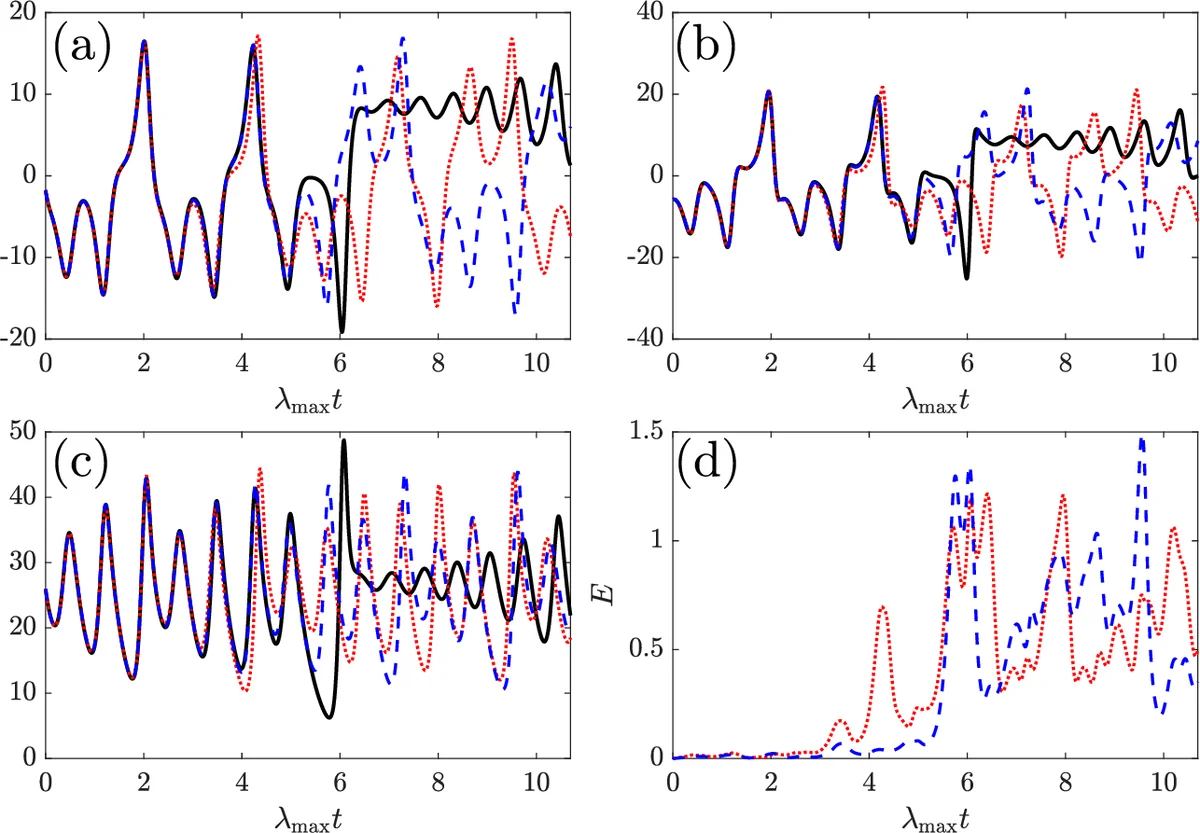
We propose a physics-informed Echo State Network (ESN) to predict the evolution of chaotic systems. Compared to conventional ESNs, the physics-informed ESNs are trained to solve supervised learning tasks while ensuring that their predictions do not violate physical laws. This is achieved by introducing an additional loss function during the training of the ESNs, which penalizes non-physical predictions without the need of any additional training data. This approach is demonstrated on a chaotic Lorenz system, where the physics-informed ESNs improve the predictability horizon by about two Lyapunov times as compared to conventional ESNs. The proposed framework shows the potential of using machine learning combined with prior physical knowledge to improve the time-accurate prediction of chaotic dynamical systems.
💡 Research Summary
The paper introduces a physics‑informed Echo State Network (PI‑ESN) designed to improve long‑term forecasting of chaotic dynamical systems. Traditional ESNs, a form of reservoir computing, learn only the output weight matrix (W_{out}) by minimizing a data‑driven mean‑squared error. While effective for many tasks, this purely data‑driven approach can produce predictions that violate the underlying physical laws, especially when training data are scarce or the system exhibits strong nonlinearity, leading to short predictability horizons.
To address this, the authors augment the loss function with a physics‑based term. The total loss is defined as
\
Comments & Academic Discussion
Loading comments...
Leave a Comment