Improved Reconstruction for high-resolution Multi-shot Diffusion Weighted Imaging
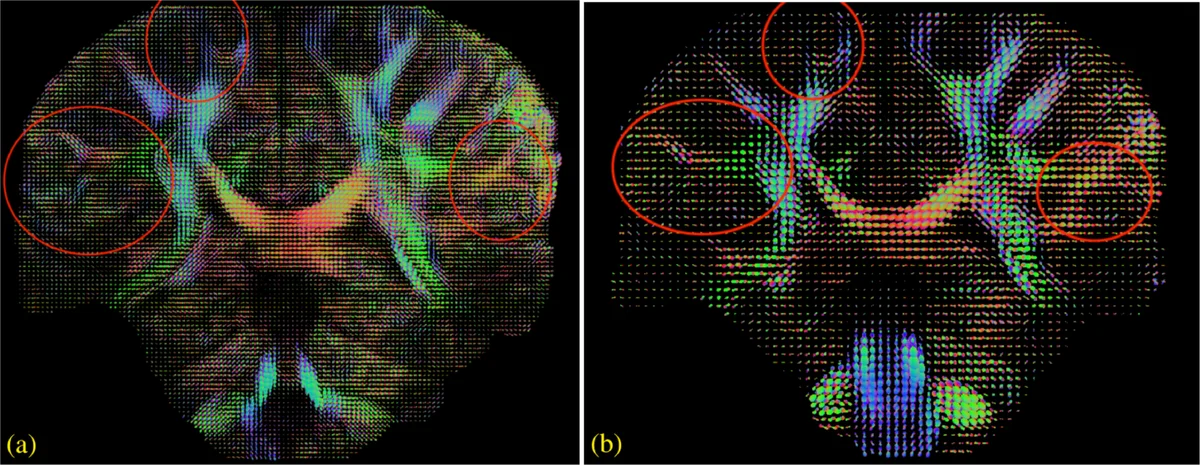
Purpose: To introduce a fast and improved direct reconstruction method for multi-shot diffusion weighted (msDW) scans for high-resolution studies. Methods:Multi-shot EPI methods can enable higher spatial resolution for diffusion MRI studies. Traditionally, such acquisitions required specialized reconstructions involving phase compensation to correct for inter-shot motion artifacts. The recently proposed MUSSELS reconstruction belongs to a new class of parallel imaging-based methods that recover artifact-free DWIs from msDW data without needing phase compensation. However, computational demands of the MUSSELS reconstruction scales as the matrix size and the number of shots increases, which hinders its practical utility for high-resolution applications. In this work, we propose a computationally efficient formulation using iterative reweighted least squares (IRLS) method. The new formulation is not only fast but it enables to accommodate additional priors such as conjugate symmetry property of the k-space data to improve the reconstruction. Using whole-brain in-vivo data, we show the utility of the new formulation for routine high-resolution studies with minimal computational burden. Results: The IRLS formulation provides about six times faster reconstruction for matrix sizes 192x192 and 256x256, compared to the original implementations. The reconstruction quality is improved by the addition of conjugate symmetry priors that reduce blurring and preserves the high-resolution details from partial Fourier acquisitions. Conclusion: The proposed method is shown to be computationally efficient to enable routine high-resolution studies. The computational complexity matches the traditional msDWI reconstruction methods and provides improved reconstruction results.
💡 Research Summary
The paper addresses a critical bottleneck in high‑resolution multi‑shot diffusion‑weighted imaging (msDW) reconstruction. Conventional single‑shot echo‑planar imaging (ssEPI) limits spatial resolution to roughly 2 mm isotropic because longer readouts cause geometric distortion, signal‑to‑noise loss, and T2* blurring. Multi‑shot EPI can overcome these limits, but the data from each shot acquire different phase offsets caused by inter‑shot motion, requiring either a multi‑stage phase‑compensation pipeline or a more sophisticated reconstruction that jointly recovers the missing k‑space samples.
MUSSELS (Multi‑shot Sensitivity‑Encoded Low‑rank Structured matrix completion) was recently introduced as a phase‑free approach. It exploits annihilation relations between the complex shot images, which translate into a low‑rank constraint on a block‑Hankel matrix built from the k‑space data of all shots. The reconstruction solves a data‑consistency term plus a nuclear‑norm regularizer on the block‑Hankel matrix, typically using an augmented Lagrangian method that alternates between a quadratic sub‑problem (solved by conjugate gradients) and a singular‑value shrinkage step (requiring an SVD of the lifted matrix).
The authors identify two major computational obstacles: (i) the lifted block‑Hankel matrix is far larger than the original data, leading to high memory consumption; (ii) each outer iteration requires a full SVD of a matrix of size m × n (with m ≫ n), giving a per‑iteration cost of O(m n²). When the image matrix grows to 192 × 192 or 256 × 256 and the number of shots exceeds four, the runtime becomes prohibitive for routine use.
To overcome this, the paper proposes an Iterative Reweighted Least Squares (IRLS) formulation that replaces the nuclear‑norm penalty with a weighted Frobenius‑norm penalty. The weight matrix W is updated each outer iteration from the current estimate of the block‑Hankel matrix:
W =
Comments & Academic Discussion
Loading comments...
Leave a Comment