Correspondence-Free Region Localization for Partial Shape Similarity via Hamiltonian Spectrum Alignment
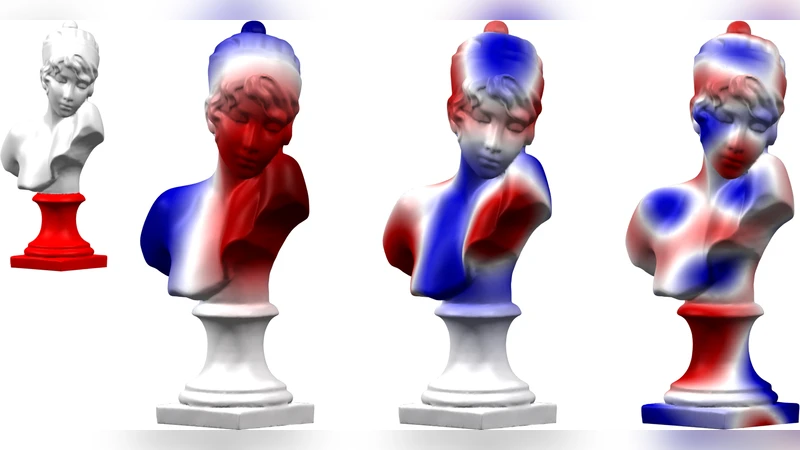
We consider the problem of localizing relevant subsets of non-rigid geometric shapes given only a partial 3D query as the input. Such problems arise in several challenging tasks in 3D vision and graphics, including partial shape similarity, retrieval, and non-rigid correspondence. We phrase the problem as one of alignment between short sequences of eigenvalues of basic differential operators, which are constructed upon a scalar function defined on the 3D surfaces. Our method therefore seeks for a scalar function that entails this alignment. Differently from existing approaches, we do not require solving for a correspondence between the query and the target, therefore greatly simplifying the optimization process; our core technique is also descriptor-free, as it is driven by the geometry of the two objects as encoded in their operator spectra. We further show that our spectral alignment algorithm provides a remarkably simple alternative to the recent shape-from-spectrum reconstruction approaches. For both applications, we demonstrate improvement over the state-of-the-art either in terms of accuracy or computational cost.
💡 Research Summary
The paper tackles the challenging problem of identifying and localizing similar sub‑regions between non‑rigid 3D shapes when only a partial query is available. Traditional pipelines for partial shape similarity rely heavily on local descriptors (e.g., SHOT, HKS) or learned embeddings, followed by a costly point‑to‑point or functional map correspondence step. Those approaches suffer from several drawbacks: they require large annotated datasets for training, involve NP‑hard combinatorial optimization, and need sophisticated regularizers to enforce spatial coherence of the matched region.
The authors propose a fundamentally different strategy that completely bypasses any correspondence computation and any descriptor extraction. Their key insight is that the eigenvalues of differential operators (the Laplace‑Beltrami operator and its perturbed version, the Hamiltonian) encode rich geometric information about a shape. By introducing a scalar potential function (v) on the surface, the Hamiltonian (H = \Delta + \operatorname{diag}(v)) modifies the spectrum of the original Laplacian. If (v) is a step function that is zero inside a region (R) and takes a large constant (\tau) outside, then all eigenfunctions whose eigenvalues are smaller than (\tau) become strictly supported inside (R) (classical confinement property). Moreover, for those low‑frequency modes the eigenvalues of the Hamiltonian on the whole shape coincide exactly with the Dirichlet eigenvalues of the Laplacian restricted to (R).
These two lemmas allow the authors to formulate the following inverse problem: given a shape (X) and a short ordered list (\mu = (\mu_1,\dots,\mu_k)) of Dirichlet eigenvalues that are known to belong to some unknown sub‑shape (R\subset X), find a non‑negative potential (v) on (X) such that the first (k) eigenvalues (\lambda(v)) of the Hamiltonian (H(v)) align with (\mu). The alignment is measured by a weighted (\ell_2) loss \
Comments & Academic Discussion
Loading comments...
Leave a Comment